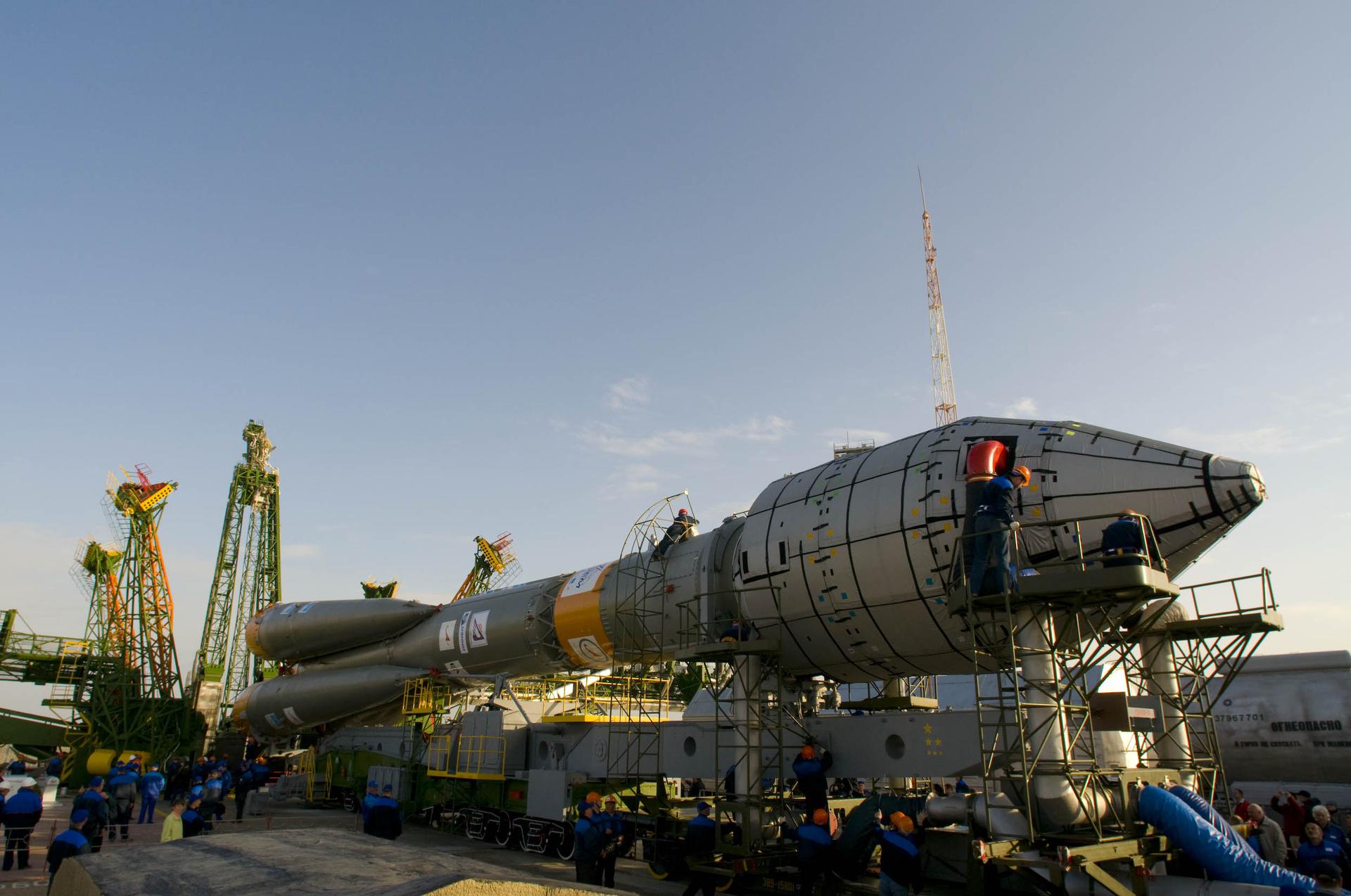
Soyuz-FG
In-activeProgress Rocket Space Center (PRSC)
June 2, 2003
Description
The Soyuz FG is a medium-lift launch vehicle qualified for manned launches and used to deliver Soyuz Spacecraft to Orbit for Missions to the International Space Station.
Specifications
-
Stages
3 -
Length
4.95 m -
Diameter
2.68 m -
Fairing Diameter
― -
Launch Mass
305.0 T -
Thrust
―
Family
-
Name
Soyuz-FG -
Family
― -
Variant
Fregat -
Alias
― -
Full Name
Soyuz-FG Fregat
Payload Capacity
-
Launch Cost
― -
Low Earth Orbit
7100.0 kg -
Geostationary Transfer
Orbit
― -
Direct Geostationary
― -
Sun-Synchronous Capacity
―
Progress Rocket Space Center
Commercial
CEO: Dmitry Baranov
PRSC 1996Progress Rocket Space Centre, formerly known as TsSKB-Progress, is a space science and aerospace research company which is known for manufacturing launch vehicles and satellites. Most notably, Progress Rocket Space Centre is the manufacturer of Soyuz launch vehicles.
Soyuz-FG/Fregat | Kanopus-V No.1 & BelKA-2
Progress Rocket Space Center | RussiaBaikonur Cosmodrome, Republic of Kazakhstan
Soyuz-FG | Giove-B
Progress Rocket Space Center | RussiaBaikonur Cosmodrome, Republic of Kazakhstan
Soyuz-FG | Radarsat-2
Progress Rocket Space Center | RussiaBaikonur Cosmodrome, Republic of Kazakhstan
Soyuz-FG | Globalstar 66,67,68,70
Progress Rocket Space Center | RussiaBaikonur Cosmodrome, Republic of Kazakhstan
Soyuz-FG | Globalstar 65,69,71,72
Progress Rocket Space Center | RussiaBaikonur Cosmodrome, Republic of Kazakhstan
Soyuz-FG | Giove A
Progress Rocket Space Center | RussiaBaikonur Cosmodrome, Republic of Kazakhstan
Soyuz-FG | Venus Express
Progress Rocket Space Center | RussiaBaikonur Cosmodrome, Republic of Kazakhstan
Status: Launch Successful
Mission:
Venus Express (VEX) was the first Venus exploration mission of the European Space Agency (ESA). Launched in November 2005, it arrived at Venus in April 2006 and began continuously sending back science data from its polar orbit around Venus. Equipped with seven scientific instruments, the main objective of the mission was the long term observation of the Venusian atmosphere.
Venus OrbitSoyuz-FG | Galaxy 14
Progress Rocket Space Center | RussiaBaikonur Cosmodrome, Republic of Kazakhstan
Soyuz-FG | Amos 2
Progress Rocket Space Center | RussiaBaikonur Cosmodrome, Republic of Kazakhstan
Soyuz-FG | Mars Express
Progress Rocket Space Center | RussiaBaikonur Cosmodrome, Republic of Kazakhstan
Status: Launch Successful
Mission:
Mars Express is a space exploration mission being conducted by the European Space Agency (ESA). The Mars Express mission is exploring the planet Mars, and is the first planetary mission attempted by the agency. Mars Express consists of two parts, the Mars Express Orbiter and Beagle 2, a lander designed to perform exobiology and geochemistry research. Although the lander failed to fully deploy after it landed on the Martian surface, the orbiter has been successfully performing scientific measurements since early 2004, namely, high-resolution imaging and mineralogical mapping of the surface, radar sounding of the subsurface structure down to the permafrost, precise determination of the atmospheric circulation and composition, and study of the interaction of the atmosphere with the interplanetary medium.
Mars OrbitKinetica 2
SpaceSail Polar Group #17
Launch Area 140 - Jiuquan Satellite Launch Center, People's Republic of China18 Low Earth Orbit communication satellites with Ku, Q and V band payloads for the G60 constellation operated by Shanghai Spacesail Technologies with…
Electron
The Sea God Surveys (iQPS Launch 9)
Rocket Lab Launch Complex 1A - Rocket Lab Launch Complex 1, Mahia Peninsula, New ZealandSynthetic aperture radar Earth observation satellite for Japanese Earth imaging company iQPS.
Falcon 9
Starlink Group 15-18
Space Launch Complex 4E - Vandenberg SFB, CA, USAA batch of 27 satellites for the Starlink mega-constellation - SpaceX's project for space-based Internet communication system.
GSLV Mk II
IRNSS-1L (NVS-03)
Satish Dhawan Space Centre Second Launch Pad - Satish Dhawan Space Centre, IndiaThis is a replacement satellite for the Indian Regional Navigation Satellite System. The constellation will provide India with an alternative to GPS …
Falcon 9
Starlink Group 15-16
Space Launch Complex 4E - Vandenberg SFB, CA, USAA batch of 27 satellites for the Starlink mega-constellation - SpaceX's project for space-based Internet communication system.