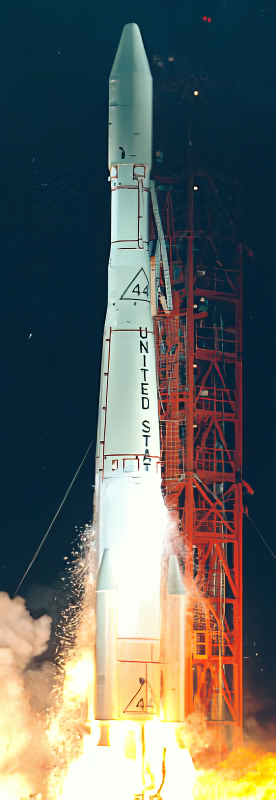
Thor Delta E1
In-activeMcDonnell Douglas (MDC)
July 1, 1966
Description
American orbital launch vehicle family with Thor first stage and a delta second stage.
Specifications
-
Stages
4 -
Length
28.0 m -
Diameter
2.44 m -
Fairing Diameter
2.44 m -
Launch Mass
68.0 T -
Thrust
1450.0 kN
Family
-
Name
Thor Delta E1 -
Family
― -
Variant
Delta E1 -
Alias
― -
Full Name
Thor Delta E1
Payload Capacity
-
Launch Cost
― -
Low Earth Orbit
540.0 kg -
Geostationary Transfer
Orbit
150.0 kg -
Direct Geostationary
― -
Sun-Synchronous Capacity
―
McDonnell Douglas
Commercial
None
MDCNone
Thor Delta E1 | Isis 2
McDonnell Douglas | United States of AmericaVandenberg SFB, CA, USA
Status: Launch Successful
Mission:
ISIS 2 was an ionospheric observatory instrumented with a sweep- and a fixed-frequency ionosonde, a VLF receiver, energetic and soft particle detectors, an ion mass spectrometer, an electrostatic probe, a retarding potential analyzer, a beacon transmitter, a cosmic noise experiment, and two photometers.
Low Earth OrbitThor Delta E1 | IMP G
McDonnell Douglas | United States of AmericaVandenberg SFB, CA, USA
Thor Delta E1 | ESSA 9
McDonnell Douglas | United States of AmericaCape Canaveral SFS, FL, USA
Thor Delta E1 | Isis 1
McDonnell Douglas | United States of AmericaVandenberg SFB, CA, USA
Status: Launch Successful
Mission:
ISIS 1 (International Satellite for Ionosphere Studies) was an ionospheric observatory instrumented with sweep- and fixed-frequency ionosondes, a VLF receiver, energetic and soft particle detectors, an ion mass spectrometer, an electrostatic probe, an electrostatic analyzer, a beacon transmitter, and a cosmic noise experiment.
Elliptical OrbitThor Delta E1 | HEOS 1
McDonnell Douglas | United States of AmericaCape Canaveral SFS, FL, USA
Status: Launch Successful
Mission:
HEOS 1 (Highly Eccentric Orbit Satellite) was an earth-orbiting, spin-stabilized satellite that was launched by ESA. The spacecraft objectives were to study interplanetary magnetic fields, cosmic rays, the solar wind, and the magnetosheath.
Elliptical OrbitThor Delta E1 | Pioneer 9
McDonnell Douglas | United States of AmericaCape Canaveral SFS, FL, USA
Status: Launch Successful
Mission:
Pioneer A to E (Pioneer 6 to 9 after launch) were a series of five solar-orbiting, spin-stabilized, solar-cell and battery-powered satellites designed to obtain measurements of interplanetary phenomena from widely separated points in space on a continuing basis.
Heliocentric N/AThor Delta E1 | GEOS B
McDonnell Douglas | United States of AmericaVandenberg SFB, CA, USA
Thor Delta E1 | Pioneer 8
McDonnell Douglas | United States of AmericaCape Canaveral SFS, FL, USA
Status: Launch Successful
Mission:
Pioneer A to E (Pioneer 6 to 9 after launch) were a series of five solar-orbiting, spin-stabilized, solar-cell and battery-powered satellites designed to obtain measurements of interplanetary phenomena from widely separated points in space on a continuing basis.
Heliocentric N/AThor Delta E1 | ESSA 6
McDonnell Douglas | United States of AmericaVandenberg SFB, CA, USA
Thor Delta E1 | INTELSAT II F-4
McDonnell Douglas | United States of AmericaCape Canaveral SFS, FL, USA
Thor Delta E1 | Explorer 35
McDonnell Douglas | United States of AmericaCape Canaveral SFS, FL, USA
Thor Delta E1 | IMP F
McDonnell Douglas | United States of AmericaVandenberg SFB, CA, USA
Thor Delta E1 | INTELSAT II F-3
McDonnell Douglas | United States of AmericaCape Canaveral SFS, FL, USA
Thor Delta E1 | INTELSAT II F-2
McDonnell Douglas | United States of AmericaCape Canaveral SFS, FL, USA
Thor Delta E1 | INTELSAT II F-1
McDonnell Douglas | United States of AmericaCape Canaveral SFS, FL, USA
Thor Delta E1 | Pioneer 7
McDonnell Douglas | United States of AmericaCape Canaveral SFS, FL, USA
Status: Launch Successful
Mission:
Pioneer A to E (Pioneer 6 to 9 after launch) were a series of five solar-orbiting, spin-stabilized, solar-cell and battery-powered satellites designed to obtain measurements of interplanetary phenomena from widely separated points in space on a continuing basis.
Heliocentric N/AThor Delta E1 | Explorer 33
McDonnell Douglas | United States of AmericaCape Canaveral SFS, FL, USA
Long March 2D
PIESAT-2 13-16
Launch Complex 9 - Taiyuan Satellite Launch Center, People's Republic of China4 X-band synthetic-aperture radar Earth observation satellites for the Chinese Earth observation satellite company PIESAT.
Electron
Owl By The Dozen (StriX Launch 12)
Rocket Lab Launch Complex 1B - Rocket Lab Launch Complex 1, Mahia Peninsula, New ZealandSynthetic aperture radar satellite for Japanese Earth imaging company Synspective.
Soyuz 2.1b/Fregat-M
Glonass-K1 No. 20 (?)
43/3 (43L) - Plesetsk Cosmodrome, Russian FederationNote: Satellite serial number and Cosmos designation not confirmed. Glonass-K are the third generation of satellite design for GLONASS satellite n…
Kuaizhou 11
SpaceTY-51 & 52
Launch Area 95A - Jiuquan Satellite Launch Center, People's Republic of China2 Earth observation radar satellites built by the Chinese satellite manufacturer SpaceTY.
Falcon 9
USSF-259
Space Launch Complex 4E - Vandenberg SFB, CA, USAUSSF-259 is a classified mission for the United States Space Force. It is possibly a batch of classified LEO satellites based on SpaceX’s Starshield …

