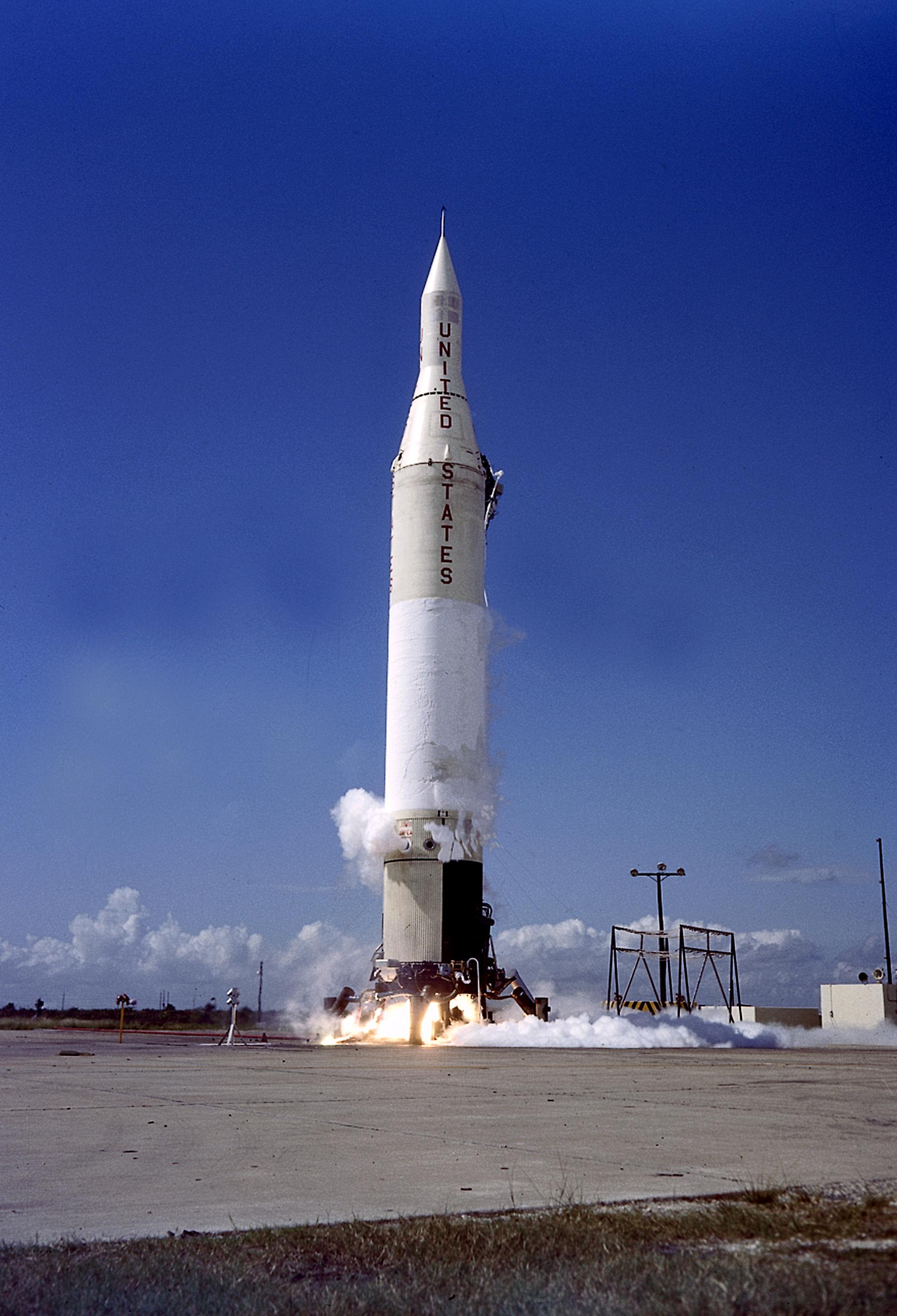
Juno II
In-activeArmy Ballistic Missile Agency (ABMA)
Dec. 6, 1958
Description
Juno II was an American space launch vehicle used during the late 1950s and early 1960s. It was derived from the Jupiter missile, which was used as the first stage.
Specifications
-
Minimum Stage
3 -
Max Stage
4 -
Length
24.0 m -
Diameter
2.67 m -
Fairing Diameter
― -
Launch Mass
55.0 T -
Thrust
654.0 kN
Family
-
Name
Juno II -
Family
― -
Variant
― -
Alias
― -
Full Name
Juno II
Payload Capacity
-
Launch Cost
― -
Low Earth Orbit
41.0 kg -
Geostationary Transfer
Orbit
― -
Direct Geostationary
― -
Sun-Synchronous Capacity
―
Army Ballistic Missile Agency
Government
None
ABMAThe Army Ballistic Missile Agency was formed to develop the U.S. Army's first large ballistic missile. The agency was established at Redstone Arsenal on 1 February 1956, and commanded by Major General John B. Medaris with Wernher von Braun as technical director.
Juno II | S-45A
Army Ballistic Missile Agency | United States of AmericaCape Canaveral SFS, FL, USA
Juno II | Explorer 11
Army Ballistic Missile Agency | United States of AmericaCape Canaveral SFS, FL, USA
Juno II | S-45
Army Ballistic Missile Agency | United States of AmericaCape Canaveral SFS, FL, USA
Juno II | Explorer 8
Army Ballistic Missile Agency | United States of AmericaCape Canaveral SFS, FL, USA
Juno II | NASA S-46
Army Ballistic Missile Agency | United States of AmericaCape Canaveral SFS, FL, USA
Juno II | Explorer 7
Army Ballistic Missile Agency | United States of AmericaCape Canaveral SFS, FL, USA
Status: Launch Successful
Mission:
Explorer 7 was designed to measure solar x-ray and Lyman-alpha flux, trapped energetic particles, and heavy primary cosmic rays. Secondary objectives included collecting data on micrometeoroid penetration, molecular sputtering and studying the Earth-atmosphere heat balance.
Low Earth OrbitJuno II | Beacon
Army Ballistic Missile Agency | United States of AmericaCape Canaveral SFS, FL, USA
Juno II | NASA S-1
Army Ballistic Missile Agency | United States of AmericaCape Canaveral SFS, FL, USA
Status: Launch Failure
Mission:
The S-1 satellite was a geoscience satellite equipped with a suite of scientific instruments to study the environment around the Earth. It was destroyed 5 seconds into launch when the launch vehicle exploded due to an issue with the launch vehicles power supply.
Elliptical OrbitJuno II | Pioneer 4
Army Ballistic Missile Agency | United States of AmericaCape Canaveral SFS, FL, USA
Juno II | Pioneer 3
Army Ballistic Missile Agency | United States of AmericaCape Canaveral SFS, FL, USA
Kinetica 2
SpaceSail Polar Group #17
Launch Area 140 - Jiuquan Satellite Launch Center, People's Republic of China18 Low Earth Orbit communication satellites with Ku, Q and V band payloads for the G60 constellation operated by Shanghai Spacesail Technologies with…
Electron
The Sea God Surveys (iQPS Launch 9)
Rocket Lab Launch Complex 1A - Rocket Lab Launch Complex 1, Mahia Peninsula, New ZealandSynthetic aperture radar Earth observation satellite for Japanese Earth imaging company iQPS.
Falcon 9
Starlink Group 15-18
Space Launch Complex 4E - Vandenberg SFB, CA, USAA batch of 27 satellites for the Starlink mega-constellation - SpaceX's project for space-based Internet communication system.
GSLV Mk II
IRNSS-1L (NVS-03)
Satish Dhawan Space Centre Second Launch Pad - Satish Dhawan Space Centre, IndiaThis is a replacement satellite for the Indian Regional Navigation Satellite System. The constellation will provide India with an alternative to GPS …
Falcon 9
Starlink Group 15-16
Space Launch Complex 4E - Vandenberg SFB, CA, USAA batch of 27 satellites for the Starlink mega-constellation - SpaceX's project for space-based Internet communication system.