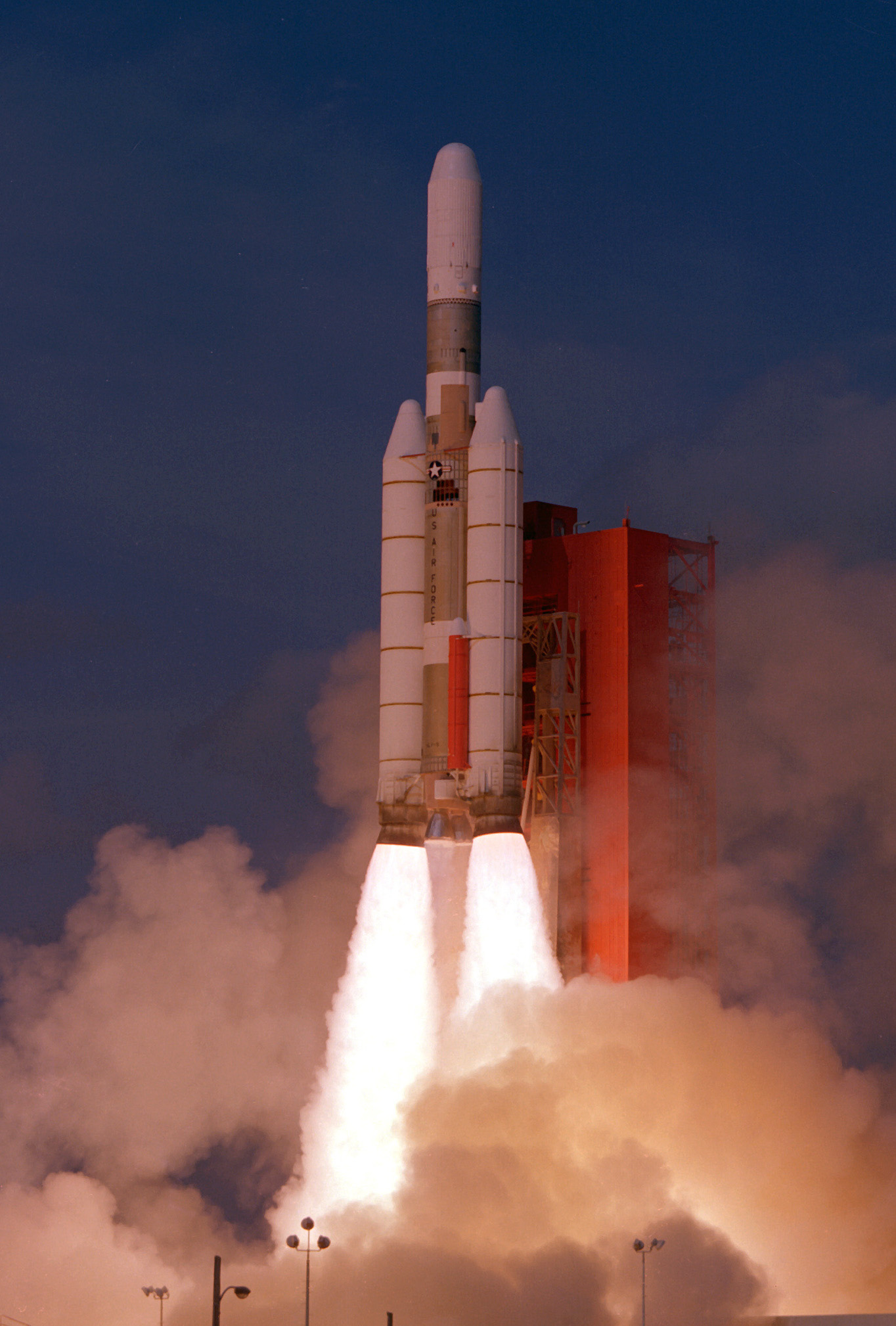
Titan IIIC
In-activeLockheed Martin (LMT)
June 18, 1965
Description
The Titan IIIC was an expendable launch system used by the United States Air Force from 1965 until 1982. It was the first Titan booster to feature large solid rocket motors and was planned to be used as a launcher for the Dyna-Soar, though the spaceplane was cancelled before it could fly. The majority of the launcher's payloads were DoD satellites, for military communications and early warning, though one flight (ATS-6) was performed by NASA. The Titan IIIC was launched exclusively from Cape Canaveral while its sibling, the Titan IIID, was launched only from Vandenberg AFB.
Specifications
-
Minimum Stage
2 -
Max Stage
3 -
Length
42.0 m -
Diameter
3.0 m -
Fairing Diameter
3.0 m -
Launch Mass
626.0 T -
Thrust
10586.0 kN
Family
-
Name
Titan IIIC -
Family
― -
Variant
IIIC -
Alias
― -
Full Name
Titan IIIC
Payload Capacity
-
Launch Cost
― -
Low Earth Orbit
13100.0 kg -
Geostationary Transfer
Orbit
3000.0 kg -
Direct Geostationary
― -
Sun-Synchronous Capacity
―
Lockheed Martin
Commercial
None
LMT 1953Lockheed Martin's Space Division started in the production of missiles and later ICBM's in the 1950s. Their TITAN missile system was used for 12 Gemini spacecraft and the Voyager probes. They have worked largely in collaboration with NASA on many of their probes, landers, and spacecraft, and hope to play a key role in NASA's return to the moon in 2024.
Titan IIIC | DSP 10
Lockheed Martin | United States of AmericaCape Canaveral SFS, FL, USA
Titan IIIC | Vortex 10
Lockheed Martin | United States of AmericaCape Canaveral SFS, FL, USA
Titan IIIC | DSP 9
Lockheed Martin | United States of AmericaCape Canaveral SFS, FL, USA
Titan IIIC | DSCS-2 13 & 14
Lockheed Martin | United States of AmericaCape Canaveral SFS, FL, USA
Titan IIIC | Vortex 9
Lockheed Martin | United States of AmericaCape Canaveral SFS, FL, USA
Titan IIIC | DSP 8
Lockheed Martin | United States of AmericaCape Canaveral SFS, FL, USA
Titan IIIC | DSCS-2 11 & 12
Lockheed Martin | United States of AmericaCape Canaveral SFS, FL, USA
Titan IIIC | Chalet 8
Lockheed Martin | United States of AmericaCape Canaveral SFS, FL, USA
Titan IIIC | DSCS-2 9 & 10
Lockheed Martin | United States of AmericaCape Canaveral SFS, FL, USA
Titan IIIC | DSCS-2 7 & 8
Lockheed Martin | United States of AmericaCape Canaveral SFS, FL, USA
Titan IIIC | DSP 7
Lockheed Martin | United States of AmericaCape Canaveral SFS, FL, USA
Titan IIIC | DSP 6
Lockheed Martin | United States of AmericaCape Canaveral SFS, FL, USA
Titan IIIC | LES 8, 9 & Solrad 11A, 11B
Lockheed Martin | United States of AmericaCape Canaveral SFS, FL, USA
Titan IIIC | DSP 5
Lockheed Martin | United States of AmericaCape Canaveral SFS, FL, USA
Titan IIIC | DSCS-2 5 & 6
Lockheed Martin | United States of AmericaCape Canaveral SFS, FL, USA
Titan IIIC | ATS 6
Lockheed Martin | United States of AmericaCape Canaveral SFS, FL, USA
Titan IIIC | DSCS-2 3 & 4
Lockheed Martin | United States of AmericaCape Canaveral SFS, FL, USA
Titan IIIC | DSP 4
Lockheed Martin | United States of AmericaCape Canaveral SFS, FL, USA
Titan IIIC | DSP 3
Lockheed Martin | United States of AmericaCape Canaveral SFS, FL, USA
Titan IIIC | DSCS-2 1 & 2
Lockheed Martin | United States of AmericaCape Canaveral SFS, FL, USA
Titan IIIC | DSP 2
Lockheed Martin | United States of AmericaCape Canaveral SFS, FL, USA
Titan IIIC | DSP 1
Lockheed Martin | United States of AmericaCape Canaveral SFS, FL, USA
Titan IIIC | Vela 6A & 6B
Lockheed Martin | United States of AmericaCape Canaveral SFS, FL, USA
Titan IIIC | Vela 5A & 5B
Lockheed Martin | United States of AmericaCape Canaveral SFS, FL, USA
Titan IIIC | TACSAT 1
Lockheed Martin | United States of AmericaCape Canaveral SFS, FL, USA
Status: Launch Successful
Mission:
TACSAT 1 (also TACOMSAT, Tactical Communications satellite) was the largest and most powerful communications satellite at the time when it was launched into synchronous orbit by a Titan-3C booster 9 February 1969, from Cape Canaveral, Florida. The experimental tactical communications satellite was designed and built by Hughes Aircraft Company, under the direction of the U.S. Air Force Space and Missile Systems Organization, for the Department of Defense.
Geosynchronous OrbitTitan IIIC | OV2-5
Lockheed Martin | United States of AmericaCape Canaveral SFS, FL, USA
Status: Launch Successful
Mission:
The OV2 (Orbiting Vehicle 2) series satellites were originally built for project ARENTS (Advanced Research Environmental Test Satellite), which was intended to obtain supporting data for the Vela program. After the cancellation of the ARENTS program, the already built hardware was reused for OV2, a low-cost series of experimental satellites, which were to be launched for free on Titan-3C test flights to very different orbits.
Geosynchronous OrbitTitan IIIC | IDCSP 20 to 27
Lockheed Martin | United States of AmericaCape Canaveral SFS, FL, USA
Titan IIIC | IDCSP 16 to 19
Lockheed Martin | United States of AmericaCape Canaveral SFS, FL, USA
Titan IIIC | Vela 4A & 4B
Lockheed Martin | United States of AmericaCape Canaveral SFS, FL, USA
Titan IIIC | IDCSP 8 to 15
Lockheed Martin | United States of AmericaCape Canaveral SFS, FL, USA
Titan IIIC | Gemini B
Lockheed Martin | United States of AmericaCape Canaveral SFS, FL, USA
Titan IIIC | IDCSP 8 to 14
Lockheed Martin | United States of AmericaCape Canaveral SFS, FL, USA
Titan IIIC | IDCSP 1 to 7
Lockheed Martin | United States of AmericaCape Canaveral SFS, FL, USA
Titan IIIC | OV2-3
Lockheed Martin | United States of AmericaCape Canaveral SFS, FL, USA
Status: Launch Successful
Mission:
The OV2 (Orbiting Vehicle 2) series satellites were originally built for project ARENTS (Advanced Research Environmental Test Satellite), which was intended to obtain supporting data for the Vela program. After the cancellation of the ARENTS program, the already built hardware was reused for OV2, a low-cost series of experimental satellites, which were to be launched for free on Titan-3C test flights to very different orbits.
Elliptical OrbitTitan IIIC | OV2-1
Lockheed Martin | United States of AmericaCape Canaveral SFS, FL, USA
Status: Launch Successful
Mission:
The OV2 (Orbiting Vehicle 2) series satellites were originally built for project ARENTS (Advanced Research Environmental Test Satellite), which was intended to obtain supporting data for the Vela program. After the cancellation of the ARENTS program, the already built hardware was reused for OV2, a low-cost series of experimental satellites, which were to be launched for free on Titan-3C test flights to very different orbits.
Low Earth OrbitLong March 2D
PIESAT-2 13-16
Launch Complex 9 - Taiyuan Satellite Launch Center, People's Republic of China4 X-band synthetic-aperture radar Earth observation satellites for the Chinese Earth observation satellite company PIESAT.
Electron
Owl By The Dozen (StriX Launch 12)
Rocket Lab Launch Complex 1B - Rocket Lab Launch Complex 1, Mahia Peninsula, New ZealandSynthetic aperture radar satellite for Japanese Earth imaging company Synspective.
Soyuz 2.1b/Fregat-M
Glonass-K1 No. 20 (?)
43/3 (43L) - Plesetsk Cosmodrome, Russian FederationNote: Satellite serial number and Cosmos designation not confirmed. Glonass-K are the third generation of satellite design for GLONASS satellite n…
Kuaizhou 11
SpaceTY-51 & 52
Launch Area 95A - Jiuquan Satellite Launch Center, People's Republic of China2 Earth observation radar satellites built by the Chinese satellite manufacturer SpaceTY.
Falcon 9
USSF-259
Space Launch Complex 4E - Vandenberg SFB, CA, USAUSSF-259 is a classified mission for the United States Space Force. It is possibly a batch of classified LEO satellites based on SpaceX’s Starshield …

