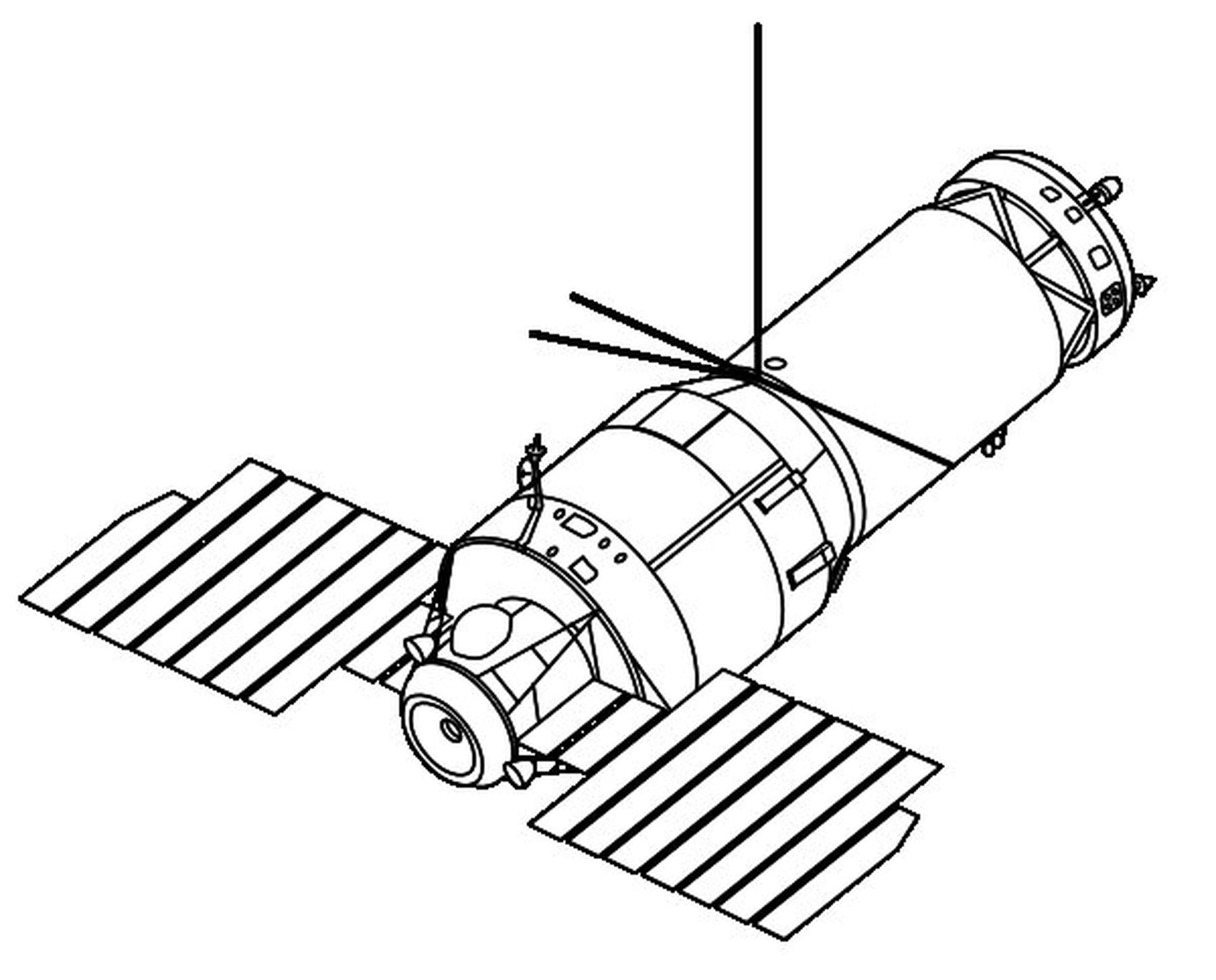
Salyut 3
Status - De-Orbited
Details
Salyut 3 (Russian: Салют-3; English: Salute 3; also known as OPS-2 or Almaz 2) was a Soviet space station launched on 25 June 1974. It was the second Almaz military space station, and the first such station to be launched successfully. It was included in the Salyut program to disguise its true military nature. Due to the military nature of the station, the Soviet Union was reluctant to release information about its design, and about the missions relating to the station. It attained an altitude of 219 to 270 km on launch and NASA reported its final orbital altitude was 268 to 272 km. Only one of the three intended crews successfully boarded and manned the station, brought by Soyuz 14; Soyuz 15 attempted to bring a second crew but failed to dock. Although little official information has been released about the station, several sources report that it contained multiple Earth-observation cameras, as well as an on-board gun. The station was deorbited, and re-entered the atmosphere on 24 January 1975. The next space station launched by the Soviet Union was the civilian station Salyut 4; the next military station was Salyut 5, which was the final Almaz space station.
Agencies
Russian Federal Space Agency (ROSCOSMOS)
Government
Administrator: Yuri Borisov
RFSA 1992The Roscosmos State Corporation for Space Activities, commonly known as Roscosmos, is the governmental body responsible for the space science program of the Russian Federation and general aerospace research. Soyuz has many launch locations the Russian sites are Baikonur, Plesetsk and Vostochny however Ariane also purchases the vehicle and launches it from French Guiana.
Falcon 9
Project Starfall Demonstration Mission
Space Launch Complex 40 - Cape Canaveral SFS, FL, USANote: Mission profile and payload details are TBD. Demonstration mission for SpaceX’s Project Starfall, which aims to mass-produce reentry capsule…
Long March 7A
TJSW-26A
201 - Wenchang Space Launch Site, People's Republic of ChinaChinese classified satellite claimed to be for communication technology test purposes. Actual mission not known.
Falcon 9
Starlink Group 17-28
Space Launch Complex 4E - Vandenberg SFB, CA, USAA batch of 24 satellites for the Starlink mega-constellation - SpaceX's project for space-based Internet communication system.
Electron
VICTUS HAZE Puma
Rocket Lab Launch Complex 1A - Rocket Lab Launch Complex 1, Mahia Peninsula, New ZealandVICTUS HAZE will see Rocket Lab design, build, launch, and operate a rendezvous proximity operation (RPO) capable spacecraft. U.S. Space Force Space …
Falcon 9
NROL-179
Space Launch Complex 4E - Vandenberg SFB, CA, USAFourteenth batch of satellites for a reconnaissance satellite constellation built by SpaceX and Northrop Grumman for the National Reconnaissance Offi…

