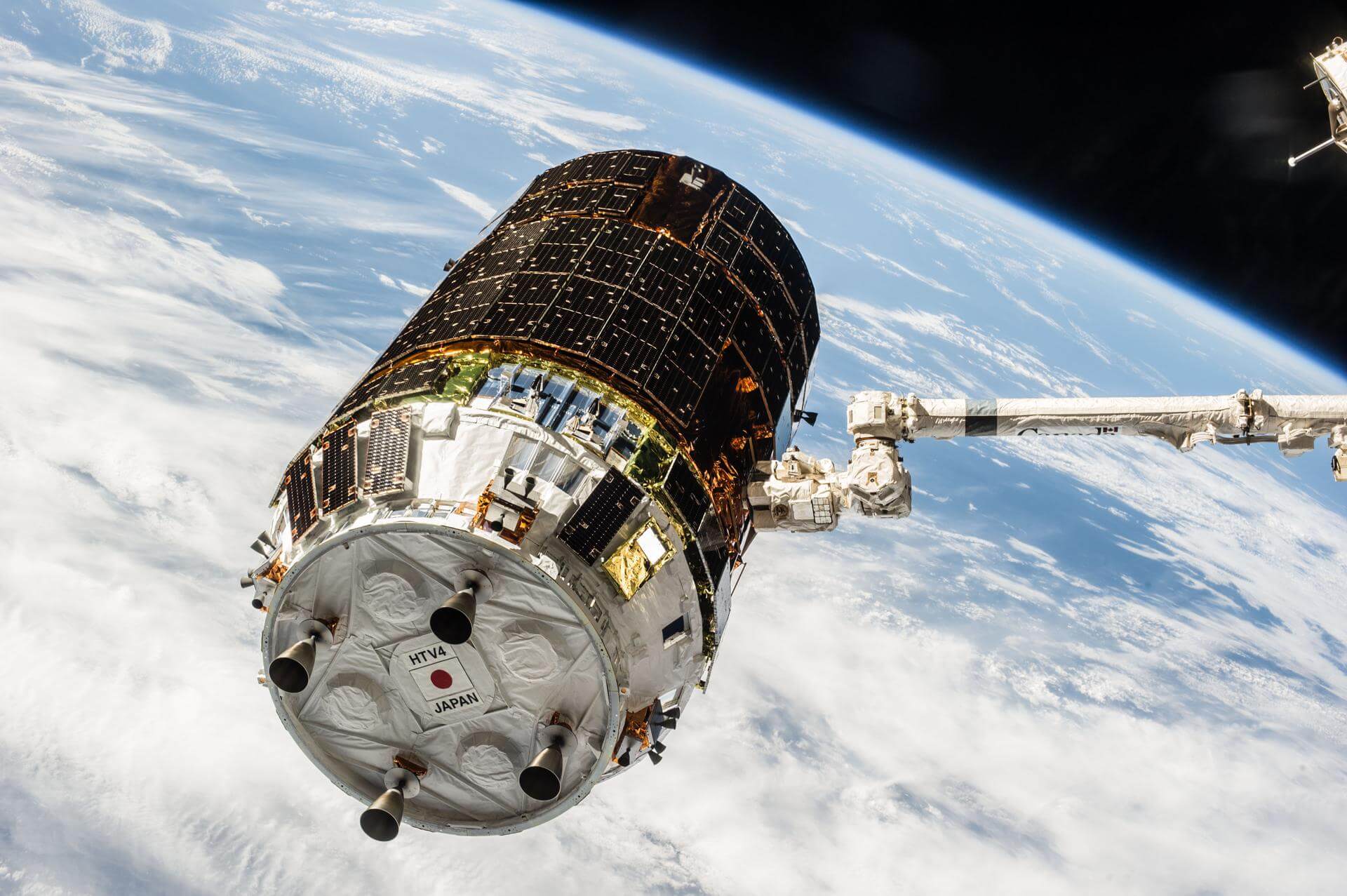
H-II Transfer Vehicle (HTV)
In-active Cargo Cargo Resupply Payload Capacity: 6000 kg Diameter: 4.4 m Height: 9.8 m()
Sept. 10, 2009
Cargo Earth Orbit Logistics
Flight Life
Solo flight about 100 hours, stand-by more than a week, docked with the ISS about 30 days.
Description
The HTV is about 9.8 metres (32 ft) long (including maneuvering thrusters at one end) and 4.4 metres (14 ft) in diameter. Total mass when empty is 10.5 tonnes (11.6 short tons), with a maximum total payload of 6,000 kilograms (13,000 lb; 6.0 t; 6.6 short tons), for a maximum launch weight of 16.5 tonnes (18.2 short tons). The HTV is comparable in function to the Russian Progress, European ATV, commercial Dragon, and commercial Cygnus spacecraft, all of which bring supplies to the ISS. Like the ATV, the HTV carries more than twice the payload of the Progress, but is launched less than half as often. Unlike Progress capsules and ATVs, which use the docking ports automatically, HTVs and American commercial spacecraft approach the ISS in stages, and once they reach their closest parking orbit to the ISS, crew grapple them using the robotic arm Canadarm2 and berth them to an open berthing port on the Harmony module.
History
Like the European Automated Transfer Vehicle the Japan Aerospace Exploration Agency had agreed to take part in the resupply operations of the international space station and developed the HTV to perform this task.
Long March 2D
PIESAT-2 13-16
Launch Complex 9 - Taiyuan Satellite Launch Center, People's Republic of China4 X-band synthetic-aperture radar Earth observation satellites for the Chinese Earth observation satellite company PIESAT.
Electron
Owl By The Dozen (StriX Launch 12)
Rocket Lab Launch Complex 1B - Rocket Lab Launch Complex 1, Mahia Peninsula, New ZealandSynthetic aperture radar satellite for Japanese Earth imaging company Synspective.
Soyuz 2.1b/Fregat-M
Glonass-K1 No. 20 (?)
43/3 (43L) - Plesetsk Cosmodrome, Russian FederationNote: Satellite serial number and Cosmos designation not confirmed. Glonass-K are the third generation of satellite design for GLONASS satellite n…
Kuaizhou 11
SpaceTY-51 & 52
Launch Area 95A - Jiuquan Satellite Launch Center, People's Republic of China2 Earth observation radar satellites built by the Chinese satellite manufacturer SpaceTY.
Falcon 9
USSF-259
Space Launch Complex 4E - Vandenberg SFB, CA, USAUSSF-259 is a classified mission for the United States Space Force. It is possibly a batch of classified LEO satellites based on SpaceX’s Starshield …
Long March 12
SatNet LEO Group 25
Commercial LC-2 - Wenchang Space Launch Site, People's Republic of ChinaA batch of 9 Low Earth Orbit communication satellites for the Chinese state owned SatNet constellation operated by the China Satellite Network Group.…
Soyuz 2.1b
Progress MS-35 (96P)
31/6 - Baikonur Cosmodrome, Republic of KazakhstanProgress resupply mission to the International Space Station.
Gravity-1
SpaceSail Polar Group #16
Yellow Sea (launch location 5) - Haiyang Oriental Spaceport9 Low Earth Orbit communication satellites with Ku, Q and V band payloads for the G60 constellation operated by Shanghai Spacesail Technologies with …
Zhuque-2E Block 2
SpaceSail Polar Group #15
Launch Area 96A - Jiuquan Satellite Launch Center, People's Republic of China10 Low Earth Orbit communication satellites with Ku, Q and V band payloads for the G60 constellation operated by Shanghai Spacesail Technologies with…
Vega-C
Sentinel-3C & FLEX
Ariane Launch Area 1 (ELV) - Guiana Space Centre, French GuianaSentinel-3C is the third satellite in the Sentinel-3 constellation, which provides high-accuracy optical, radar and altimetry data for marine and lan…

