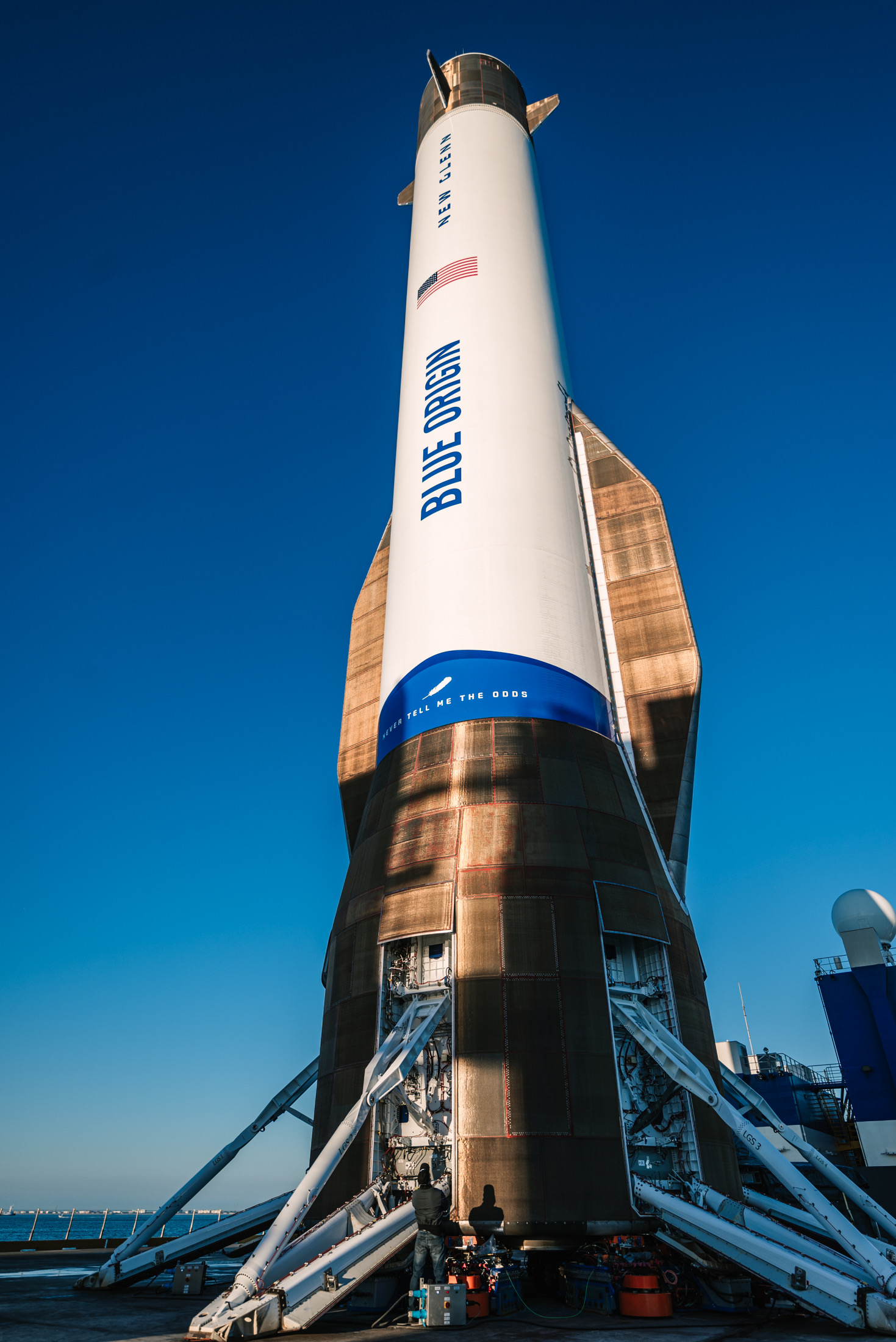
New Glenn - GS1-SN002
Details
Status - Active
Second New Glenn first stage booster. Named "Never Tell Me The Odds". Used for the second New Glenn launch with EscaPADE, becoming the first New Glenn Stage 1 booster (GS1) to be recovered. Currently it's slated for re-use on New Glenn's third launch with AST SpaceMobile's BlueBird Block 2 FM2.
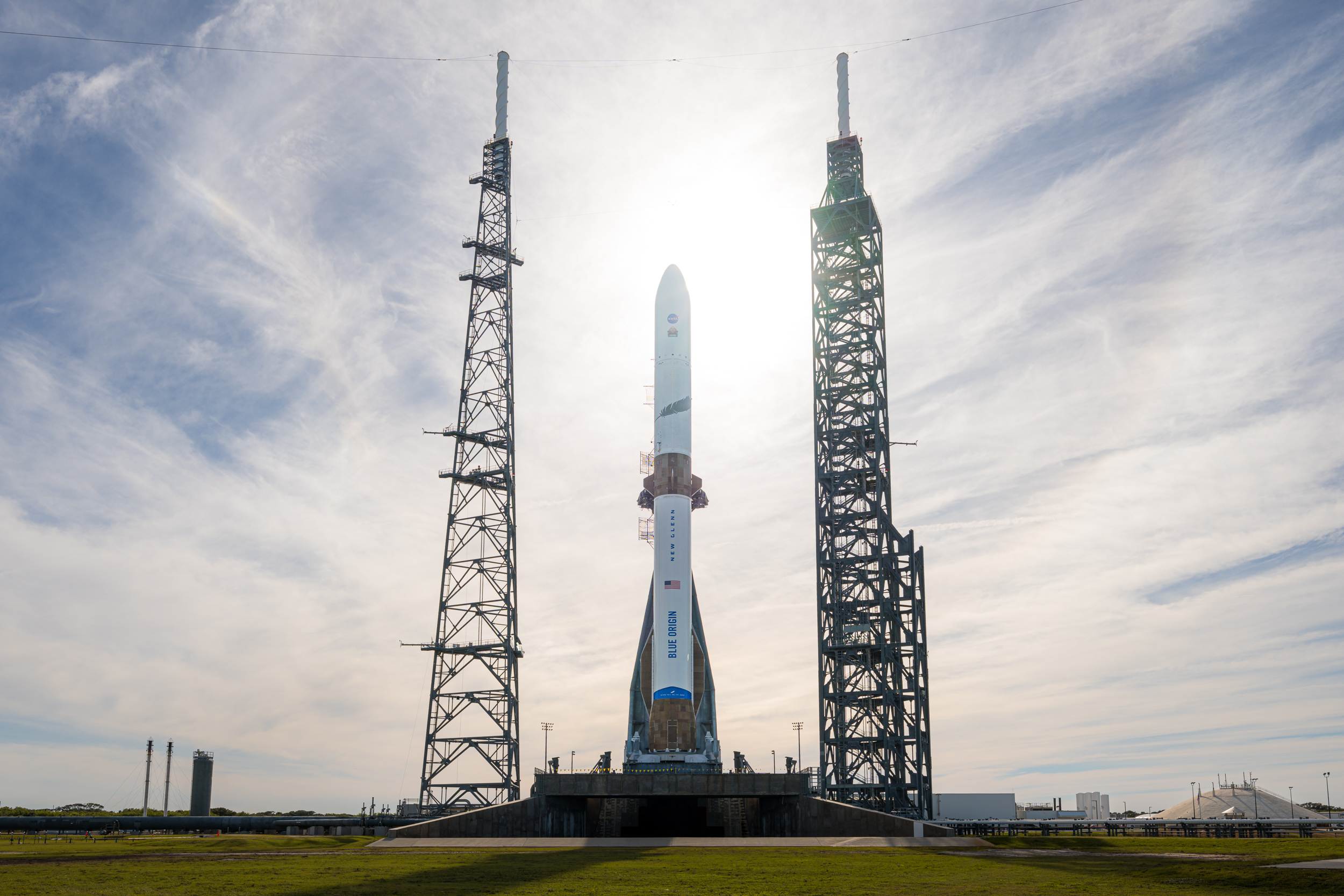
New Glenn | BlueBird 7 (Block 2 #2)
Blue Origin | United States of AmericaCape Canaveral SFS, FL, USA
Status: Launch Failure
Mission:
AST SpaceMobile’s Block 2 BlueBird satellites are designed to deliver up to 10 times the bandwidth capacity of the BlueBird Block 1 satellites, required to achieve 24/7 continuous cellular broadband service coverage in the United States, with beams designed to support a capacity of up to 40 MHz, enabling peak data transmission speeds up to 120 Mbps, supporting voice, full data and video applications. The Block 2 BlueBirds, featuring as large as 2400 square foot communications arrays, will be the largest satellites ever commercially deployed in Low Earth orbit once launched. This launch will feature 1 satellite, BlueBird 7/BlueBird Block 2 FM2.
Low Earth Orbit NG-3 GS1-SN002 - Flight Proven ( ) JacklynNew Glenn | EscaPADE
Blue Origin | United States of AmericaCape Canaveral SFS, FL, USA
Status: Launch Successful
Mission:
Second flight of Blue Origin's New Glenn launch vehicle carrying the Escape and Plasma Acceleration and Dynamics Explorers (EscaPADE), a dual-spacecraft mission from University of California, Berkeley to study ion and sputtered escape from Mars. The spacecrafts' scientific goals are to understand the processes controlling the structure of Mars' hybrid magnetosphere and how it guides ion flows; understand how energy and momentum are transported from the solar wind through Mars' magnetosphere; and understand the processes controlling the flow of energy and matter into and out of the collisional atmosphere.
Mars Orbit GS1-SN002 - Maiden Flight JacklynLong March 2D
PIESAT-2 13-16
Launch Complex 9 - Taiyuan Satellite Launch Center, People's Republic of China4 X-band synthetic-aperture radar Earth observation satellites for the Chinese Earth observation satellite company PIESAT.
Electron
Owl By The Dozen (StriX Launch 12)
Rocket Lab Launch Complex 1B - Rocket Lab Launch Complex 1, Mahia Peninsula, New ZealandSynthetic aperture radar satellite for Japanese Earth imaging company Synspective.
Soyuz 2.1b/Fregat-M
Glonass-K1 No. 20 (?)
43/3 (43L) - Plesetsk Cosmodrome, Russian FederationNote: Satellite serial number and Cosmos designation not confirmed. Glonass-K are the third generation of satellite design for GLONASS satellite n…
Kuaizhou 11
SpaceTY-51 & 52
Launch Area 95A - Jiuquan Satellite Launch Center, People's Republic of China2 Earth observation radar satellites built by the Chinese satellite manufacturer SpaceTY.
Falcon 9
USSF-259
Space Launch Complex 4E - Vandenberg SFB, CA, USAUSSF-259 is a classified mission for the United States Space Force. It is possibly a batch of classified LEO satellites based on SpaceX’s Starshield …

