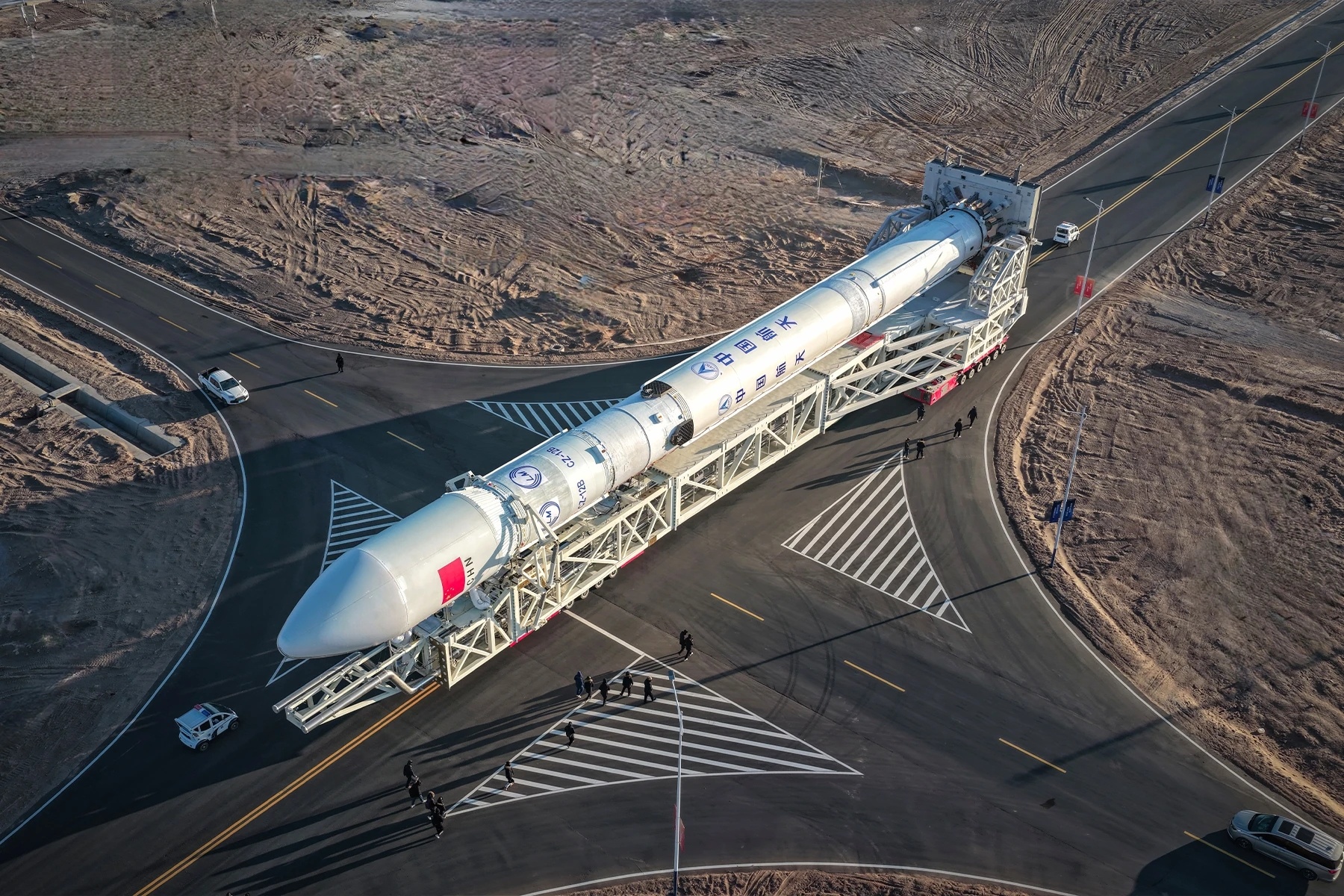
Long March 12B
Active Re-UsableChina Aerospace Science and Technology Corporation (CASC)
None
Description
Long March 12B/Changzheng 12B (LM-12B/CZ-12B) is a reusable orbital launch vehicle developed by the China Aerospace Science and Technology Commercial Launch Vehicle Group (CACL), a subsidiary company of the state-owned China Aerospace Science and Technology Corporation (CASC). The rocket is based on the Long March 12, but extensively re-designed for first stage re-usability, and use of gas generator cycle kerosene/liquid oxygen powered rocket engines in both stages. The first stage uses 9 YF-102R engines and the second stage uses 1 YF-102V engine, both from CASC's Academy of Aerospace Liquid Propulsion Technology (AALPT). On launch missions where the first stage is recovered, it will land on a down-range landing pad located in Minqin County, Gansu Province.
Specifications
-
Stages
2 -
Length
72.0 m -
Diameter
4.37 m -
Fairing Diameter
― -
Launch Mass
― -
Thrust
7940.0 kN
Family
-
Name
Long March 12B -
Family
― -
Variant
― -
Alias
CZ-12B -
Full Name
Long March 12B
Payload Capacity
-
Launch Cost
― -
Low Earth Orbit
20000.0 kg -
Geostationary Transfer
Orbit
― -
Direct Geostationary
― -
Sun-Synchronous Capacity
15000.0 kg
China Aerospace Science and Technology Corporation
Government
Chairman & President: Lei Fanpei
CASC 1999The China Aerospace Science and Technology Corporation (CASC) is the main contractor for the Chinese space program. It is state-owned and has a number of subordinate entities which design, develop and manufacture a range of spacecraft, launch vehicles, strategic and tactical missile systems, and ground equipment. It was officially established in July 1999 as part of a Chinese government reform drive, having previously been one part of the former China Aerospace Corporation. Various incarnations of the program date back to 1956.
Upcoming Spaceflights
Long March 12B | Demo Flight
China Aerospace Science and Technology Corporation | ChinaJiuquan Satellite Launch Center, People's Republic of China
TBD March, 2026
Flight Record
No spaceflights found for .
Falcon 9
Starlink Group 10-33
Space Launch Complex 40 - Cape Canaveral SFS, FL, USAA batch of 29 satellites for the Starlink mega-constellation - SpaceX's project for space-based Internet communication system.
Falcon 9
Starlink Group 10-46
Space Launch Complex 40 - Cape Canaveral SFS, FL, USAA batch of 29 satellites for the Starlink mega-constellation - SpaceX's project for space-based Internet communication system.
Falcon 9
Starlink Group 17-24
Space Launch Complex 4E - Vandenberg SFB, CA, USAA batch of 25 satellites for the Starlink mega-constellation - SpaceX's project for space-based Internet communication system.
Kuaizhou 11
8 satellites
Launch Area 95A - Jiuquan Satellite Launch Center, People's Republic of ChinaRide-share launch of 8 satellites to sun-synchronous orbit: * Juntian-1-04A * Dongpo-11 * Dongpo-12 * Dongpo-16 * Weitong-1-01 * Xiguang-1-06…
Long March 6A
Yaogan 50-02
Launch Complex 9A - Taiyuan Satellite Launch Center, People's Republic of ChinaThe Yaogan 50-02 is a Chinese military “remote sensing” satellite of unknown purposes.

