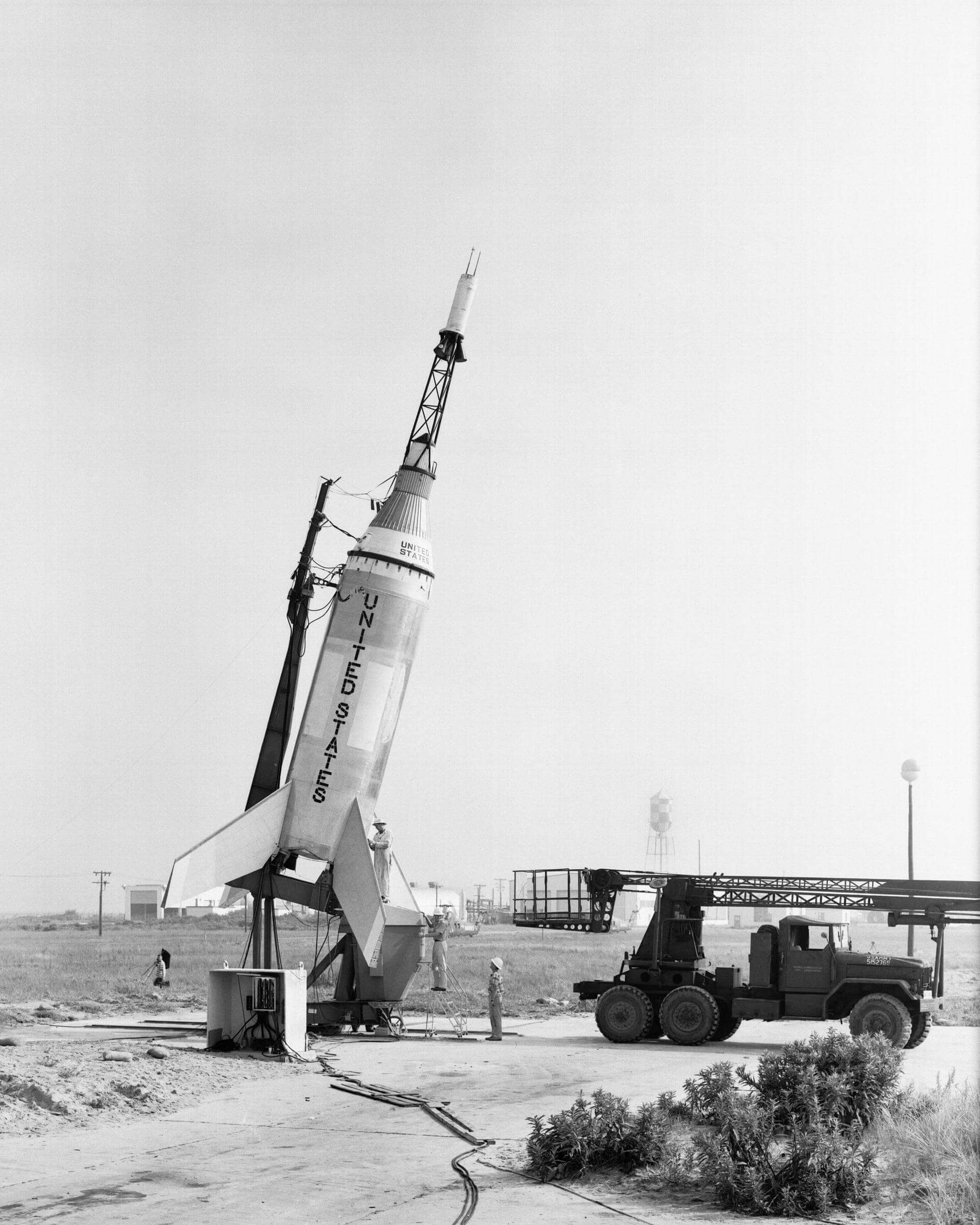
Little Joe
In-activeNorth American Aviation ()
Aug. 21, 1959
Description
Little Joe was a solid-fueled booster rocket used by NASA for eight launches from 1959-1960 from Wallops Island, Virginia to test the launch escape system and heat shield for Project Mercury capsules.
Specifications
-
Stages
1 -
Length
17.0 m -
Diameter
― -
Fairing Diameter
― -
Launch Mass
― -
Thrust
―
Family
-
Name
Little Joe -
Family
― -
Variant
― -
Alias
― -
Full Name
Little Joe
Payload Capacity
-
Launch Cost
― -
Low Earth Orbit
― -
Geostationary Transfer
Orbit
― -
Direct Geostationary
― -
Sun-Synchronous Capacity
―
North American Aviation
Commercial
None
1928North American Aviation (NAA) was a major American aerospace manufacturer, responsible for a number of historic aircraft, including the T-6 Texan trainer, the P-51 Mustang fighter, the B-25 Mitchell bomber, the F-86 Sabre jet fighter, the X-15 rocket plane, and the XB-70, as well as Apollo command and service module, the second stage of the Saturn V rocket, the Space Shuttle orbiter and the B-1 Lancer.
Little Joe | LJ-5B
North American Aviation | United States of AmericaWallops Flight Facility, Virginia, USA
April 28, 1961, 2:03 p.m.
Little Joe | LJ-5A
North American Aviation | United States of AmericaWallops Flight Facility, Virginia, USA
March 18, 1961, 4:49 p.m.
Little Joe | LJ-5
North American Aviation | United States of AmericaWallops Flight Facility, Virginia, USA
Nov. 8, 1960, 3:18 p.m.
Status: Launch Failure
Mission:
Suborbital test flight of the Mercury spacecraft, conducted as part of the U.S. Mercury program. The objective was to test a production Mercury capsule and the launch escape system during an ascent abort at maximum dynamic pressure. Sixteen seconds after liftoff, the escape rocket and the tower jettison rocket both fired prematurely. Furthermore, the booster, capsule, and escape tower failed to separate as intended. The entire stack was destroyed on impact with the Atlantic Ocean.
SuborbitalLittle Joe | LJ-1B
North American Aviation | United States of AmericaWallops Flight Facility, Virginia, USA
Jan. 21, 1960, 2:23 p.m.
Status: Launch Successful
Mission:
The Little Joe 1B was a suborbital launch escape system test of the Mercury spacecraft, conducted as part of the U.S. Mercury program. The mission also carried a female rhesus monkey (Macaca mulatta) named Miss Sam in the Mercury spacecraft.
SuborbitalLittle Joe | LJ-2
North American Aviation | United States of AmericaWallops Flight Facility, Virginia, USA
Dec. 4, 1959, 4:20 p.m.
Little Joe | LJ-1A
North American Aviation | United States of AmericaWallops Flight Facility, Virginia, USA
Nov. 4, 1959, 2:30 p.m.
Status: Launch was a Partial Failure
Mission:
Little Joe 1A (LJ-1A) was an unmanned rocket launched as part of NASA's Mercury program on November 4, 1959. This flight, a repeat of the Little Joe 1 (LJ-1) launch, was to test a launch abort under high aerodynamic load conditions. Due to a delayed in the escape motor startup, the abort maneuver was not accomplished at the desired dynamic pressure, requiring a repeat of the test.
SuborbitalLittle Joe | LJ-6
North American Aviation | United States of AmericaWallops Flight Facility, Virginia, USA
Oct. 4, 1959, 10 a.m.
Little Joe | LJ-1
North American Aviation | United States of AmericaWallops Flight Facility, Virginia, USA
Aug. 21, 1959, noon
Status: Launch Failure
Mission:
Little Joe 1 (LJ-1) was a failed launch of a Little Joe by NASA, a solid fuel rocket that was designed for a Max Q abort and Launch Escape System test for Mercury capsule. The objective was to determine how well the escape rocket would function under the most severe dynamic loading conditions anticipated during a Mercury-Atlas launching.
SuborbitalZhuque-2E
Mass Simulator
Launch Area 96A - Jiuquan Satellite Launch Center, People's Republic of China2.8 tonnes Mass Simulator launched to a 900 km polar orbit on a test flight proving further upgrades to the ZQ-2E, including a longer 1st stage and e…
Long March 6A
SpaceSail Polar Group 09
Launch Complex 9A - Taiyuan Satellite Launch Center, People's Republic of China18 Low Earth Orbit communication satellites with Ku, Q and V band payloads for the G60 constellation operated by Shanghai Spacesail Technologies with…
Falcon 9
NROL-172
Space Launch Complex 4E - Vandenberg SFB, CA, USAThirteenth batch of satellites for a reconnaissance satellite constellation built by SpaceX and Northrop Grumman for the National Reconnaissance Offi…
Long March 7
Tianzhou-10
201 - Wenchang Space Launch Site, People's Republic of ChinaNinth cargo delivery mission to the Chinese space station.
Falcon 9
Starlink Group 17-29
Space Launch Complex 4E - Vandenberg SFB, CA, USAA batch of 24 satellites for the Starlink mega-constellation - SpaceX's project for space-based Internet communication system.

