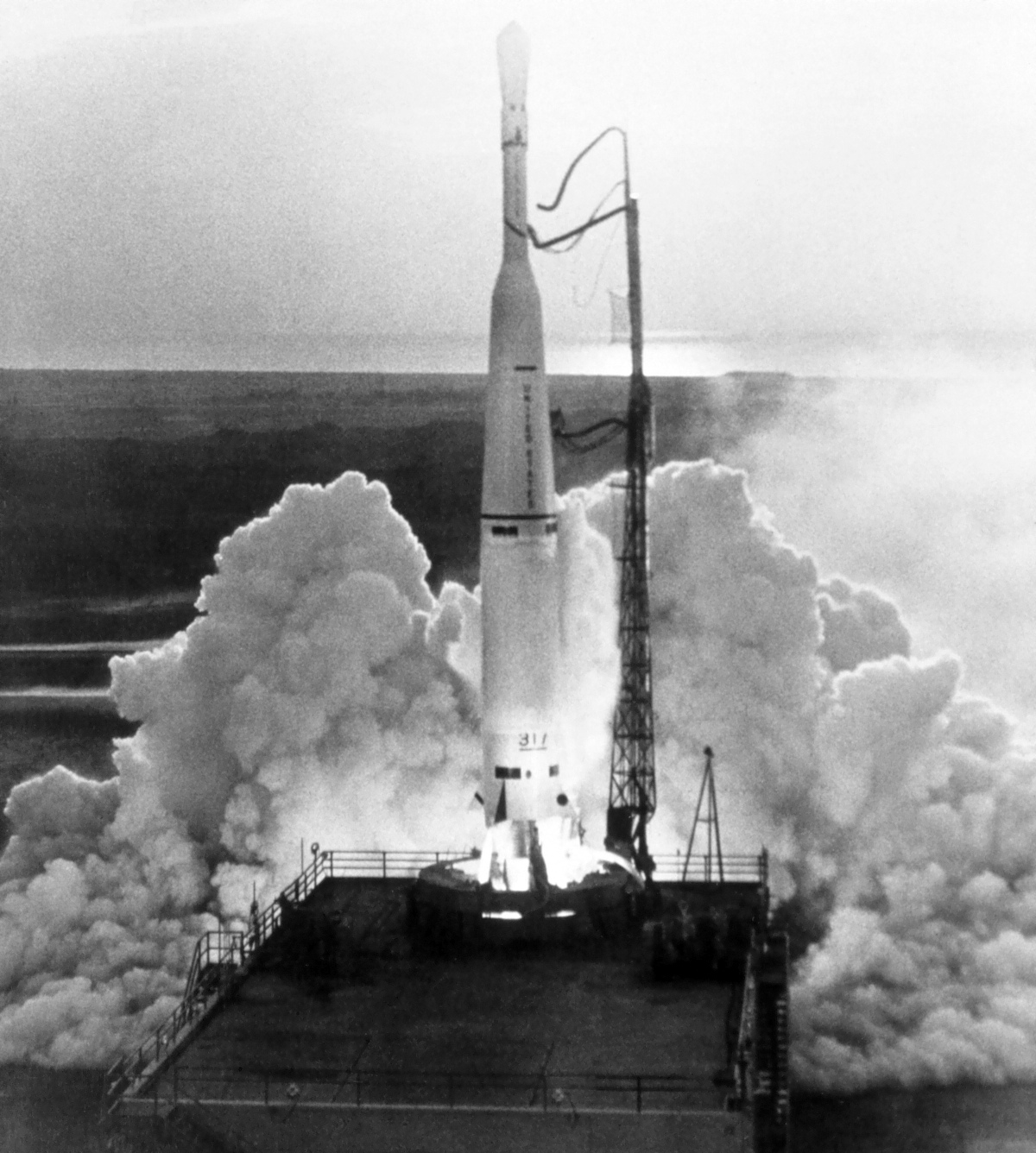
Thor Delta
In-activeMcDonnell Douglas (MDC)
May 13, 1960
Description
American orbital launch vehicle. Commercial name for the military's Thor-Delta.
Specifications
-
Stages
3 -
Length
31.0 m -
Diameter
2.44 m -
Fairing Diameter
2.44 m -
Launch Mass
54.0 T -
Thrust
667.0 kN
Family
-
Name
Thor Delta -
Family
― -
Variant
Delta -
Alias
― -
Full Name
Thor Delta
Payload Capacity
-
Launch Cost
$7270000 -
Low Earth Orbit
226.0 kg -
Geostationary Transfer
Orbit
― -
Direct Geostationary
― -
Sun-Synchronous Capacity
―
McDonnell Douglas
Commercial
None
MDCNone
Thor Delta | Tiros 6
McDonnell Douglas | United States of AmericaCape Canaveral SFS, FL, USA
Thor Delta | Telstar 1
McDonnell Douglas | United States of AmericaCape Canaveral SFS, FL, USA
Thor Delta | Tiros 5
McDonnell Douglas | United States of AmericaCape Canaveral SFS, FL, USA
Thor Delta | Ariel 1
McDonnell Douglas | United States of AmericaCape Canaveral SFS, FL, USA
Thor Delta | OSO 1
McDonnell Douglas | United States of AmericaCape Canaveral SFS, FL, USA
Thor Delta | Tiros 4
McDonnell Douglas | United States of AmericaCape Canaveral SFS, FL, USA
Thor Delta | Tiros 2
McDonnell Douglas | United States of AmericaCape Canaveral SFS, FL, USA
Thor Delta | Echo 1
McDonnell Douglas | United States of AmericaCape Canaveral SFS, FL, USA
Status: Launch Successful
Mission:
The Echo 1A spacecraft was a 30.48 m diameter balloon of mylar polyester film 0.0127 mm thick. The spacecraft was designed as a passive communications reflector for transcontinental and intercontinental telephone (voice), radio, and television signals. It had 107.9 MHz beacon transmitters for telemetry purposes. These transmitters were powered by five nickel-cadmium batteries that were charged by 70 solar cells mounted on the balloon. Because of the large area-to-mass ratio of the spacecraft, data for the calculation of atmospheric density and solar pressure could be acquired. The spacecraft was also used to evaluate the technical feasibility of satellite triangulation during the latter portion of its life. Echo 1 failed during the coast period after launch, as the attitude control jets on the second stage failed and the spacecraft did not achieve orbit. Echo 1A was a successful relaunch.
Elliptical OrbitThor Delta | Echo
McDonnell Douglas | United States of AmericaCape Canaveral SFS, FL, USA
Status: Launch Failure
Mission:
The Echo 1 spacecraft was a 30.48 m diameter balloon of mylar polyester film 0.0127 mm thick. The spacecraft was designed as a passive communications reflector for transcontinental and intercontinental telephone (voice), radio, and television signals. It had 107.9 MHz beacon transmitters for telemetry purposes. These transmitters were powered by five nickel-cadmium batteries that were charged by 70 solar cells mounted on the balloon. Because of the large area-to-mass ratio of the spacecraft, data for the calculation of atmospheric density and solar pressure could be acquired. The spacecraft was also used to evaluate the technical feasibility of satellite triangulation during the latter portion of its life. Echo 1 failed during the coast period after launch, as the attitude control jets on the second stage failed and the spacecraft did not achieve orbit. Echo 1A was a successful relaunch.
Elliptical OrbitStarship
Starlink Group 31-1 (Starship Flight 14)
Orbital Launch Pad 2 - SpaceX Starbase, TX, USA14th test flight of the two-stage Starship launch vehicle. 3rd flight of Starship V3 and the first Starship flight to deploy satellites (a group of S…
Falcon 9
USSF-385
Space Launch Complex 4E - Vandenberg SFB, CA, USAA classified mission for the United States Space Force. It is possibly a batch of classified LEO satellites based on SpaceX’s Starshield satellite bu…
Electron
Owlright, Owlright, Owlright (StriX Launch 13)
Rocket Lab Launch Complex 1B - Rocket Lab Launch Complex 1, Mahia Peninsula, New ZealandSynthetic aperture radar satellite for Japanese Earth imaging company Synspective.
Long March 6A
Yaogan 40 Group 04
Launch Complex 9A - Taiyuan Satellite Launch Center, People's Republic of China3 Chinese reconnaissance satellites of unknown purposes, officially reported as for "Electromagnetic environment probing".
Long March 8A
SatNet LEO Group 26
Commercial LC-1 - Wenchang Space Launch Site, People's Republic of ChinaA batch of 9 Low Earth Orbit communication satellites for the Chinese state owned SatNet constellation operated by the China Satellite Network Group.…

