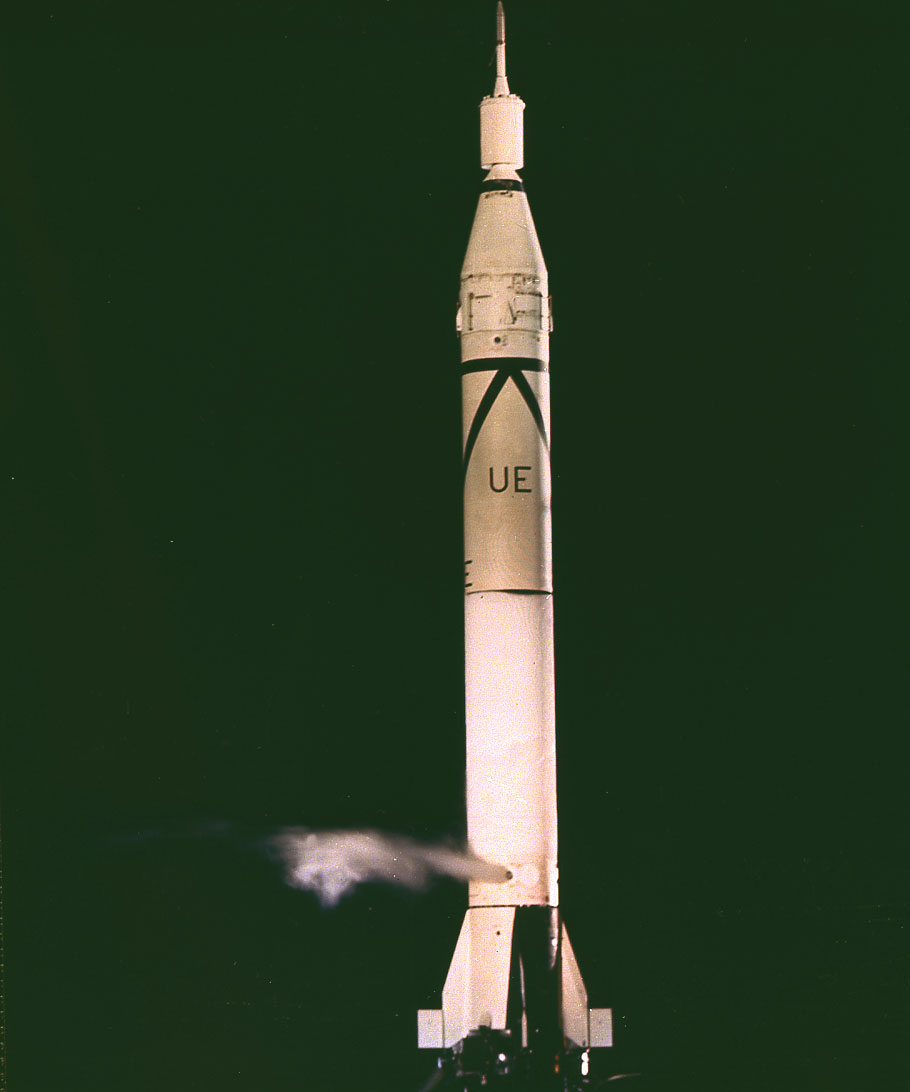
Juno-I
In-activeChrysler (CHR)
Jan. 31, 1958
Description
The Juno I was a four-stage American booster rocket which launched America's first satellite, Explorer 1 in 1958. A member of thr redstone family, it was derived from the Jupiter-C sounding rocket.
Specifications
-
Stages
4 -
Length
21.2 m -
Diameter
1.78 m -
Fairing Diameter
1.78 m -
Launch Mass
29.0 T -
Thrust
416.0 kN
Family
-
Name
Juno-I -
Family
― -
Variant
Juno I -
Alias
― -
Full Name
Juno-I
Payload Capacity
-
Launch Cost
― -
Low Earth Orbit
11.0 kg -
Geostationary Transfer
Orbit
― -
Direct Geostationary
― -
Sun-Synchronous Capacity
―
Chrysler
Commercial
None
CHR 1950In July 1959, NASA chose the Redstone missile as the basis for the Mercury-Redstone Launch Vehicle to be used for suborbital test flights of the Project Mercury spacecraft. Three unmanned MRLV launch attempts were made between November 1960 and March 1961, two of which were successful. The MRLV successfully launched the chimpanzee Ham, and astronauts Alan Shepard and Gus Grissom on three suborbital flights in January, May and July 1961, respectively.
Juno-I | Beacon
Chrysler | United States of AmericaCape Canaveral SFS, FL, USA
Juno-I | Explorer 5
Chrysler | United States of AmericaCape Canaveral SFS, FL, USA
Juno-I | Explorer 4
Chrysler | United States of AmericaCape Canaveral SFS, FL, USA
Juno-I | Explorer 3
Chrysler | United States of AmericaCape Canaveral SFS, FL, USA
Juno-I | Explorer 2
Chrysler | United States of AmericaCape Canaveral SFS, FL, USA
Long March 2D
PIESAT-2 13-16
Launch Complex 9 - Taiyuan Satellite Launch Center, People's Republic of China4 X-band synthetic-aperture radar Earth observation satellites for the Chinese Earth observation satellite company PIESAT.
Electron
Owl By The Dozen (StriX Launch 12)
Rocket Lab Launch Complex 1B - Rocket Lab Launch Complex 1, Mahia Peninsula, New ZealandSynthetic aperture radar satellite for Japanese Earth imaging company Synspective.
Soyuz 2.1b/Fregat-M
Glonass-K1 No. 20 (?)
43/3 (43L) - Plesetsk Cosmodrome, Russian FederationNote: Satellite serial number and Cosmos designation not confirmed. Glonass-K are the third generation of satellite design for GLONASS satellite n…
Kuaizhou 11
SpaceTY-51 & 52
Launch Area 95A - Jiuquan Satellite Launch Center, People's Republic of China2 Earth observation radar satellites built by the Chinese satellite manufacturer SpaceTY.
Falcon 9
USSF-259
Space Launch Complex 4E - Vandenberg SFB, CA, USAUSSF-259 is a classified mission for the United States Space Force. It is possibly a batch of classified LEO satellites based on SpaceX’s Starshield …

