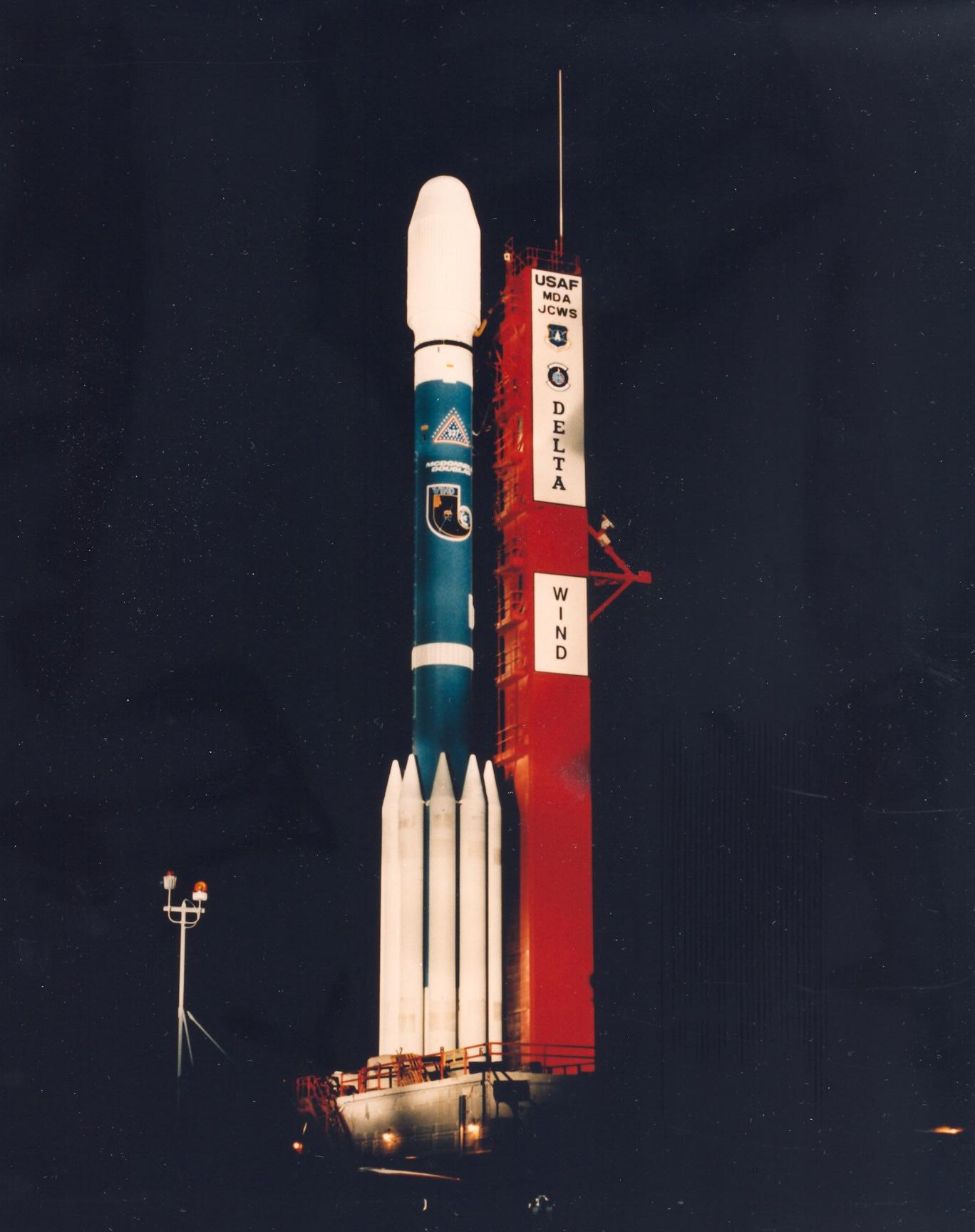
Delta II
In-activeMcDonnell Douglas (MDC)
Nov. 1, 1994
Description
Delta II was an expendable launch system, originally designed and built by McDonnell Douglas. Delta II was part of the Delta rocket family and entered service in 1989. Delta II vehicles included the Delta 6000, and the two later Delta 7000 variants ("Light" and "Heavy"). The rocket flew its final mission ICESat-2 on 15 September 2018, earning the launch vehicle a streak of 100 successful missions in a row, with the last failure being GPS IIR-1 in 1997.
Specifications
-
Stages
4 -
Length
38.9 m -
Diameter
2.44 m -
Fairing Diameter
2.44 m -
Launch Mass
231.0 T -
Thrust
4000.0 kN
Family
-
Name
Delta II -
Family
― -
Variant
7925-10 -
Alias
― -
Full Name
Delta II 7925-10
Payload Capacity
-
Launch Cost
― -
Low Earth Orbit
― -
Geostationary Transfer
Orbit
― -
Direct Geostationary
― -
Sun-Synchronous Capacity
―
McDonnell Douglas
Commercial
None
MDCNone
Delta 7925-10 | Polar
McDonnell Douglas | United States of AmericaVandenberg SFB, CA, USA
Status: Launch Successful
Mission:
Polar is one of four spacecraft in the Global Geospace Science (GGS) program. These are among the spacecraft (Wind, Geotail, SOHO, and Cluster) in the International Solar Terrestrial Physics (ISTP) program. POLAR measures solar wind entry, ionospheric output, and the depositions of energy into the neutral atmosphere at high latitudes.
Elliptical OrbitDelta 7925-10 | Wind
McDonnell Douglas | United States of AmericaCape Canaveral SFS, FL, USA
Status: Launch Successful
Mission:
The main purpose of the Wind spacecraft is to measure the incoming solar wind, magnetic fields and particles, although early on it will also observe the Earth's foreshock region. Wind, together with Geotail, Polar, SOHO, and Cluster projects, constitute a cooperative scientific satellite project designated the International Solar Terrestrial Physics (ISTP) program which aims at gaining improved understanding of the physics of solar terrestrial relations.
Heliocentric L1Long March 2D
PIESAT-2 13-16
Launch Complex 9 - Taiyuan Satellite Launch Center, People's Republic of China4 X-band synthetic-aperture radar Earth observation satellites for the Chinese Earth observation satellite company PIESAT.
Electron
Owl By The Dozen (StriX Launch 12)
Rocket Lab Launch Complex 1B - Rocket Lab Launch Complex 1, Mahia Peninsula, New ZealandSynthetic aperture radar satellite for Japanese Earth imaging company Synspective.
Soyuz 2.1b/Fregat-M
Glonass-K1 No. 20 (?)
43/3 (43L) - Plesetsk Cosmodrome, Russian FederationNote: Satellite serial number and Cosmos designation not confirmed. Glonass-K are the third generation of satellite design for GLONASS satellite n…
Kuaizhou 11
SpaceTY-51 & 52
Launch Area 95A - Jiuquan Satellite Launch Center, People's Republic of China2 Earth observation radar satellites built by the Chinese satellite manufacturer SpaceTY.
Falcon 9
USSF-259
Space Launch Complex 4E - Vandenberg SFB, CA, USAUSSF-259 is a classified mission for the United States Space Force. It is possibly a batch of classified LEO satellites based on SpaceX’s Starshield …

