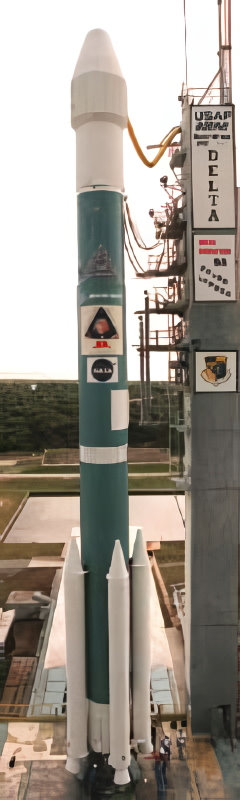
Delta II
In-activeMcDonnell Douglas (MDC)
Dec. 11, 1998
Description
Delta II was an expendable launch system, originally designed and built by McDonnell Douglas. Delta II was part of the Delta rocket family and entered service in 1989. Delta II vehicles included the Delta 6000, and the two later Delta 7000 variants ("Light" and "Heavy"). The rocket flew its final mission ICESat-2 on 15 September 2018, earning the launch vehicle a streak of 100 successful missions in a row, with the last failure being GPS IIR-1 in 1997.
Specifications
-
Stages
4 -
Length
39.0 m -
Diameter
2.44 m -
Fairing Diameter
2.44 m -
Launch Mass
170.0 T -
Thrust
3020.0 kN
Family
-
Name
Delta II -
Family
― -
Variant
7425-9.5 -
Alias
― -
Full Name
Delta II 7425-9.5
Payload Capacity
-
Launch Cost
― -
Low Earth Orbit
― -
Geostationary Transfer
Orbit
― -
Direct Geostationary
― -
Sun-Synchronous Capacity
―
McDonnell Douglas
Commercial
None
MDCNone
Delta 7425-9.5 | Contour
McDonnell Douglas | United States of AmericaCape Canaveral SFS, FL, USA
Status: Launch Successful
Mission:
The CONTOUR (Comet Nucleus Tour) probe, built and operated by the Johns Hopkins University's Applied Physics Laboratory (APL), began its five year mission to explore three comets, using repeated encounters with the earth to modify its orbit in order to reach each target.
Sun-Synchronous OrbitDelta 7425-9.5 | Mars Polar Lander
McDonnell Douglas | United States of AmericaCape Canaveral SFS, FL, USA
Status: Launch Successful
Mission:
The Mars Polar Lander, also known as the Mars Surveyor '98 Lander, was a 290-kilogram robotic spacecraft lander launched by NASA on January 3, 1999 to study the soil and climate of Planum Australe, a region near the south pole on Mars. It formed part of the Mars Surveyor '98 mission. On December 3, 1999, however, after the descent phase was expected to be complete, the lander failed to reestablish communication with Earth. A post-mortem analysis determined the most likely cause of the mishap was premature termination of the engine firing prior to the lander touching the surface, causing it to strike the planet at a high velocity.
Heliocentric N/ADelta 7425-9.5 | Mars Climate Orbiter
McDonnell Douglas | United States of AmericaCape Canaveral SFS, FL, USA
Status: Launch Successful
Mission:
The Mars Surveyor '98 program is comprised of two spacecraft launched separately, the MCO (Mars Climate Orbiter, formerly the Mars Surveyor '98 Orbiter) and the MPL (Mars Polar Lander, formerly the Mars Surveyor '98 Lander). The two missions were to study the Martian weather, climate, and water and carbon dioxide budget, in order to understand the reservoirs, behavior, and atmospheric role of volatiles and to search for evidence of long-term and episodic climate changes. The Mars Climate Orbiter was destroyed when a navigation error caused it to miss its target altitude at Mars by 80 to 90 km, instead entering the Martian atmosphere at an altitude of 57 km during the orbit insertion maneuver.
Heliocentric N/ALong March 2D
PIESAT-2 13-16
Launch Complex 9 - Taiyuan Satellite Launch Center, People's Republic of China4 X-band synthetic-aperture radar Earth observation satellites for the Chinese Earth observation satellite company PIESAT.
Electron
Owl By The Dozen (StriX Launch 12)
Rocket Lab Launch Complex 1B - Rocket Lab Launch Complex 1, Mahia Peninsula, New ZealandSynthetic aperture radar satellite for Japanese Earth imaging company Synspective.
Soyuz 2.1b/Fregat-M
Glonass-K1 No. 20 (?)
43/3 (43L) - Plesetsk Cosmodrome, Russian FederationNote: Satellite serial number and Cosmos designation not confirmed. Glonass-K are the third generation of satellite design for GLONASS satellite n…
Kuaizhou 11
SpaceTY-51 & 52
Launch Area 95A - Jiuquan Satellite Launch Center, People's Republic of China2 Earth observation radar satellites built by the Chinese satellite manufacturer SpaceTY.
Falcon 9
USSF-259
Space Launch Complex 4E - Vandenberg SFB, CA, USAUSSF-259 is a classified mission for the United States Space Force. It is possibly a batch of classified LEO satellites based on SpaceX’s Starshield …

