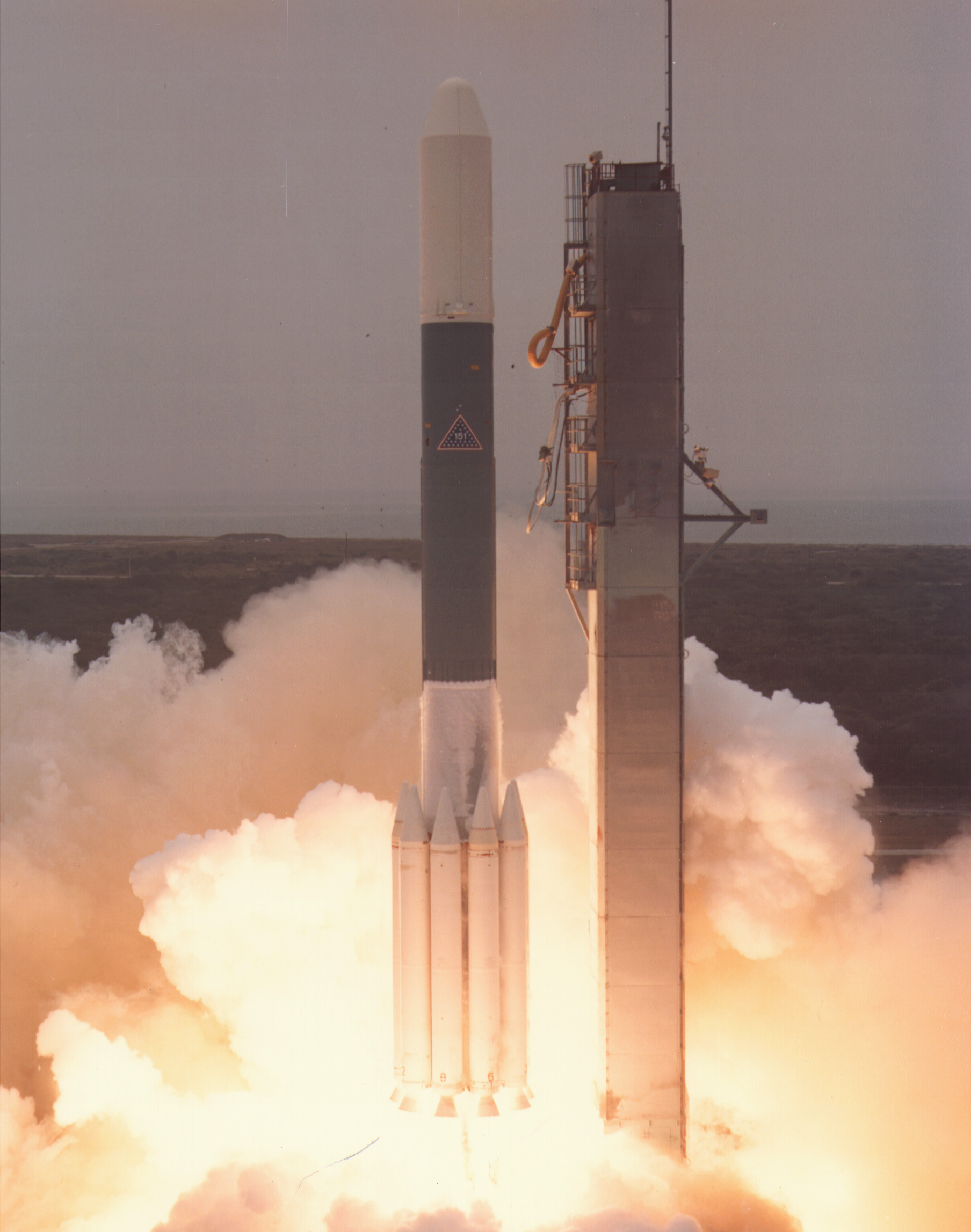
Delta 3920/PAM
In-activeMcDonnell Douglas (MDC)
Aug. 26, 1982
Description
The Delta 3000 series was an American expendable launch system which was used to conduct 38 orbital launches between 1975 and 1989. It was a member of the Delta family of rockets. Several variants existed, which were differentiated by a four digit numerical code.
Specifications
-
Stages
4 -
Length
36.0 m -
Diameter
2.44 m -
Fairing Diameter
2.44 m -
Launch Mass
191.0 T -
Thrust
3188.0 kN
Family
-
Name
Delta 3920/PAM -
Family
― -
Variant
3920/PAM -
Alias
― -
Full Name
Delta 3920/PAM
Payload Capacity
-
Launch Cost
― -
Low Earth Orbit
1280.0 kg -
Geostationary Transfer
Orbit
― -
Direct Geostationary
― -
Sun-Synchronous Capacity
―
McDonnell Douglas
Commercial
None
MDCNone
Delta 3920/PAM | Palapa B2P
McDonnell Douglas | United States of AmericaCape Canaveral SFS, FL, USA
March 20, 1987, 10:22 p.m.
Delta 3920/PAM | Galaxy 3
McDonnell Douglas | United States of AmericaCape Canaveral SFS, FL, USA
Sept. 21, 1984, 10:18 p.m.
Delta 3920/PAM | Galaxy 2
McDonnell Douglas | United States of AmericaCape Canaveral SFS, FL, USA
Sept. 22, 1983, 10:16 p.m.
Delta 3920/PAM | Telstar 301
McDonnell Douglas | United States of AmericaCape Canaveral SFS, FL, USA
July 28, 1983, 10:49 p.m.
Delta 3920/PAM | Galaxy 1
McDonnell Douglas | United States of AmericaCape Canaveral SFS, FL, USA
June 28, 1983, 11:08 p.m.
Falcon 9
Starlink Group 10-33
Space Launch Complex 40 - Cape Canaveral SFS, FL, USAA batch of 29 satellites for the Starlink mega-constellation - SpaceX's project for space-based Internet communication system.
Falcon 9
Starlink Group 10-46
Space Launch Complex 40 - Cape Canaveral SFS, FL, USAA batch of 29 satellites for the Starlink mega-constellation - SpaceX's project for space-based Internet communication system.
Falcon 9
Starlink Group 17-24
Space Launch Complex 4E - Vandenberg SFB, CA, USAA batch of 25 satellites for the Starlink mega-constellation - SpaceX's project for space-based Internet communication system.
Kuaizhou 11
8 satellites
Launch Area 95A - Jiuquan Satellite Launch Center, People's Republic of ChinaRide-share launch of 8 satellites to sun-synchronous orbit: * Juntian-1-04A * Dongpo-11 * Dongpo-12 * Dongpo-16 * Weitong-1-01 * Xiguang-1-06…
Long March 6A
Yaogan 50-02
Launch Complex 9A - Taiyuan Satellite Launch Center, People's Republic of ChinaThe Yaogan 50-02 is a Chinese military “remote sensing” satellite of unknown purposes.

