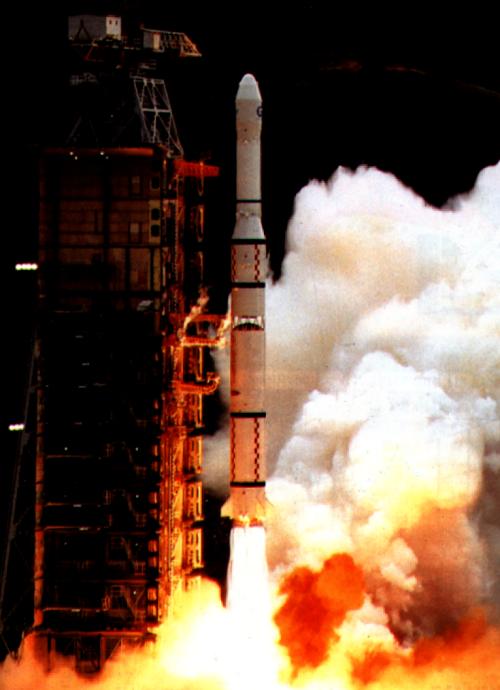
Long March 3
In-activeChina Aerospace Science and Technology Corporation (CASC)
Jan. 29, 1984
Description
The Long March 3 is a chinese orbital carrier rocket. They all launched from Launch Area 3 at the Xichang Satellite Launch Center. It is a 3 stage rocket used to put communication satellites into geosynchronous trasfer orbits.
Specifications
-
Stages
3 -
Length
23.49 m -
Diameter
3.35 m -
Fairing Diameter
3.35 m -
Launch Mass
204.0 T -
Thrust
2961.0 kN
Family
-
Name
Long March 3 -
Family
― -
Variant
― -
Alias
― -
Full Name
Long March 3
Payload Capacity
-
Launch Cost
― -
Low Earth Orbit
5000.0 kg -
Geostationary Transfer
Orbit
1500.0 kg -
Direct Geostationary
― -
Sun-Synchronous Capacity
―
China Aerospace Science and Technology Corporation
Government
Chairman & President: Lei Fanpei
CASC 1999The China Aerospace Science and Technology Corporation (CASC) is the main contractor for the Chinese space program. It is state-owned and has a number of subordinate entities which design, develop and manufacture a range of spacecraft, launch vehicles, strategic and tactical missile systems, and ground equipment. It was officially established in July 1999 as part of a Chinese government reform drive, having previously been one part of the former China Aerospace Corporation. Various incarnations of the program date back to 1956.
Long March 3 | Feng Yun 2B
China Aerospace Science and Technology Corporation | ChinaXichang Satellite Launch Center, People's Republic of China
Long March 3 | Feng Yun 2A
China Aerospace Science and Technology Corporation | ChinaXichang Satellite Launch Center, People's Republic of China
Long March 3 | Zhongxing 7
China Aerospace Science and Technology Corporation | ChinaXichang Satellite Launch Center, People's Republic of China
Status: Launch Failure
Mission:
ChinaSat 7 or ZX 7 (Zhongxing 7) is a Hughes HS-376 model geostationary telecommunications satellite built for the China Telecommunications Broadcast Satellite Corporation (ChinaSat). It was the first satellite ChinaSat had ordered from a western spacecraft contractor, Hughes Space and Communications International, Inc., known today as Boeing Satellite Systems International, Inc.
Geostationary OrbitLong March 3 | Apstar 1A
China Aerospace Science and Technology Corporation | ChinaXichang Satellite Launch Center, People's Republic of China
Status: Launch Successful
Mission:
The APSTAR 1 spacecraft carries such general communications traffic as voice, fax, data, and television signals across China and Hong Kong, Indonesia, Japan, Singapore, and Vietnam. APSTAR 1A has expanded coverage to India and Pakistan. Hughes Space and Communications International, Inc., signed a contract in May 1992 with APT Satellite Company, Ltd., of Hong Kong for the first satellite. APT ordered APSTAR IA in March 1995. The spacecraft were built at the Hughes Space and Communications Company facilities in El Segundo, Calif.
Geostationary OrbitLong March 3 | APSTAR 1
China Aerospace Science and Technology Corporation | ChinaXichang Satellite Launch Center, People's Republic of China
Status: Launch Successful
Mission:
The APSTAR 1 spacecraft carries such general communications traffic as voice, fax, data, and television signals across China and Hong Kong, Indonesia, Japan, Singapore, and Vietnam. APSTAR 1A has expanded coverage to India and Pakistan. Hughes Space and Communications International, Inc., signed a contract in May 1992 with APT Satellite Company, Ltd., of Hong Kong for the first satellite. APT ordered APSTAR IA in March 1995. The spacecraft were built at the Hughes Space and Communications Company facilities in El Segundo, Calif.
Geostationary OrbitLong March 3 | DFH-2A 5
China Aerospace Science and Technology Corporation | ChinaXichang Satellite Launch Center, People's Republic of China
Long March 3 | Asiasat 1
China Aerospace Science and Technology Corporation | ChinaXichang Satellite Launch Center, People's Republic of China
Long March 3 | DFH-2A 4
China Aerospace Science and Technology Corporation | ChinaXichang Satellite Launch Center, People's Republic of China
Long March 3 | DFH-2A 3
China Aerospace Science and Technology Corporation | ChinaXichang Satellite Launch Center, People's Republic of China
Long March 3 | DFH-2A 2
China Aerospace Science and Technology Corporation | ChinaXichang Satellite Launch Center, People's Republic of China
Long March 3 | DFH-2A 1
China Aerospace Science and Technology Corporation | ChinaXichang Satellite Launch Center, People's Republic of China
Long March 3 | DFH-2 2
China Aerospace Science and Technology Corporation | ChinaXichang Satellite Launch Center, People's Republic of China
Starship
Starlink Group 31-1 (Starship Flight 14)
Orbital Launch Pad 2 - SpaceX Starbase, TX, USA14th test flight of the two-stage Starship launch vehicle. 3rd flight of Starship V3 and the first Starship flight to deploy satellites (a group of S…
Falcon 9
USSF-385
Space Launch Complex 4E - Vandenberg SFB, CA, USAA classified mission for the United States Space Force. It is possibly a batch of classified LEO satellites based on SpaceX’s Starshield satellite bu…
Electron
Owlright, Owlright, Owlright (StriX Launch 13)
Rocket Lab Launch Complex 1B - Rocket Lab Launch Complex 1, Mahia Peninsula, New ZealandSynthetic aperture radar satellite for Japanese Earth imaging company Synspective.
Long March 6A
Yaogan 40 Group 04
Launch Complex 9A - Taiyuan Satellite Launch Center, People's Republic of China3 Chinese reconnaissance satellites of unknown purposes, officially reported as for "Electromagnetic environment probing".
Long March 8A
SatNet LEO Group 26
Commercial LC-1 - Wenchang Space Launch Site, People's Republic of ChinaA batch of 9 Low Earth Orbit communication satellites for the Chinese state owned SatNet constellation operated by the China Satellite Network Group.…

