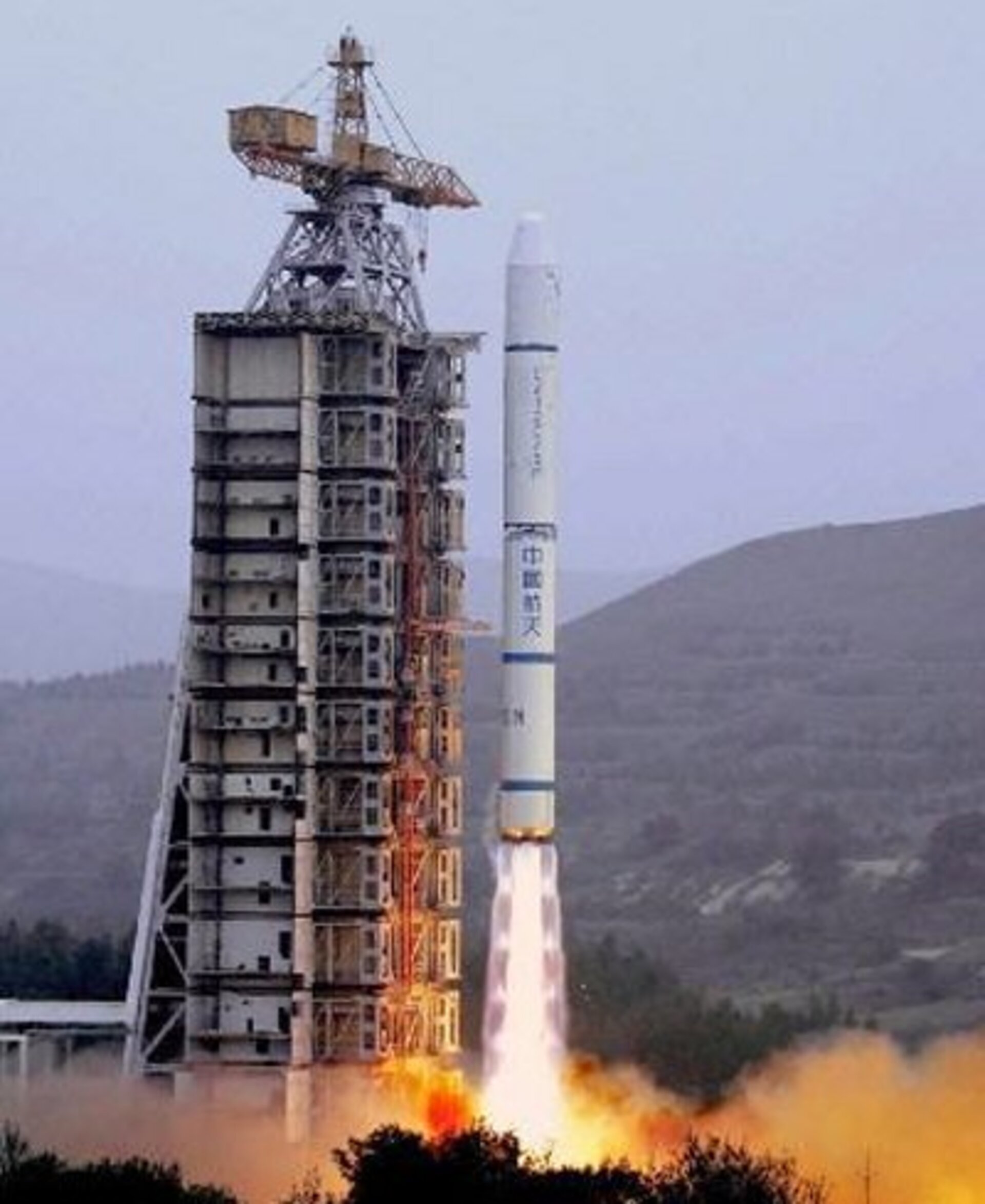
Long March 2C/SM
In-activeChina Aerospace Science and Technology Corporation (CASC)
Dec. 29, 2003
Description
The Long March 2C is a family of expendable launch vehicles made and operated by China. It is a two stage launch vehicle with storable propellants, consisting of Nitrogen Tetroxide and Unsymmetrical Dimethylhydrazine.
Specifications
-
Stages
3 -
Length
42.0 m -
Diameter
3.35 m -
Fairing Diameter
3.35 m -
Launch Mass
233.0 T -
Thrust
2962.0 kN
Family
-
Name
Long March 2C/SM -
Family
― -
Variant
C/SM -
Alias
― -
Full Name
Long March 2C/SM
Payload Capacity
-
Launch Cost
― -
Low Earth Orbit
3850.0 kg -
Geostationary Transfer
Orbit
1440.0 kg -
Direct Geostationary
― -
Sun-Synchronous Capacity
―
China Aerospace Science and Technology Corporation
Government
Chairman & President: Lei Fanpei
CASC 1999The China Aerospace Science and Technology Corporation (CASC) is the main contractor for the Chinese space program. It is state-owned and has a number of subordinate entities which design, develop and manufacture a range of spacecraft, launch vehicles, strategic and tactical missile systems, and ground equipment. It was officially established in July 1999 as part of a Chinese government reform drive, having previously been one part of the former China Aerospace Corporation. Various incarnations of the program date back to 1956.
Long March 2C/SM | Tan Ce 2
China Aerospace Science and Technology Corporation | ChinaTaiyuan Satellite Launch Center, People's Republic of China
Long March 2C/SM | Tan Ce 1
China Aerospace Science and Technology Corporation | ChinaXichang Satellite Launch Center, People's Republic of China
Status: Launch Successful
Mission:
The Double Star spacecraft, called also Tan Ce (TC) which in Chinese means ‘Probe‘, is a joint Chinese and ESA mission to study the effect of the Sun on the Earth's environment. The polar spacecraft (TC-2) will monitor the energy input from the solar wind into the polar ionosphere. The equatorial spacecraft (TC-1) will investigate the so-called substorm process, when it is in the Earth's magnetotail, and the entry of solar particle on the front side of the magnetosphere.
Elliptical OrbitLong March 2D
PIESAT-2 13-16
Launch Complex 9 - Taiyuan Satellite Launch Center, People's Republic of China4 X-band synthetic-aperture radar Earth observation satellites for the Chinese Earth observation satellite company PIESAT.
Electron
Owl By The Dozen (StriX Launch 12)
Rocket Lab Launch Complex 1B - Rocket Lab Launch Complex 1, Mahia Peninsula, New ZealandSynthetic aperture radar satellite for Japanese Earth imaging company Synspective.
Soyuz 2.1b/Fregat-M
Glonass-K1 No. 20 (?)
43/3 (43L) - Plesetsk Cosmodrome, Russian FederationNote: Satellite serial number and Cosmos designation not confirmed. Glonass-K are the third generation of satellite design for GLONASS satellite n…
Kuaizhou 11
SpaceTY-51 & 52
Launch Area 95A - Jiuquan Satellite Launch Center, People's Republic of China2 Earth observation radar satellites built by the Chinese satellite manufacturer SpaceTY.
Falcon 9
USSF-259
Space Launch Complex 4E - Vandenberg SFB, CA, USAUSSF-259 is a classified mission for the United States Space Force. It is possibly a batch of classified LEO satellites based on SpaceX’s Starshield …

