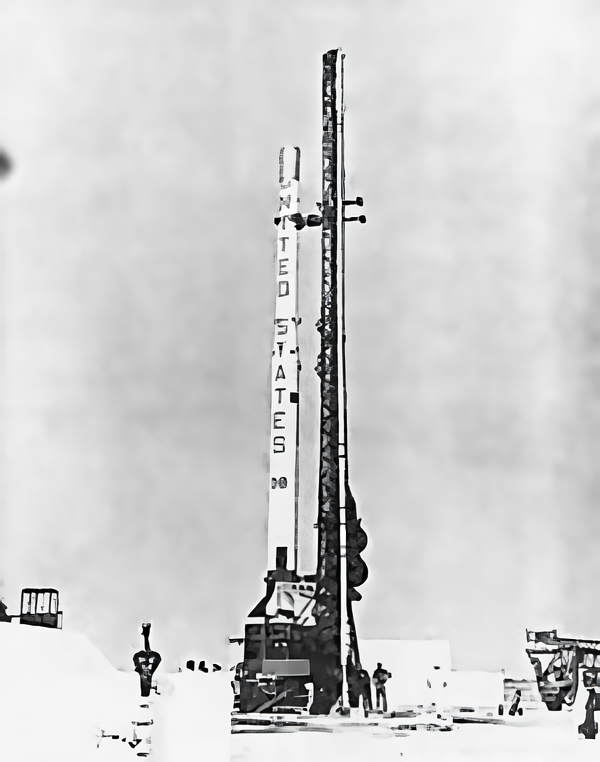
Blue Scout II
In-activeVought ()
March 3, 1961
Description
The RM-90 Blue Scout II was an American sounding rocket and expendable launch system which was flown three times during 1961. It was used for two HETS test flights, and the launch of the Mercury-Scout 1 satellite for NASA. It was a member of the Scout family of rockets.
Specifications
-
Stages
4 -
Length
24.0 m -
Diameter
1.02 m -
Fairing Diameter
1.02 m -
Launch Mass
16.0 T -
Thrust
471.0 kN
Family
-
Name
Blue Scout II -
Family
― -
Variant
II -
Alias
― -
Full Name
Blue Scout II
Payload Capacity
-
Launch Cost
― -
Low Earth Orbit
30.0 kg -
Geostationary Transfer
Orbit
― -
Direct Geostationary
― -
Sun-Synchronous Capacity
―
Vought
Commercial
None
1917Vought was the name of several related American aerospace firms. These have included, in the past, Lewis and Vought Corporation, Chance Vought, Vought-Sikorsky, LTV Aerospace (part of Ling-Temco-Vought), Vought Aircraft Companies, and Vought Aircraft Industries. The first incarnation of Vought was established by Chance M. Vought and Birdseye Lewis in 1917. In 1928, it was acquired by United Aircraft and Transport Corporation, which a few years later became United Aircraft Corporation; this was the first of many reorganizations and buyouts. During the 1920s and 1930s, Vought Aircraft and Chance Vought specialized in carrier-based aircraft for the United States Navy, by far its biggest customer. Chance Vought produced thousands of planes during World War II, including the F4U Corsair. Vought became independent again in 1954, and was purchased by Ling-Temco-Vought in 1961. The company designed and produced a variety of planes and missiles throughout the Cold War. Vought was sold from LTV and owned in various degrees by the Carlyle Group and Northrop Grumman in the early 1990s. It was then fully bought by Carlyle, renamed Vought Aircraft Industries, with headquarters in Dallas, Texas. In June 2010, the Carlyle Group sold Vought to the Triumph Group.
Blue Scout II | Mercury-Scout 1
Vought | United States of AmericaCape Canaveral SFS, FL, USA
Nov. 1, 1961, 3:32 p.m.
Falcon 9
BlueBird 11-13 (Block 2 #6-8)
Space Launch Complex 40 - Cape Canaveral SFS, FL, USAAST SpaceMobile’s Block 2 BlueBird satellites are designed to deliver up to 10 times the bandwidth capacity of the BlueBird Block 1 satellites, requi…
Smart Dragon 3
OSE HS-01 & 02
Haiyang offshore launch location - Haiyang Oriental Spaceport2 hyper-spectral Earth observation satellites from Chinese company STAR.VISION. Both satellites are built in corporation with foreign customers: *…
Falcon 9
Starlink Group 17-53
Space Launch Complex 4E - Vandenberg SFB, CA, USAA batch of 24 satellites for the Starlink mega-constellation - SpaceX's project for space-based Internet communication system.
Long March 8A
SatNet LEO Group 23
Commercial LC-1 - Wenchang Space Launch Site, People's Republic of ChinaA batch of 9 Low Earth Orbit communication satellites for the Chinese state owned SatNet constellation operated by the China Satellite Network Group.…
Falcon 9
Starlink Group 17-52
Space Launch Complex 4E - Vandenberg SFB, CA, USAA batch of 24 satellites for the Starlink mega-constellation - SpaceX's project for space-based Internet communication system.

