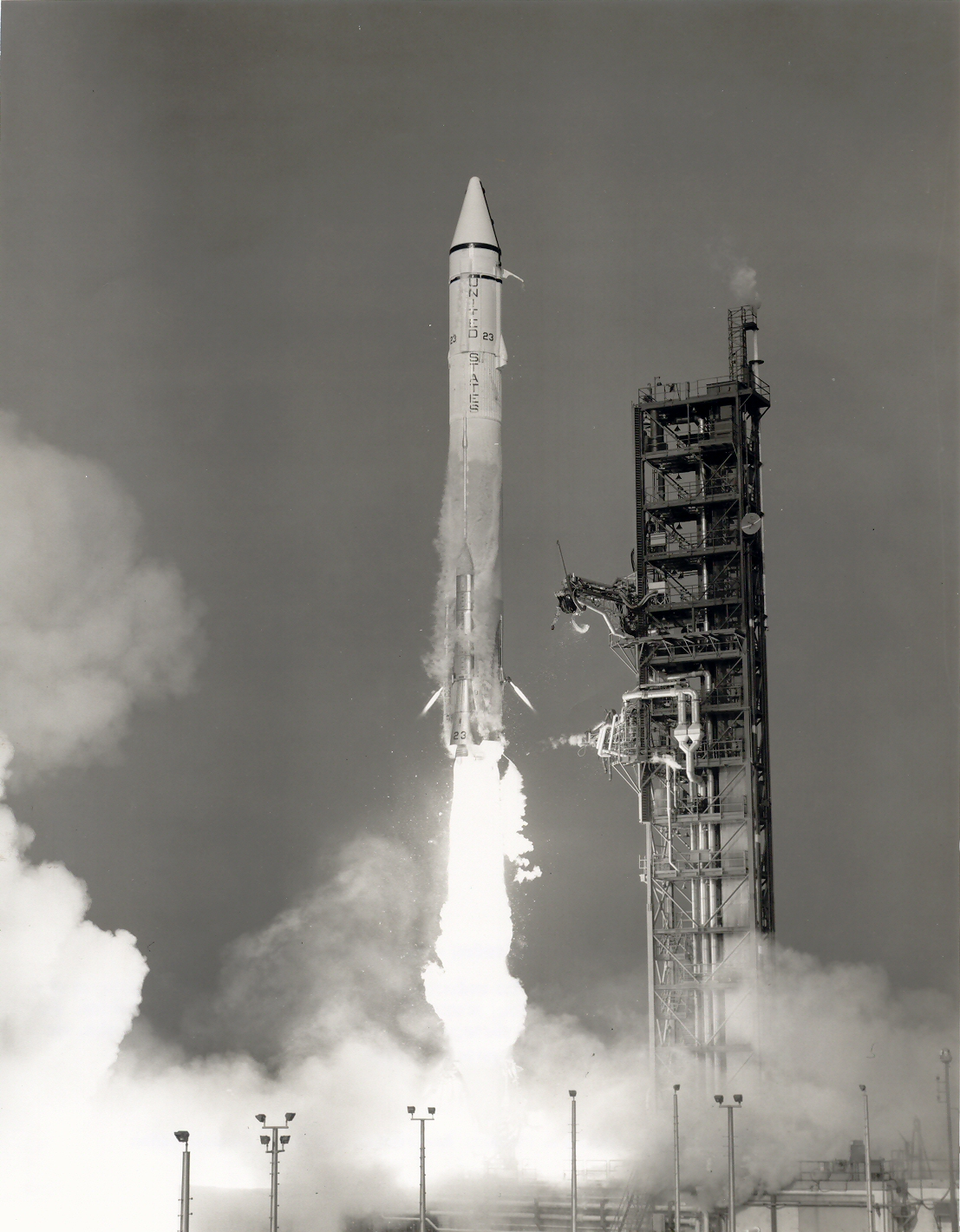
Atlas SLV-3C Centaur
In-activeConvair ()
Sept. 8, 1967
Description
The Atlas-Centaur was a US expendable launch vehicle derived from the SM-65 Atlas D missile. Launches were conducted from Launch Complex 36 at the Cape Canaveral Air Force Station in Florida.
Specifications
-
Stages
2 -
Length
21.0 m -
Diameter
3.05 m -
Fairing Diameter
3.05 m -
Launch Mass
120.0 T -
Thrust
―
Family
-
Name
Atlas SLV-3C Centaur -
Family
― -
Variant
SLV-3C Centaur -
Alias
― -
Full Name
Atlas SLV-3C Centaur
Payload Capacity
-
Launch Cost
― -
Low Earth Orbit
800.0 kg -
Geostationary Transfer
Orbit
― -
Direct Geostationary
― -
Sun-Synchronous Capacity
―
Convair
Commercial
None
1943Convair, previously Consolidated Vultee, was an American aircraft manufacturing company that later expanded into rockets and spacecraft. The company was formed in 1943 by the merger of Consolidated Aircraft and Vultee Aircraft. In 1953 it was purchased by General Dynamics, and operated as their Convair Division for most of its corporate history.
Atlas SLV-3C Centaur | Copernicus
Convair | United States of AmericaCape Canaveral SFS, FL, USA
Atlas SLV-3C Centaur | INTELSAT IV F5
Convair | United States of AmericaCape Canaveral SFS, FL, USA
Atlas SLV-3C Centaur | Pioneer 10
Convair | United States of AmericaCape Canaveral SFS, FL, USA
Atlas SLV-3C Centaur | INTELSAT IV F4
Convair | United States of AmericaCape Canaveral SFS, FL, USA
Atlas SLV-3C Centaur | INTELSAT IV F3
Convair | United States of AmericaCape Canaveral SFS, FL, USA
Atlas SLV-3C Centaur | Mariner 9
Convair | United States of AmericaCape Canaveral SFS, FL, USA
Atlas SLV-3C Centaur | Mariner 8
Convair | United States of AmericaCape Canaveral SFS, FL, USA
Atlas SLV-3C Centaur | INTELSAT IV F2
Convair | United States of AmericaCape Canaveral SFS, FL, USA
Atlas SLV-3C Centaur | OAO B
Convair | United States of AmericaCape Canaveral SFS, FL, USA
Atlas SLV-3C Centaur | ATS 5
Convair | United States of AmericaCape Canaveral SFS, FL, USA
Status: Launch Successful
Mission:
ATS-5, the last spacecraft in the Hughes/NASA ATS program, was launched August 12, 1969, in a near-perfect trajectory for insertion into synchronous orbit. Although injected successfully into orbit, the spacecraft's reverse spin (counterclockwise) prevented successful deployment of the 124 foot gravity gradient booms for the stabilization experiment. However nine of the other 13 experiments aboard the spacecraft returned useful data.
Geosynchronous OrbitAtlas SLV-3C Centaur | Mariner 7
Convair | United States of AmericaCape Canaveral SFS, FL, USA
Status: Launch Successful
Mission:
Mariner 6 and 7 comprised a dual-spacecraft mission to Mars, the sixth and seventh missions in the Mariner series of spacecraft used for planetary exploration in the flyby mode. The primary objectives of the missions were to study the surface and atmosphere of Mars during close flybys to establish the basis for future investigations, particularly those relevant to the search for extraterrestrial life, and to demonstrate and develop technologies required for future Mars missions and other long-duration missions far from the Sun.
Mars flybyAtlas SLV-3C Centaur | Mariner 6
Convair | United States of AmericaCape Canaveral SFS, FL, USA
Status: Launch Successful
Mission:
Mariner 6 and 7 comprised a dual-spacecraft mission to Mars, the sixth and seventh missions in the Mariner series of spacecraft used for planetary exploration in the flyby mode. The primary objectives of the missions were to study the surface and atmosphere of Mars during close flybys to establish the basis for future investigations, particularly those relevant to the search for extraterrestrial life, and to demonstrate and develop technologies required for future Mars missions and other long-duration missions far from the Sun.
Mars flybyAtlas SLV-3C Centaur | OAO 2
Convair | United States of AmericaCape Canaveral SFS, FL, USA
Atlas SLV-3C Centaur | ATS 4
Convair | United States of AmericaCape Canaveral SFS, FL, USA
Atlas SLV-3C Centaur | Surveyor 7
Convair | United States of AmericaCape Canaveral SFS, FL, USA
Atlas SLV-3C Centaur | Surveyor 6
Convair | United States of AmericaCape Canaveral SFS, FL, USA
Starship
Starlink Group 31-1 (Starship Flight 14)
Orbital Launch Pad 2 - SpaceX Starbase, TX, USA14th test flight of the two-stage Starship launch vehicle. 3rd flight of Starship V3 and the first Starship flight to deploy satellites (a group of S…
Falcon 9
USSF-385
Space Launch Complex 4E - Vandenberg SFB, CA, USAA classified mission for the United States Space Force. It is possibly a batch of classified LEO satellites based on SpaceX’s Starshield satellite bu…
Electron
Owlright, Owlright, Owlright (StriX Launch 13)
Rocket Lab Launch Complex 1B - Rocket Lab Launch Complex 1, Mahia Peninsula, New ZealandSynthetic aperture radar satellite for Japanese Earth imaging company Synspective.
Long March 6A
Yaogan 40 Group 04
Launch Complex 9A - Taiyuan Satellite Launch Center, People's Republic of China3 Chinese reconnaissance satellites of unknown purposes, officially reported as for "Electromagnetic environment probing".
Long March 8A
SatNet LEO Group 26
Commercial LC-1 - Wenchang Space Launch Site, People's Republic of ChinaA batch of 9 Low Earth Orbit communication satellites for the Chinese state owned SatNet constellation operated by the China Satellite Network Group.…

