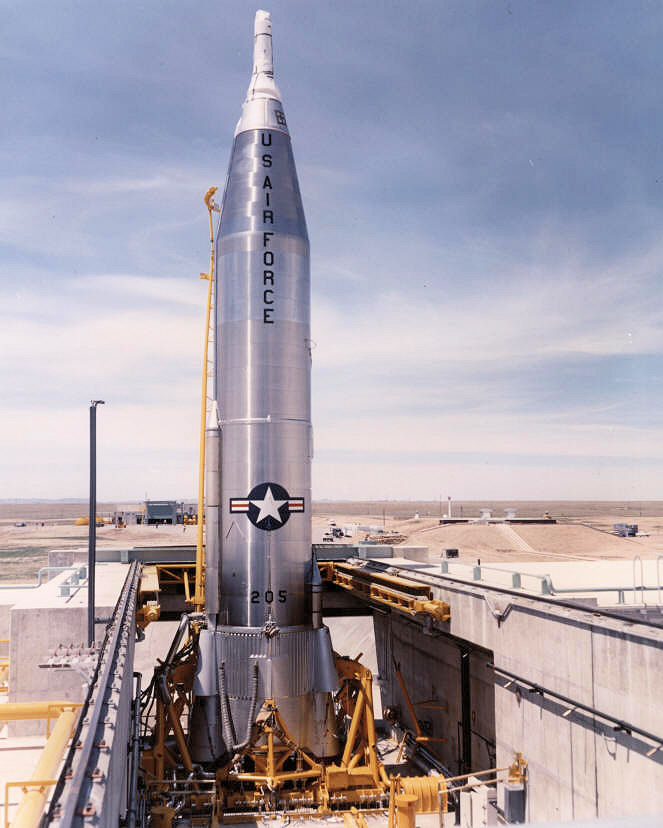
Atlas D
In-activeConvair ()
April 14, 1959
Description
The SM-65D Atlas, or Atlas D, was the first operational version of the U.S. Atlas missile. Atlas D was first used as an intercontinental ballistic missile (ICBM) to deliver a nuclear weapon payload on a suborbital trajectory. It was later developed as a launch vehicle to carry a payload to low Earth orbit on its own, and later to geosynchronous orbit, to the Moon, Venus, or Mars with the Agena or Centaur upper stage.
Specifications
-
Stages
1 -
Length
25.15 m -
Diameter
3.0 m -
Fairing Diameter
3.0 m -
Launch Mass
119.0 T -
Thrust
1880.0 kN
Family
-
Name
Atlas D -
Family
― -
Variant
D -
Alias
― -
Full Name
SM-65D Atlas
Payload Capacity
-
Launch Cost
― -
Low Earth Orbit
1400.0 kg -
Geostationary Transfer
Orbit
― -
Direct Geostationary
― -
Sun-Synchronous Capacity
―
Convair
Commercial
None
1943Convair, previously Consolidated Vultee, was an American aircraft manufacturing company that later expanded into rockets and spacecraft. The company was formed in 1943 by the merger of Consolidated Aircraft and Vultee Aircraft. In 1953 it was purchased by General Dynamics, and operated as their Convair Division for most of its corporate history.
Atlas D | OV1-11,12,86
Convair | United States of AmericaVandenberg SFB, CA, USA
July 27, 1967, 7 p.m.
Atlas D | OV1-9 & 10
Convair | United States of AmericaVandenberg SFB, CA, USA
Dec. 11, 1966, 9:09 p.m.
Atlas D | OV1-7
Convair | United States of AmericaVandenberg SFB, CA, USA
July 14, 1966, 2:10 a.m.
Atlas D | OV1-4 & 5
Convair | United States of AmericaVandenberg SFB, CA, USA
March 30, 1966, 9:20 a.m.
Atlas D | OV1-2
Convair | United States of AmericaVandenberg SFB, CA, USA
Oct. 5, 1965, 9:07 a.m.
Atlas D | OV1-3
Convair | United States of AmericaVandenberg SFB, CA, USA
May 28, 1965, 2:54 a.m.
Atlas D | FIRE 2
Convair | United States of AmericaCape Canaveral SFS, FL, USA
May 22, 1965, 9:55 p.m.
Status: Launch Successful
Mission:
FIRE (Flight Investigation of Re-Entry) was a high-speed reentry heat research program to obtain data on materials, heating rates, and radio signal attenuation on spacecraft reentering the atmosphere at speeds of about 24,500 miles per hour.
SuborbitalAtlas D | OV1-1
Convair | United States of AmericaVandenberg SFB, CA, USA
Jan. 21, 1965, 9:34 p.m.
Atlas D | FIRE 1
Convair | United States of AmericaCape Canaveral SFS, FL, USA
April 14, 1964, 9:42 p.m.
Status: Launch Successful
Mission:
FIRE (Flight Investigation of Re-Entry) was a high-speed reentry heat research program to obtain data on materials, heating rates, and radio signal attenuation on spacecraft reentering the atmosphere at speeds of about 24,500 miles per hour.
SuborbitalFalcon 9
NROL-95
Space Launch Complex 40 - Cape Canaveral SFS, FL, USAClassified payload for the US National Reconnaissance Office.
Long March 6A
TJSW-27A & B
Launch Complex 9A - Taiyuan Satellite Launch Center, People's Republic of China2 Chinese classified satellites claimed to be for communication technology test purposes. Actual mission not known.
Long March 7A
Tianlian 3-01
201 - Wenchang Space Launch Site, People's Republic of ChinaTianlian is a Chinese data tracking and relay communications geostationary satellite series. The TL-3 (Tian Lian 3) satellites are the 3rd generation…
Falcon 9
Starlink Group 17-51
Space Launch Complex 4E - Vandenberg SFB, CA, USAA batch of 24 satellites for the Starlink mega-constellation - SpaceX's project for space-based Internet communication system.
Starship
Flight 13
Orbital Launch Pad 2 - SpaceX Starbase, TX, USA13th test flight of the two-stage Starship launch vehicle. Second flight of Starship V3. For the first time, Starship will carry 20 V3 Starlink sa…

