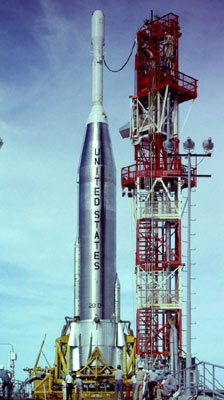
Atlas-Able
In-activeConvair ()
Nov. 26, 1959
Description
The Atlas-Able was an American expendable launch system derived from the SM-65 Atlas missile. It was a member of the Atlas family of rockets, and was used to launch several Pioneer spacecraft towards the Moon. Of the five Atlas-Able rockets built, two failed during static firings, and the other three failed to reach orbit.
Specifications
-
Stages
3 -
Length
35.0 m -
Diameter
3.05 m -
Fairing Diameter
3.05 m -
Launch Mass
120.0 T -
Thrust
1587.0 kN
Family
-
Name
Atlas-Able -
Family
― -
Variant
― -
Alias
― -
Full Name
Atlas-Able
Payload Capacity
-
Launch Cost
― -
Low Earth Orbit
― -
Geostationary Transfer
Orbit
250.0 kg -
Direct Geostationary
― -
Sun-Synchronous Capacity
―
Convair
Commercial
None
1943Convair, previously Consolidated Vultee, was an American aircraft manufacturing company that later expanded into rockets and spacecraft. The company was formed in 1943 by the merger of Consolidated Aircraft and Vultee Aircraft. In 1953 it was purchased by General Dynamics, and operated as their Convair Division for most of its corporate history.
Atlas-Able | P-31
Convair | United States of AmericaCape Canaveral SFS, FL, USA
Atlas-Able | P-30 (Able VA)
Convair | United States of AmericaCape Canaveral SFS, FL, USA
Atlas-Able | P-3
Convair | United States of AmericaCape Canaveral SFS, FL, USA
Status: Launch Failure
Mission:
The Pioneer P-1, -3, -30 and -31 series was intended to be a lunar orbiter probe, but the mission failed shortly after launch. The objectives were to place a highly instrumented probe in lunar orbit, to investigate the environment between the Earth and Moon, and to develop technology for controlling and maneuvering spacecraft from Earth.
Lunar OrbitLong March 2D
PIESAT-2 13-16
Launch Complex 9 - Taiyuan Satellite Launch Center, People's Republic of China4 X-band synthetic-aperture radar Earth observation satellites for the Chinese Earth observation satellite company PIESAT.
Electron
Owl By The Dozen (StriX Launch 12)
Rocket Lab Launch Complex 1B - Rocket Lab Launch Complex 1, Mahia Peninsula, New ZealandSynthetic aperture radar satellite for Japanese Earth imaging company Synspective.
Soyuz 2.1b/Fregat-M
Glonass-K1 No. 20 (?)
43/3 (43L) - Plesetsk Cosmodrome, Russian FederationNote: Satellite serial number and Cosmos designation not confirmed. Glonass-K are the third generation of satellite design for GLONASS satellite n…
Kuaizhou 11
SpaceTY-51 & 52
Launch Area 95A - Jiuquan Satellite Launch Center, People's Republic of China2 Earth observation radar satellites built by the Chinese satellite manufacturer SpaceTY.
Falcon 9
USSF-259
Space Launch Complex 4E - Vandenberg SFB, CA, USAUSSF-259 is a classified mission for the United States Space Force. It is possibly a batch of classified LEO satellites based on SpaceX’s Starshield …

