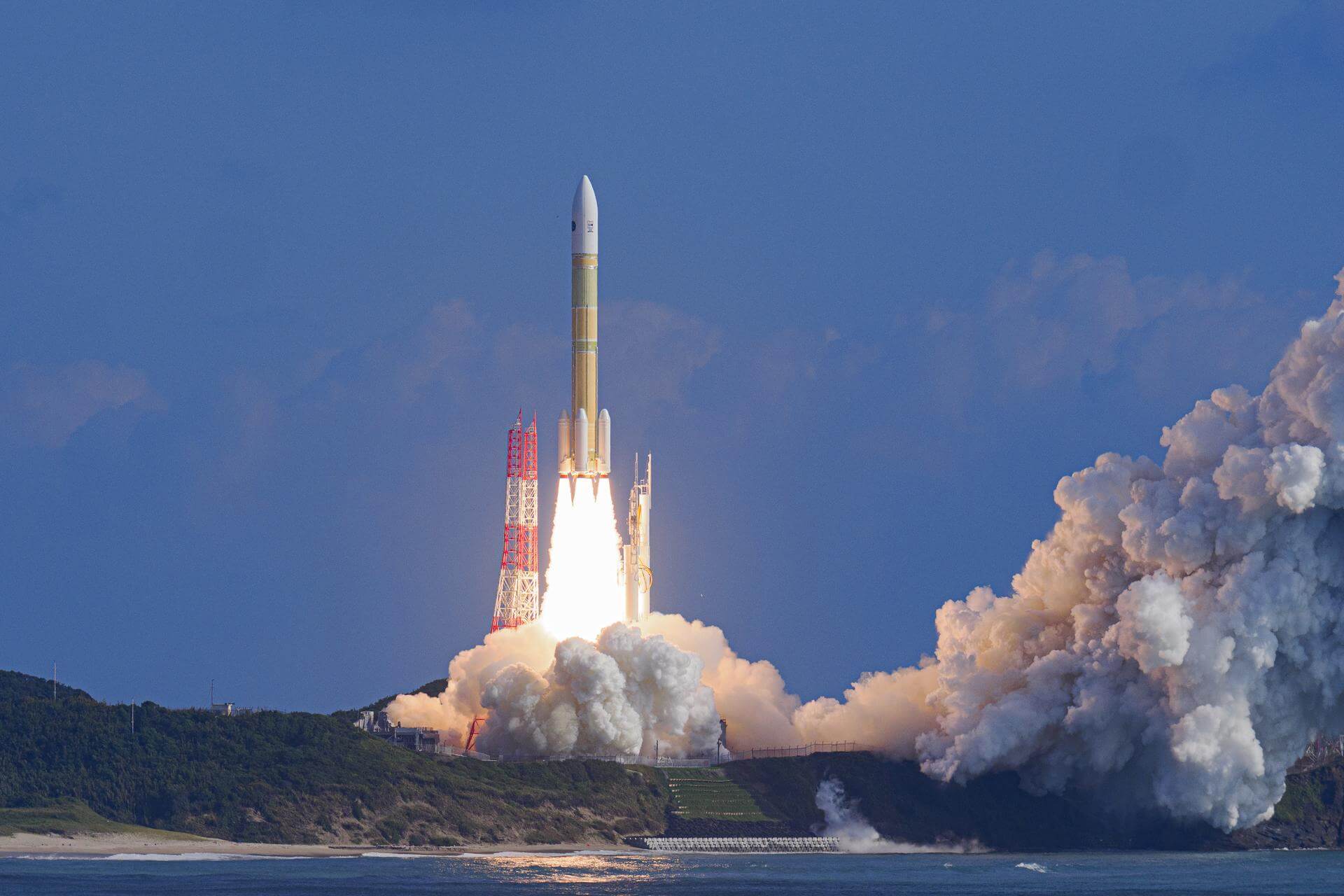
H3-24
ActiveMitsubishi Heavy Industries (MHI)
Oct. 26, 2025
Description
The H3 Launch Vehicle is an expendable launch system in development in Japan. Each H3 booster configuration has a two-digit and a letter designation that indicates the features of that configuration. The first digit represents the number of LE-9 engines on the main stage, either "2" or "3". The second digit indicates the number of SRB-3 solid rocket boosters attached to the base of the rocket, and can be "0", "2" or "4". All layouts of solid boosters are symmetrical. The letter in the end shows the length of the payload fairing, either short "S" or long "L". For example, an H3-24L has two engines, four solid rocket boosters, and a long fairing, whereas an H3-30S has three engines, no solid rocket boosters, and a short fairing.
Specifications
-
Stages
2 -
Length
63.0 m -
Diameter
5.27 m -
Fairing Diameter
5.27 m -
Launch Mass
― -
Thrust
12142.0 kN
Family
-
Name
H3-24 -
Family
― -
Variant
24 -
Alias
― -
Full Name
H3-24
Payload Capacity
-
Launch Cost
$50000000 -
Low Earth Orbit
― -
Geostationary Transfer
Orbit
7900.0 kg -
Direct Geostationary
― -
Sun-Synchronous Capacity
―
Mitsubishi Heavy Industries
Commercial
President: Seiji Izumisawa
MHI 1884Mitsubishi Heavy Industries, Ltd. is a Japanese multinational engineering, electrical equipment and electronics company headquartered in Tokyo, Japan. MHI is one of the core companies of the Mitsubishi Group. MHI's products include aerospace components, air conditioners, aircraft, automotive components, forklift trucks, hydraulic equipment, machine tools, missiles, power generation equipment, printing machines, ships and space launch vehicles. Through its defense-related activities, it is the world's 23rd-largest defense contractor measured by 2011 defense revenues and the largest based in Japan.
Upcoming Spaceflights
H3-24 | Martian Moon eXplorer (MMX)
Mitsubishi Heavy Industries | JapanTanegashima Space Center, Japan
H3-24 | Lunar Polar Exploration Mission (LUPEX)
Mitsubishi Heavy Industries | JapanTanegashima Space Center, Japan
Status: To Be Determined
Mission:
The Lunar Polar Exploration mission (LUPEX) is a robotic lunar mission jointly developed by the Indian Space Research Organisation (ISRO) and Japan Aerospace Exploration Agency (JAXA), deploying a lunar rover and lander to explore the south pole region of the Moon. JAXA will provide the under-development H3 launch vehicle and the rover, while ISRO would be responsible for the lander.
Lunar OrbitH3-24 | HTV-X3
Mitsubishi Heavy Industries | JapanTanegashima Space Center, Japan
H3-24 | HTV-X2
Mitsubishi Heavy Industries | JapanTanegashima Space Center, Japan
H3-24 | DESTINY+ & RAMSES
Mitsubishi Heavy Industries | JapanTanegashima Space Center, Japan
Status: To Be Determined
Mission:
DESTINY+ (Demonstration and Experiment of Space Technology for INterplanetary voYage with Phaethon fLyby and dUst Science) is a planned asteroid exploration mission to 3200 Phaethon, the parent body of the Geminids meteor shower. It will demonstrate further improvements of low cost solar electric propulsion in deep space and innovative light-weight solar array panel technology. The spacecraft will carry 3 science instruments: * DESTINY Dust Analyzer (DDA) * Telescopic Camera for Phaethon (TCAP) * Multiband Camera for Phaethon (MCAP) RAMSES (Rapid Apophis Mission for Space Safety) is a European-Japanese planetary defense mission to near-Earth asteroid 99942 Apophis, led by the European Space Agency (ESA). The spacecraft will arrive around Apophis in February 2029, before the asteroid’s very close fly-by to Earth on 13 April 2029. It will conduct measurements of the asteroid's properties before and during the Earth flyby to study its response to the close encounter with the planet. The spacecraft will leverage much of the technology developed for the Hera mission. At the asteroid, RAMSES will deploy two smaller CubeSats, one carrying a dust analyser, a low-frequency radar, the other will attempt to land on Apophis and provide high-resolution images from the surface.
AsteroidLong March 2D
PIESAT-2 13-16
Launch Complex 9 - Taiyuan Satellite Launch Center, People's Republic of China4 X-band synthetic-aperture radar Earth observation satellites for the Chinese Earth observation satellite company PIESAT.
Electron
Owl By The Dozen (StriX Launch 12)
Rocket Lab Launch Complex 1B - Rocket Lab Launch Complex 1, Mahia Peninsula, New ZealandSynthetic aperture radar satellite for Japanese Earth imaging company Synspective.
Soyuz 2.1b/Fregat-M
Glonass-K1 No. 20 (?)
43/3 (43L) - Plesetsk Cosmodrome, Russian FederationNote: Satellite serial number and Cosmos designation not confirmed. Glonass-K are the third generation of satellite design for GLONASS satellite n…
Kuaizhou 11
SpaceTY-51 & 52
Launch Area 95A - Jiuquan Satellite Launch Center, People's Republic of China2 Earth observation radar satellites built by the Chinese satellite manufacturer SpaceTY.
Falcon 9
USSF-259
Space Launch Complex 4E - Vandenberg SFB, CA, USAUSSF-259 is a classified mission for the United States Space Force. It is possibly a batch of classified LEO satellites based on SpaceX’s Starshield …

