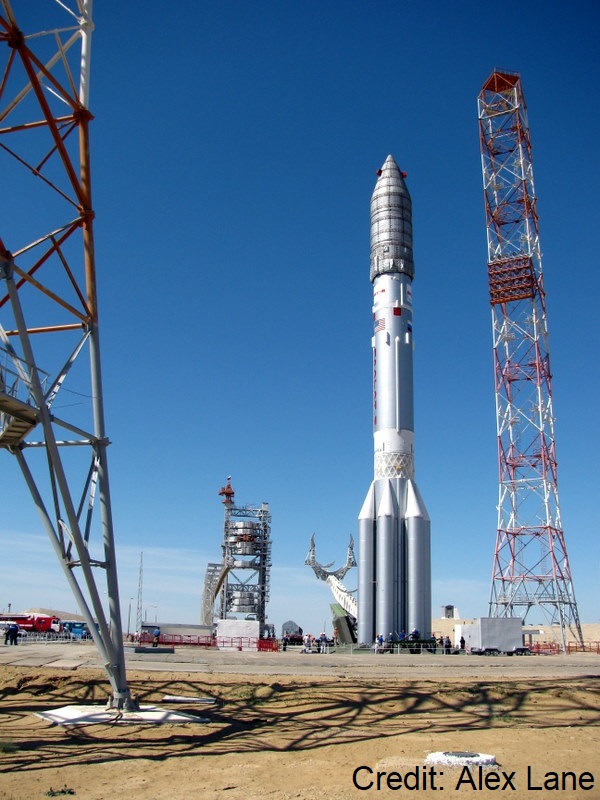
Proton-M
ActiveKhrunichev State Research and Production Space Center (KhSC)
April 7, 2001
Description
Proton-M is a three stage Russian heavy lift launch vehicle derived from the Soviet Proton launch vehicle. Image Credit: Alex Lane
Specifications
-
Stages
3 -
Length
58.2 m -
Diameter
7.4 m -
Fairing Diameter
4.35 m -
Launch Mass
705.0 T -
Thrust
10532.0 kN
Family
-
Name
Proton-M -
Family
― -
Variant
― -
Alias
― -
Full Name
Proton-M
Payload Capacity
-
Launch Cost
$65000000 -
Low Earth Orbit
23000.0 kg -
Geostationary Transfer
Orbit
6920.0 kg -
Direct Geostationary
3250.0 kg -
Sun-Synchronous Capacity
―
Khrunichev State Research and Production Space Center
Government
Director: Andrey Vladimirovich Kalinovskiy
KhSC 1916Khrunichev State Research and Production Space Center is a Moscow-based producer of spacecraft and space-launch systems, including the Proton and Rokot rockets and is currently developing the Angara rocket family. The Proton launch vehicle launches from Baikonur and Rokot launches from Baikonur and Plesetsk. Angara will launch from Plesetsk and Vostochny.
Proton-M | MLM Nauka
Khrunichev State Research and Production Space Center | RussiaBaikonur Cosmodrome, Republic of Kazakhstan
Status: Launch Successful
Mission:
Nauka (which means "Science" in Russian), also known as Multipurpose Laboratory Module (MLM), is a new module of the russian segment of the ISS. It will dock at Zvezda's nadir port, replacing the Pirs module occupying it since September 2001. The Nauka module is designed to be used for experiments, docking and cargo as well as serve as a crew work and rest area. It is equipped with full guidance and navigation control including engines and an attitude control system that can be used as a backup by the ISS. The Nauka module also brings the European Robotic Arm, for which a spare elbow joint was already launched in 2010, to the orbital laboratory.
Low Earth OrbitLong March 2D
PIESAT-2 13-16
Launch Complex 9 - Taiyuan Satellite Launch Center, People's Republic of China4 X-band synthetic-aperture radar Earth observation satellites for the Chinese Earth observation satellite company PIESAT.
Electron
Owl By The Dozen (StriX Launch 12)
Rocket Lab Launch Complex 1B - Rocket Lab Launch Complex 1, Mahia Peninsula, New ZealandSynthetic aperture radar satellite for Japanese Earth imaging company Synspective.
Soyuz 2.1b/Fregat-M
Glonass-K1 No. 20 (?)
43/3 (43L) - Plesetsk Cosmodrome, Russian FederationNote: Satellite serial number and Cosmos designation not confirmed. Glonass-K are the third generation of satellite design for GLONASS satellite n…
Kuaizhou 11
SpaceTY-51 & 52
Launch Area 95A - Jiuquan Satellite Launch Center, People's Republic of China2 Earth observation radar satellites built by the Chinese satellite manufacturer SpaceTY.
Falcon 9
USSF-259
Space Launch Complex 4E - Vandenberg SFB, CA, USAUSSF-259 is a classified mission for the United States Space Force. It is possibly a batch of classified LEO satellites based on SpaceX’s Starshield …

