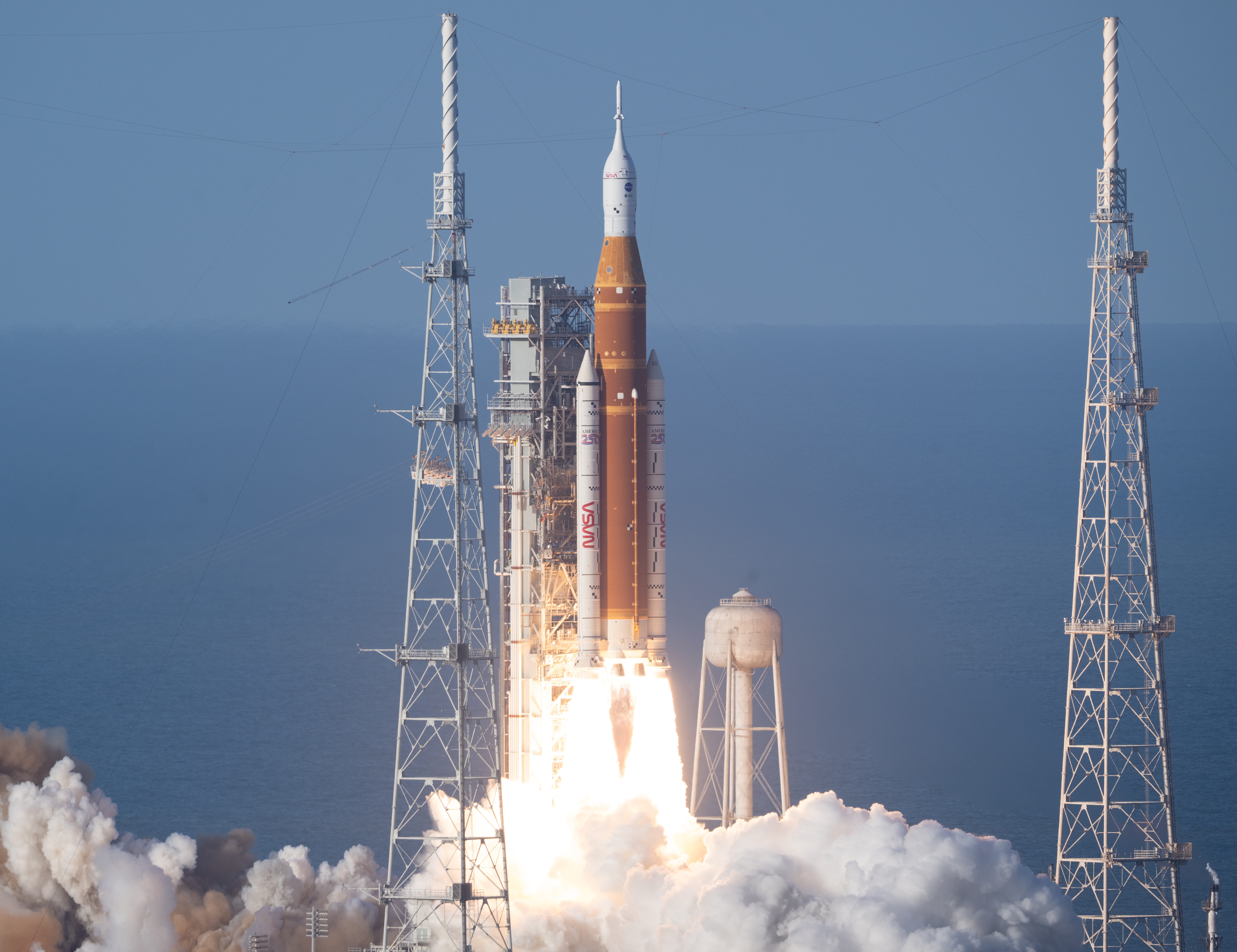
Space Launch System (SLS)
ActiveNational Aeronautics and Space Administration (NASA)
Nov. 16, 2022
Description
The Space Launch System (SLS) is an American Space Shuttle-derived heavy expendable launch vehicle. It is part of NASA's deep space exploration plans including as the main launch vehicle of the Artemis program. SLS follows the cancellation of the Constellation program, and is to replace the retired Space Shuttle.
Specifications
-
Stages
2 -
Length
98.0 m -
Diameter
8.4 m -
Fairing Diameter
8.4 m -
Launch Mass
2628.0 T -
Thrust
39000.0 kN
Family
-
Name
Space Launch System (SLS) -
Family
― -
Variant
Block 1 -
Alias
― -
Full Name
Space Launch System Block 1
Payload Capacity
-
Launch Cost
$2000000000 -
Low Earth Orbit
95000.0 kg -
Geostationary Transfer
Orbit
― -
Direct Geostationary
― -
Sun-Synchronous Capacity
―
National Aeronautics and Space Administration
Government
Administrator: Jared Isaacman
NASA 1958The National Aeronautics and Space Administration is an independent agency of the executive branch of the United States federal government responsible for the civilian space program, as well as aeronautics and aerospace research. NASA have many launch facilities but most are inactive. The most commonly used pad will be LC-39B at Kennedy Space Center in Florida.
Upcoming Spaceflights
SLS Block 1 | Artemis III
National Aeronautics and Space Administration | United States of AmericaKennedy Space Center, FL, USA
Status: To Be Determined
Mission:
Artemis III is the second crew mission as part of the Artemis program. Artemis III will send a crew of 4 on a Low Earth Orbit mission, with the Orion rendezvous and dock with one or both commercial lunar landers in development by SpaceX and Blue Origin, performing in-space tests of the docked vehicles, integrated checkout of life support, communications, and propulsion systems, as well as tests of the new Extravehicular Activity (xEVA) suits.
Low Earth OrbitSLS Block 1 | Artemis II
National Aeronautics and Space Administration | United States of AmericaKennedy Space Center, FL, USA
Status: Launch Successful
Mission:
Artemis II is the first crewed mission as part of the Artemis program. Artemis II will send a crew of 4 - 3 Americans and 1 Canadian around the moon and return them back to Earth. The mission will test the core systems of NASA's Orion spacecraft including the critical life support system, among other systems which could not be tested during Artemis I due to the lack of crew onboard.
Lunar flybySLS Block 1 | Artemis I
National Aeronautics and Space Administration | United States of AmericaKennedy Space Center, FL, USA
Kinetica 1
9 satellites
Launch Area 130 - Jiuquan Satellite Launch Center, People's Republic of ChinaShare-ride of 9 commercial Earth observation and technology demonstration satellites to SSO, details TBD.
Falcon 9
Starlink Group 15-27
Space Launch Complex 4E - Vandenberg SFB, CA, USAA batch of 27 satellites for the Starlink mega-constellation - SpaceX's project for space-based Internet communication system.
Long March 2D
PIESAT-2 13-16
Launch Complex 9 - Taiyuan Satellite Launch Center, People's Republic of China4 X-band synthetic-aperture radar Earth observation satellites for the Chinese Earth observation satellite company PIESAT.
Electron
Owl By The Dozen (StriX Launch 12)
Rocket Lab Launch Complex 1B - Rocket Lab Launch Complex 1, Mahia Peninsula, New ZealandSynthetic aperture radar satellite for Japanese Earth imaging company Synspective.
Soyuz 2.1b/Fregat-M
Glonass-K1 No. 20 (?)
43/3 (43L) - Plesetsk Cosmodrome, Russian FederationNote: Satellite serial number and Cosmos designation not confirmed. Glonass-K are the third generation of satellite design for GLONASS satellite n…

