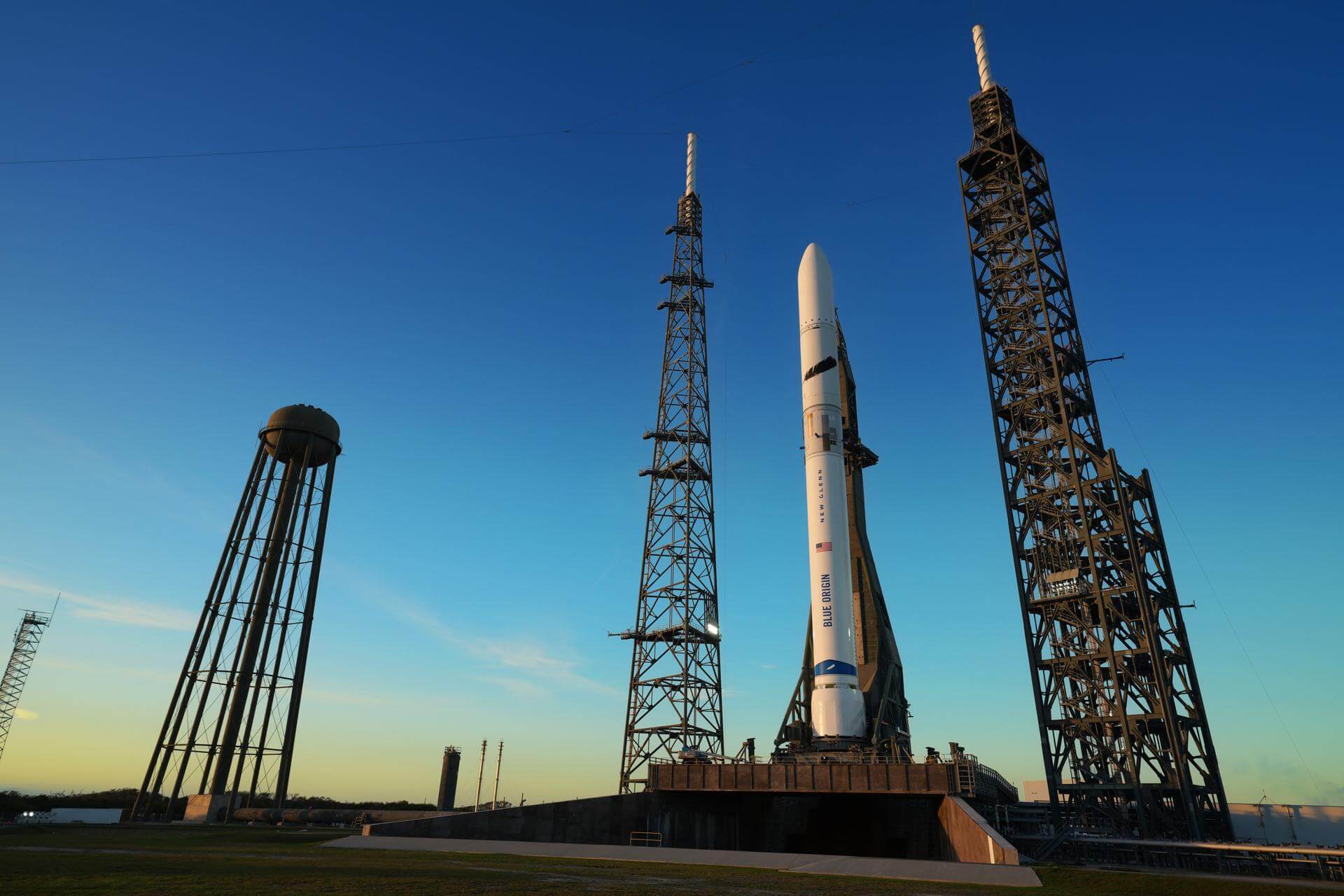
New Glenn
Active Re-UsableBlue Origin (BO)
Jan. 16, 2025
Description
The New Glenn is a privately funded orbital launch vehicle in development by Blue Origin. New Glenn is described as a 7-meter-diameter (23 ft), two- or three-stage rocket.
Specifications
-
Stages
2 -
Length
98.0 m -
Diameter
7.0 m -
Fairing Diameter
7.0 m -
Launch Mass
― -
Thrust
17126.0 kN
Family
-
Name
New Glenn -
Family
― -
Variant
― -
Alias
― -
Full Name
New Glenn
Payload Capacity
-
Launch Cost
― -
Low Earth Orbit
45000.0 kg -
Geostationary Transfer
Orbit
13000.0 kg -
Direct Geostationary
― -
Sun-Synchronous Capacity
―
Blue Origin
Commercial
CEO: Jeff Bezos
BO 2000Blue Origin is an American privately funded aerospace manufacturer and spaceflight services company set up by Amazon.com founder Jeff Bezos with its headquarters in Kent, Washington. The company is developing technologies to enable private human access to space with the goal to dramatically lower costs and increase reliability. Blue Origin currently launches its New Shepard sub-orbital vehicle from its West Texas launch site, they are currently constructing a launch pad for their orbital vehicle New Glenn at Cape Canaveral LC-36.
Upcoming Spaceflights
New Glenn | Amazon Leo (LN-01)
Blue Origin | United States of AmericaCape Canaveral SFS, FL, USA
Status: To Be Determined
Mission:
Amazon Leo, formerly known as Project Kuiper, is a mega constellation of satellites in Low Earth Orbit that will offer broadband internet access, this constellation will be managed by Kuiper Systems LLC, a subsidiary of Amazon. This constellation is planned to be composed of 3,276 satellites. The satellites are projected to be placed in 98 orbital planes in three orbital layers, one at 590 km, 610 km and 630 km altitude. 48 satellites will be carried on this New Glenn launch.
Low Earth Orbit Unknown NG - Maiden Flight JacklynNew Glenn | BlueBird Block 2
Blue Origin | United States of AmericaCape Canaveral SFS, FL, USA
Status: To Be Determined
Mission:
AST SpaceMobile’s Block 2 BlueBird satellites are designed to deliver up to 10 times the bandwidth capacity of the BlueBird Block 1 satellites, required to achieve 24/7 continuous cellular broadband service coverage in the United States, with beams designed to support a capacity of up to 40 MHz, enabling peak data transmission speeds up to 120 Mbps, supporting voice, full data and video applications. The Block 2 BlueBirds, featuring as large as 2400 square foot communications arrays, will be the largest satellites ever commercially deployed in Low Earth orbit once launched. This launch will feature 8 satellites.
Low Earth OrbitNew Glenn | Blue Moon Pathfinder
Blue Origin | United States of AmericaCape Canaveral SFS, FL, USA
New Glenn | Blue Origin HLS LEO Demo
Blue Origin | United States of AmericaCape Canaveral SFS, FL, USA
Status: To Be Determined
Mission:
The Blue Moon HLS pathfinder spacecraft in support of NASA's Artemis III mission in Low Earth Orbit will be a modified Blue Moon Mark 1 vehicle equipped with a docking mechanism, a crew cabin and environmental control systems on board. This Blue Moon HLS will launch before the Artemis III Orion has launched into LEO aboard SLS. Once docked, Orion and Blue Moon will spend about two days docked together for tests and technology demonstrations, with the Artemis III crew scheduled to enter the lander.
Low Earth OrbitNew Glenn | Blue Moon Pathfinder Mission 2 & VIPER
Blue Origin | United States of AmericaCape Canaveral SFS, FL, USA
Status: To Be Determined
Mission:
2nd of the National Team’s Blue Moon MK1 lunar lander test missions to validate the necessary technologies for its HLS lunar module. Some of the life support hardware will travel on this mission in preparation for the first crew Blue Moon flight. This mission will also carry NASA’s VIPER (Volatiles Investigating Polar Exploration Rover) lunar rover. VIPER is designed to explore the relatively nearby but extreme environment of the Moon in search of ice and other potential resources. This mobile robot will land at the South Pole of the Moon on a 100-day mission, in order to teach us about the origin and distribution of water on the Moon and help determine how we can harvest the Moon's resources for future human space exploration. VIPER is designed to roam the Moon using its three instruments and a 1 meter long drill to detect and analyze various lunar soil environments at a range of depths and temperatures. The rover can venture into permanently shadowed craters, some of the coldest spots in the solar system, where ice reserves have endured for billions of years. The rover was originally slated to launch on Astrobotic’s Griffin Mission One lunar lander (with the Falcon Heavy rocket), but the VIPER mission was cancelled in July 2024 due to budget cuts. After consulting with the industry to find alternative ways to deliver the rover to the lunar surface, NASA ultimately chose to launch it with Blue Origin’s 2nd Blue Moon MK1 lander mission.
Low Earth OrbitNew Glenn | Mars Telecommunications Orbiter
Blue Origin | United States of AmericaCape Canaveral SFS, FL, USA
Status: To Be Determined
Mission:
The Mars Telecommunications Orbiter (MTO) will provide a future dedicated high-speed communications relay network for continuous coverage between Earth and Mars for future NASA and cooperating partners’ Mars science missions, with the flexibility to meet future Mars science and exploration needs. It will replace multiple communication relay units installed on existing Mars science orbiters. Blue Origin will design, develop, integrate, launch, and operate the spacecraft and network. The MTO is based on Blue Origin’s Blue Ring satellite bus.
Mars Orbit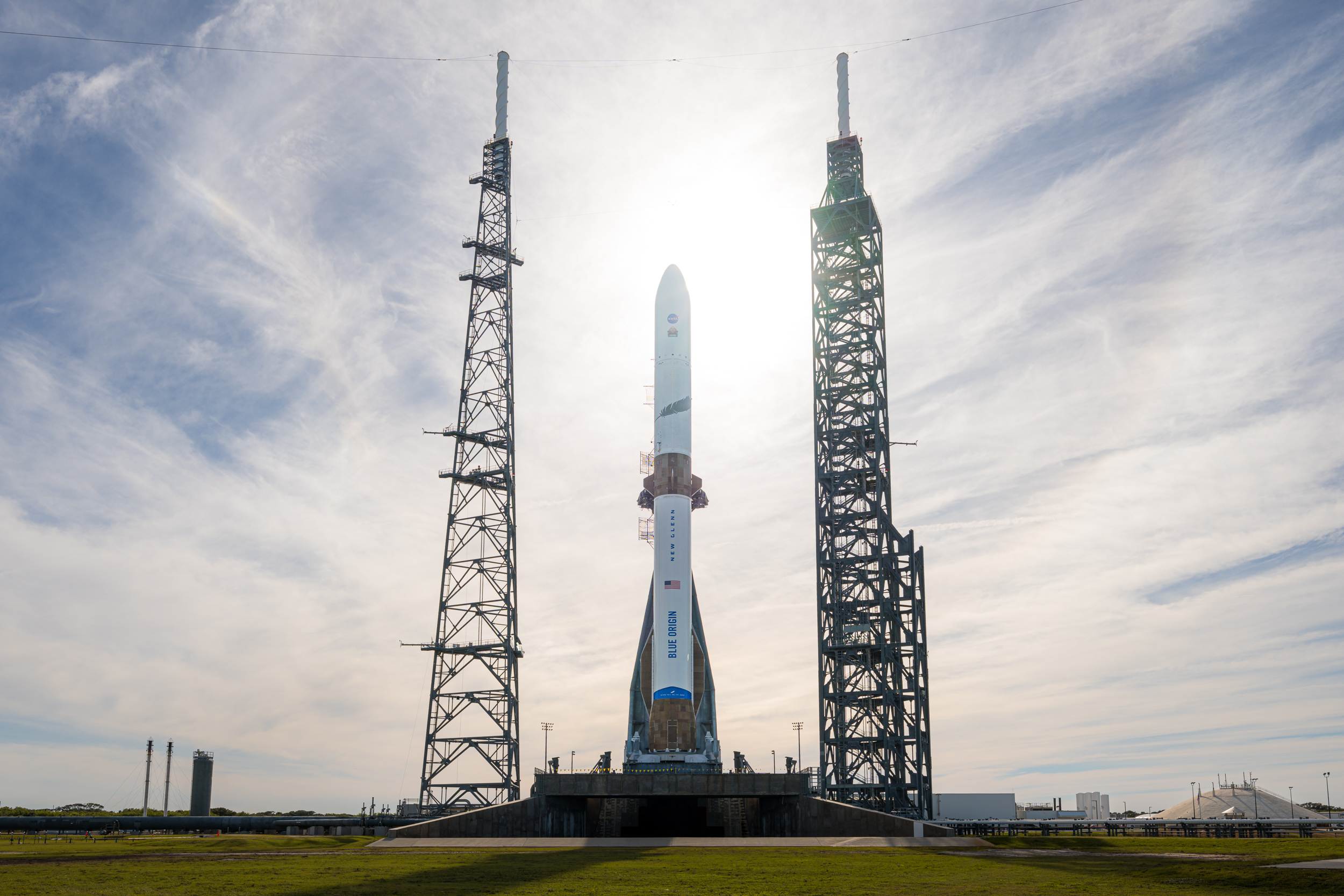
New Glenn | BlueBird 7 (Block 2 #2)
Blue Origin | United States of AmericaCape Canaveral SFS, FL, USA
Status: Launch Failure
Mission:
AST SpaceMobile’s Block 2 BlueBird satellites are designed to deliver up to 10 times the bandwidth capacity of the BlueBird Block 1 satellites, required to achieve 24/7 continuous cellular broadband service coverage in the United States, with beams designed to support a capacity of up to 40 MHz, enabling peak data transmission speeds up to 120 Mbps, supporting voice, full data and video applications. The Block 2 BlueBirds, featuring as large as 2400 square foot communications arrays, will be the largest satellites ever commercially deployed in Low Earth orbit once launched. This launch will feature 1 satellite, BlueBird 7/BlueBird Block 2 FM2.
Low Earth Orbit NG-3 GS1-SN002 - Flight Proven ( ) JacklynNew Glenn | EscaPADE
Blue Origin | United States of AmericaCape Canaveral SFS, FL, USA
Status: Launch Successful
Mission:
Second flight of Blue Origin's New Glenn launch vehicle carrying the Escape and Plasma Acceleration and Dynamics Explorers (EscaPADE), a dual-spacecraft mission from University of California, Berkeley to study ion and sputtered escape from Mars. The spacecrafts' scientific goals are to understand the processes controlling the structure of Mars' hybrid magnetosphere and how it guides ion flows; understand how energy and momentum are transported from the solar wind through Mars' magnetosphere; and understand the processes controlling the flow of energy and matter into and out of the collisional atmosphere.
Mars Orbit GS1-SN002 - Maiden Flight Jacklyn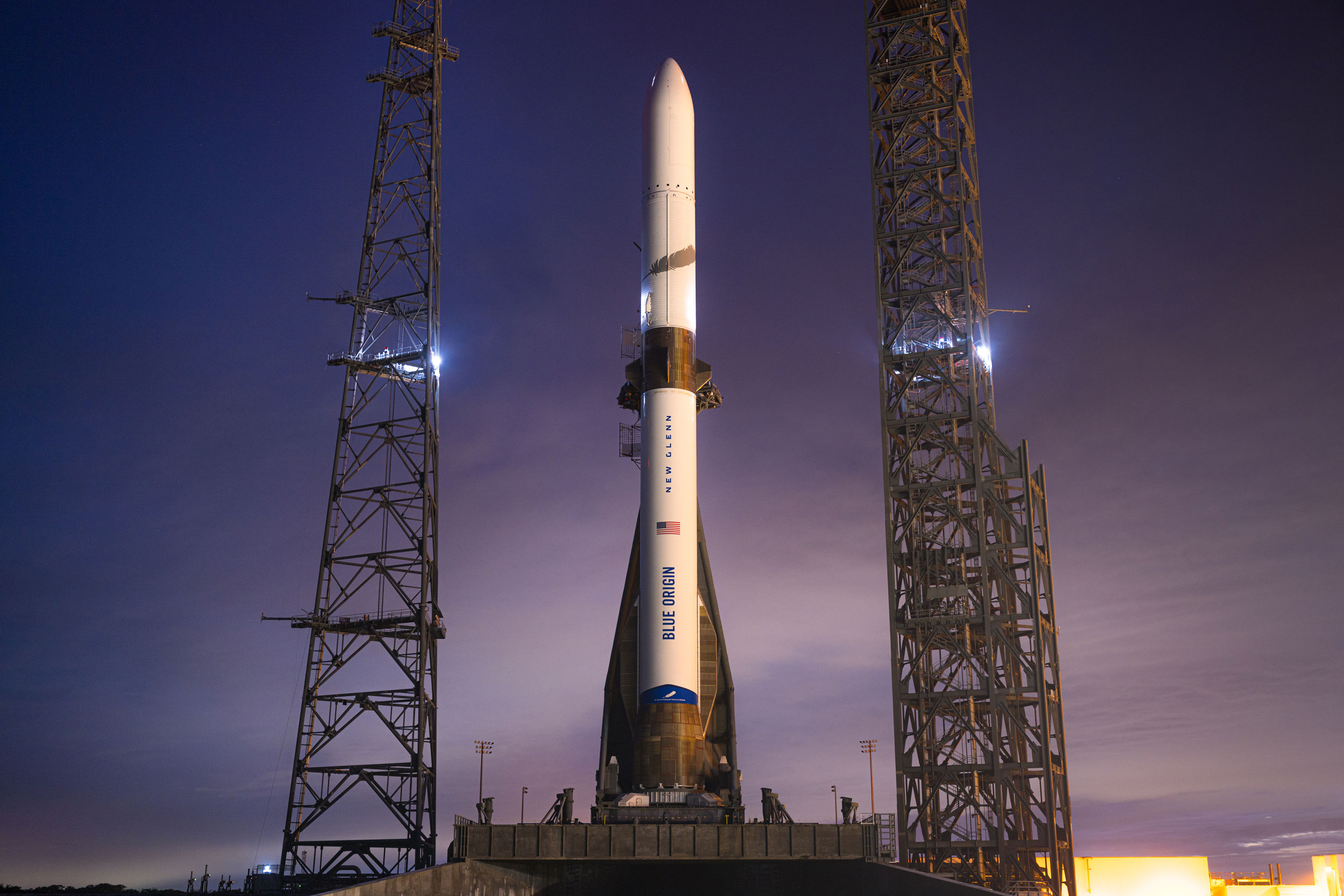
New Glenn | Maiden Flight
Blue Origin | United States of AmericaCape Canaveral SFS, FL, USA
Status: Launch Successful
Mission:
Maiden flight of the New Glenn launch vehicle. Will carry the prototype Blue Ring payload tug and payload hoisting platform, consisting of communications array, power systems, and a flight computer affixed to a secondary payload adapter ring, remaining attached to the 2nd stage. This launch will serve as New Glenn's first National Security Space Launch certification flight. Target orbit is 2400 x 19300 km at 30° inclination.
Medium Earth Orbit GS1-SN001 - Maiden Flight JacklynLong March 2D
PIESAT-2 13-16
Launch Complex 9 - Taiyuan Satellite Launch Center, People's Republic of China4 X-band synthetic-aperture radar Earth observation satellites for the Chinese Earth observation satellite company PIESAT.
Electron
Owl By The Dozen (StriX Launch 12)
Rocket Lab Launch Complex 1B - Rocket Lab Launch Complex 1, Mahia Peninsula, New ZealandSynthetic aperture radar satellite for Japanese Earth imaging company Synspective.
Soyuz 2.1b/Fregat-M
Glonass-K1 No. 20 (?)
43/3 (43L) - Plesetsk Cosmodrome, Russian FederationNote: Satellite serial number and Cosmos designation not confirmed. Glonass-K are the third generation of satellite design for GLONASS satellite n…
Kuaizhou 11
SpaceTY-51 & 52
Launch Area 95A - Jiuquan Satellite Launch Center, People's Republic of China2 Earth observation radar satellites built by the Chinese satellite manufacturer SpaceTY.
Falcon 9
USSF-259
Space Launch Complex 4E - Vandenberg SFB, CA, USAUSSF-259 is a classified mission for the United States Space Force. It is possibly a batch of classified LEO satellites based on SpaceX’s Starshield …

