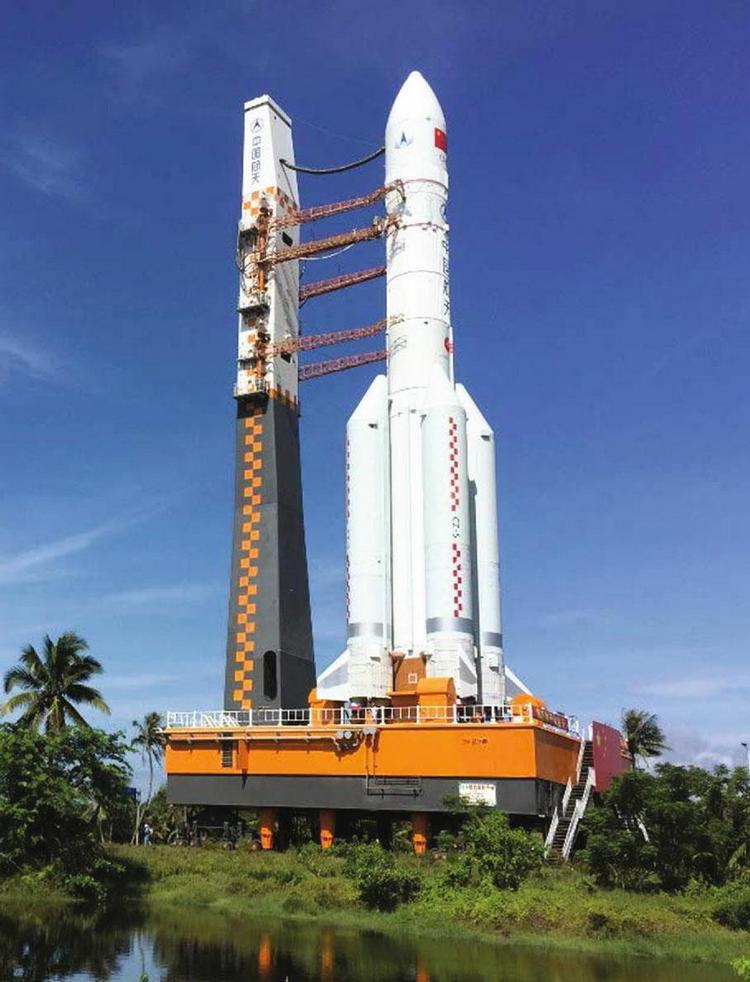
Long March 5/YZ-2
ActiveChina Aerospace Science and Technology Corporation (CASC)
Nov. 3, 2016
Description
Specifications
-
Length
― -
Diameter
― -
Fairing Diameter
― -
Launch Mass
― -
Thrust
―
Family
-
Name
Long March 5/YZ-2 -
Family
― -
Variant
YZ-2 -
Alias
― -
Full Name
Long March 5/YZ-2
Payload Capacity
-
Launch Cost
― -
Low Earth Orbit
― -
Geostationary Transfer
Orbit
― -
Direct Geostationary
― -
Sun-Synchronous Capacity
―
China Aerospace Science and Technology Corporation
Government
Chairman & President: Lei Fanpei
CASC 1999The China Aerospace Science and Technology Corporation (CASC) is the main contractor for the Chinese space program. It is state-owned and has a number of subordinate entities which design, develop and manufacture a range of spacecraft, launch vehicles, strategic and tactical missile systems, and ground equipment. It was officially established in July 1999 as part of a Chinese government reform drive, having previously been one part of the former China Aerospace Corporation. Various incarnations of the program date back to 1956.
Long March 5 / YZ-2 | Shijian 18
China Aerospace Science and Technology Corporation | ChinaWenchang Space Launch Site, People's Republic of China
Status: Launch Failure
Mission:
Shijian 18 is a Chinese experimental geostationary satellite based on the new DFH-5 Bus. Reportedly the transmission capacity of the satellite is double that of current Chinese communications satellites, allowing more television channels and clearer programs to be transmitted. The new satellite will also improve internet connectivity and accessibility as well as reduce users' costs.
Geostationary Transfer OrbitLong March 5 / YZ-2 | Shijian 17
China Aerospace Science and Technology Corporation | ChinaWenchang Space Launch Site, People's Republic of China
Status: Launch Successful
Mission:
This will be the maiden flight of the Long March 5, which is China's next-generation heavy-lift space launch system, comparable in performance to the European Ariane 5 and the U.S. Delta IV Heavy. The rocket is powered by RP-1 and Hydrogen, and will be able to place 25 tonnes into low earth orbit. It is carrying Shijian-17, an experimental satellite, reportedly tasked with testing ion propulsion systems for future space station keeping uses.
Geostationary OrbitLong March 2D
PIESAT-2 13-16
Launch Complex 9 - Taiyuan Satellite Launch Center, People's Republic of China4 X-band synthetic-aperture radar Earth observation satellites for the Chinese Earth observation satellite company PIESAT.
Electron
Owl By The Dozen (StriX Launch 12)
Rocket Lab Launch Complex 1B - Rocket Lab Launch Complex 1, Mahia Peninsula, New ZealandSynthetic aperture radar satellite for Japanese Earth imaging company Synspective.
Soyuz 2.1b/Fregat-M
Glonass-K1 No. 20 (?)
43/3 (43L) - Plesetsk Cosmodrome, Russian FederationNote: Satellite serial number and Cosmos designation not confirmed. Glonass-K are the third generation of satellite design for GLONASS satellite n…
Kuaizhou 11
SpaceTY-51 & 52
Launch Area 95A - Jiuquan Satellite Launch Center, People's Republic of China2 Earth observation radar satellites built by the Chinese satellite manufacturer SpaceTY.
Falcon 9
USSF-259
Space Launch Complex 4E - Vandenberg SFB, CA, USAUSSF-259 is a classified mission for the United States Space Force. It is possibly a batch of classified LEO satellites based on SpaceX’s Starshield …

