Pegasus
In-activeOrbital Sciences Corporation (OSC)
April 5, 1990
Description
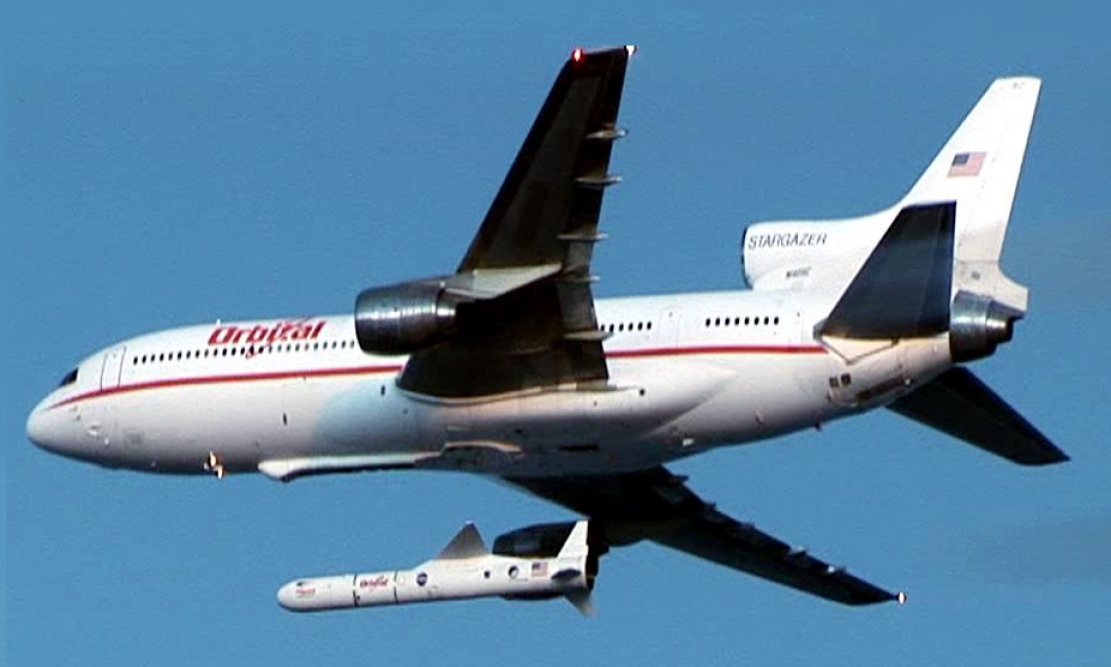
The Pegasus is an air-launched rocket developed by Orbital Sciences Corporation (now part of Northrop Grumman Innovation Systems). Capable of carrying small payloads of up to 443 kilograms (977 lb) into low Earth orbit, the vehicle consists of three solid propellant stages and an optional monopropellant fourth stage. Pegasus is released from its carrier aircraft at approximately 40,000 ft (12,000 m), and its first stage has a wing and a tail to provide lift and attitude control while in the atmosphere.
Specifications
-
Stages
3 -
Length
16.9 m -
Diameter
1.27 m -
Fairing Diameter
― -
Launch Mass
18.0 T -
Thrust
580.0 kN -
Apogee (Sub-Orbital)
4000.0 km
Family
-
Name
Pegasus -
Family
― -
Variant
― -
Alias
― -
Full Name
Pegasus
Payload Capacity
-
Launch Cost
$40000000 -
Low Earth Orbit
443.0 kg -
Geostationary Transfer
Orbit
― -
Direct Geostationary
― -
Sun-Synchronous Capacity
―
Orbital Sciences Corporation
Commercial
None
OSCPegasus | APEX
Orbital Sciences Corporation | United States of AmericaAir launch to orbit
Status: Launch Successful
Mission:
APEX (Advanced Photovoltaic & Electronic Experiment) successfully tested a wide array of advanced photovoltaic and electronic components in a harsh radiation environment, provided significant data to support improved designs for future space systems. During operation, APEX's highly elliptical orbit allowed the investigation of space plasma effects on high-voltage operation (current leakage at positive voltages and arcing at negative voltages) in the perigee region, plus the investigation of space radiation effects (decreased array power output from passage through the inner radiation belt) in the apogee region.
Elliptical OrbitPegasus | Array of Low Energy X-ray Imaging Sensors (ALEXIS)
Orbital Sciences Corporation | United States of AmericaAir launch to orbit
Pegasus | Satélite de Coleta de Dados-1 (SCD-1)
Orbital Sciences Corporation | United States of AmericaAir launch to orbit
Long March 2D
PIESAT-2 13-16
Launch Complex 9 - Taiyuan Satellite Launch Center, People's Republic of China4 X-band synthetic-aperture radar Earth observation satellites for the Chinese Earth observation satellite company PIESAT.
Electron
Owl By The Dozen (StriX Launch 12)
Rocket Lab Launch Complex 1B - Rocket Lab Launch Complex 1, Mahia Peninsula, New ZealandSynthetic aperture radar satellite for Japanese Earth imaging company Synspective.
Soyuz 2.1b/Fregat-M
Glonass-K1 No. 20 (?)
43/3 (43L) - Plesetsk Cosmodrome, Russian FederationNote: Satellite serial number and Cosmos designation not confirmed. Glonass-K are the third generation of satellite design for GLONASS satellite n…
Kuaizhou 11
SpaceTY-51 & 52
Launch Area 95A - Jiuquan Satellite Launch Center, People's Republic of China2 Earth observation radar satellites built by the Chinese satellite manufacturer SpaceTY.
Falcon 9
USSF-259
Space Launch Complex 4E - Vandenberg SFB, CA, USAUSSF-259 is a classified mission for the United States Space Force. It is possibly a batch of classified LEO satellites based on SpaceX’s Starshield …

