Watch the Launch

Additional Media

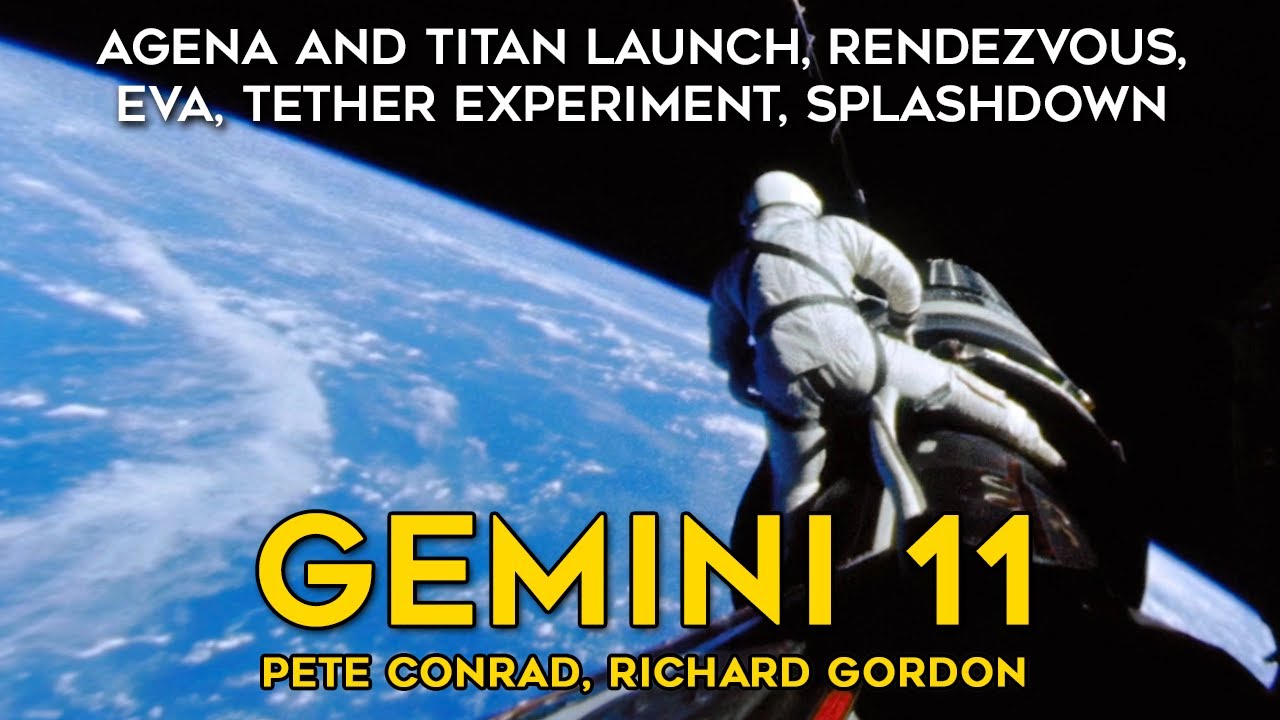
NASA GEMINI XI MISSION QUICK LOOK 1966 CHARLES CONRAD RICHARD GORDON AGENA ROCKET XD10174

Want to support this channel and help us preserve old films? Visit https://www.patreon.com/PeriscopeFilm Browse our products on Amazon: https://amzn.to/2YILTSD This film will take a look at NASA’s Ge...

Gemini 11 Launch

Gemini 11 (officially Gemini XI) was a 1966 manned spaceflight in NASA's Gemini program. It was the 9th manned Gemini flight, the 17th manned American flight and the 25th spaceflight of all time (incl...

Gemini 11 launch

NASA Gemini 11 launch on September 12, 1966. Astronauts Charles "Pete" Conrad, Jr. and Richard F. Gordon, Jr. The Gemini-Titan launch vehicles used Gemini-Titan II rockets. Gemini 11 spacecraft reac...

Gemini XI (Gemini 11)

Circle Image

Overview

Destination: Low Earth Orbit
Mission: Human Exploration

Low Earth Orbit Launch Complex 19 Cape Canaveral SFS, FL, USA

Gemini 11 was the ninth crewed mission of the NASA's Project Gemini. It was commanded by Command Pilot Charles "Pete" Conrad, Jr. and Pulot Richard F. Gordon, Jr. The crew performed a direct-ascent rendezvous with the Agena Target Vehicle on the first orbit and used the Agena rocket engine to put the combined craft in a higher orbit. Astronauts also performed two EVAs and conducted various scientific experiments. The mission started on September 12, 1966, 14:42:26 UTC and, having performed the first totally automatic, computer-controlled reentry, it ended on September 15, 1966, 13:59:35 UTC.

Titan II

Family:
Configuration: GLV

The Titan II GLV (Gemini Launch Vehicle) or Gemini-Titan II was an American expendable launch system derived from the Titan II missile, which was used to launch twelve Gemini missions for NASA between 1964 and 1966. Two unmanned launches followed by ten manned ones were conducted from Launch Complex 19 at the Cape Canaveral Air Force Station, starting with Gemini 1 on April 8, 1964.

Specifications
  • Stages
    2
  • Length
    33.2 m
  • Diameter
    3.05 m
  • Fairing Diameter
  • Launch Mass
    154.0 T
  • Thrust
    1913.0 kN
Family
  • Name
    Titan II
  • Family
  • Variant
    GLV
  • Alias
  • Full Name
    Titan II GLV
Payload Capacity
  • Launch Cost
  • Low Earth Orbit
    3850.0 kg
  • Geostationary Transfer Orbit
  • Direct Geostationary
  • Sun-Synchronous Capacity

Gemini SC11


In-active Human Rated Crew On-board: 2 Crew Capacity: 2
Destination: Low Earth Orbit
Serial Number: 11

Gemini SC11 is the Gemini capsule used for the Gemini 11 mission launched on September 12, 1966 and crewed by astronauts Charles "Pete" Conrad Jr. (command pilot) and Richard F. Gordon Jr. (pilot).

Gemini Details

Crew


Pete Conrad

Command Pilot - configurations.Country.None - ( NASA )

Status: Deceased

Date of Birth: June 2, 1930
Date of Death: June 8, 1999

Richard F. Gordon Jr.

Pilot - configurations.Country.None - ( NASA )

Status: Deceased

Date of Birth: Oct. 5, 1929
Date of Death: Nov. 6, 2017

National Aeronautics and Space Administration

National Aeronautics and Space Administration

(NASA)

Administrator: Jared Isaacman Founded: 1958 Successes: 121 Failures: 20 Pending: 5

Agency Type:

The National Aeronautics and Space Administration is an independent agency of the executive branch of the United States federal government responsible for the civilian space program, as well as aeronautics and aerospace research. NASA have many launch facilities but most are inactive. The most commonly used pad will be LC-39B at Kennedy Space Center in Florida.

INFO WIKI

Cape Canaveral SFS, FL, USA

Launch Complex 19


Electron
Success
1 day, 11 hours ago
Don't Be Such A Square (STP-S30)
Rocket Lab Launch Complex 2 (Launch Area 0 C) - Wallops Flight Facility, Virginia, USA

STP-S30 is a complex mission that will deliver research experiments and technology demonstrations to orbit for the DoD and contribute to future space…


Falcon 9
Success
2 days ago
Starlink Group 15-13
Space Launch Complex 4E - Vandenberg SFB, CA, USA

A batch of 27 satellites for the Starlink mega-constellation - SpaceX's project for space-based Internet communication system.


Falcon 9
Success
2 days, 2 hours ago
Starlink Group 6-99
Launch Complex 39A - Kennedy Space Center, FL, USA

A batch of 29 satellites for the Starlink mega-constellation - SpaceX's project for space-based Internet communication system.


Ariane 62
Success
2 days, 11 hours ago
Galileo L14 (FOC FM33 & FM34)
Ariane Launch Area 4 - Guiana Space Centre, French Guiana

Payload consists of two satellites for Europe's Galileo navigation system.


Atlas V 551
Success
3 days, 7 hours ago
Amazon Leo (LA-04)
Space Launch Complex 41 - Cape Canaveral SFS, FL, USA

Amazon Leo, formerly known as Project Kuiper, is a mega constellation of satellites in Low Earth Orbit that will offer broadband internet access, thi…


Long March 4B
Success
3 days, 13 hours ago
Ziyuan-3-04
Launch Complex 9 - Taiyuan Satellite Launch Center, People's Republic of China

The ZY-3 (Ziyuan-3, 'Resource-3') series represents China's first high-resolution, stereoscopic mapping satellites for civilian use. The second sa…


Falcon 9
Success
4 days, 10 hours ago
Starlink Group 6-82
Space Launch Complex 40 - Cape Canaveral SFS, FL, USA

A batch of 29 satellites for the Starlink mega-constellation - SpaceX's project for space-based Internet communication system.


Falcon 9
Success
5 days, 10 hours ago
Starlink Group 15-12
Space Launch Complex 4E - Vandenberg SFB, CA, USA

A batch of 27 satellites for the Starlink mega-constellation - SpaceX's project for space-based Internet communication system.


Electron
Success
5 days, 13 hours ago
Raise and Shine (RAISE-4)
Rocket Lab Launch Complex 1B - Rocket Lab Launch Complex 1, Mahia Peninsula, New Zealand

RAISE-4 (RApid Innovative payload demonstration Satellite-4) is a Japan Aerospace Exploration Agency (JAXA) satellite for on-orbit demonstrations of …


Kuaizhou 11
Success
6 days, 15 hours ago
DEAR-5
Launch Area 95A - Jiuquan Satellite Launch Center, People's Republic of China

DEAR-5 is a commercial in-orbit payload and micro-gravity experiments hosting spacecraft developed by Chinese commercial company AZSPACE for various …