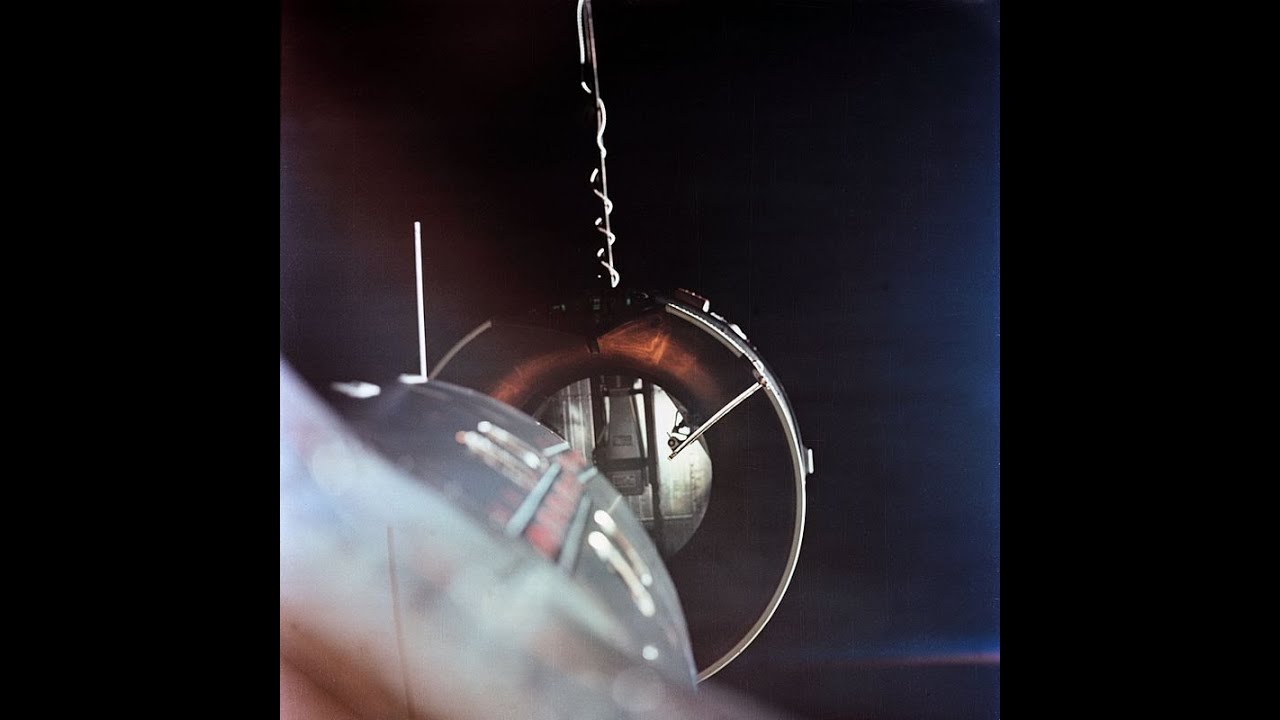
Titan II GLV | Gemini VIII
Launch Successful
L - -- : -- : -- : --
Instantaneous launch window.
Launch Window
-


Instantaneous launch window.
-
Gemini 8 was the sixth crewed mission of the NASA's Project Gemini. The mission was commanded by Command Pilot Neil A. Armstrong and Pilot David R. Scott. Gemini 8 conducted the first docking of two spacecraft in orbit, but suffered the first critical in-space system failure of a U.S. spacecraft which threatened the lives of the astronauts and required immediate abort of the mission. The mission began on March 16, 1966, 16:41:02 UTC and ended on March 17, 1966, 03:22:28 UTC.
The Titan II GLV (Gemini Launch Vehicle) or Gemini-Titan II was an American expendable launch system derived from the Titan II missile, which was used to launch twelve Gemini missions for NASA between 1964 and 1966. Two unmanned launches followed by ten manned ones were conducted from Launch Complex 19 at the Cape Canaveral Air Force Station, starting with Gemini 1 on April 8, 1964.
Gemini SC8 is the Gemini capsule used for the Gemini 8 mission launched on March 16, 1966 and crewed by astronauts Neil Armstrong (command pilot) and David Scott (pilot).
Gemini Details
Date of
Birth: Aug. 5, 1930
Date of Death:
Aug. 25, 2012
Date of
Birth: June 6, 1932
Age: 94
The National Aeronautics and Space Administration is an independent agency of the executive branch of the United States federal government responsible for the civilian space program, as well as aeronautics and aerospace research. NASA have many launch facilities but most are inactive. The most commonly used pad will be LC-39B at Kennedy Space Center in Florida.
INFO WIKI4 X-band synthetic-aperture radar Earth observation satellites for the Chinese Earth observation satellite company PIESAT.
Synthetic aperture radar satellite for Japanese Earth imaging company Synspective.
Note: Satellite serial number and Cosmos designation not confirmed. Glonass-K are the third generation of satellite design for GLONASS satellite n…
2 Earth observation radar satellites built by the Chinese satellite manufacturer SpaceTY.
USSF-259 is a classified mission for the United States Space Force. It is possibly a batch of classified LEO satellites based on SpaceX’s Starshield …
A batch of 9 Low Earth Orbit communication satellites for the Chinese state owned SatNet constellation operated by the China Satellite Network Group.…
Progress resupply mission to the International Space Station.
9 Low Earth Orbit communication satellites with Ku, Q and V band payloads for the G60 constellation operated by Shanghai Spacesail Technologies with …
10 Low Earth Orbit communication satellites with Ku, Q and V band payloads for the G60 constellation operated by Shanghai Spacesail Technologies with…
Sentinel-3C is the third satellite in the Sentinel-3 constellation, which provides high-accuracy optical, radar and altimetry data for marine and lan…