Saturn V | Apollo 10
Launch Successful
L - -- : -- : -- : --
Instantaneous launch window.
Launch Window
-


Instantaneous launch window.
-
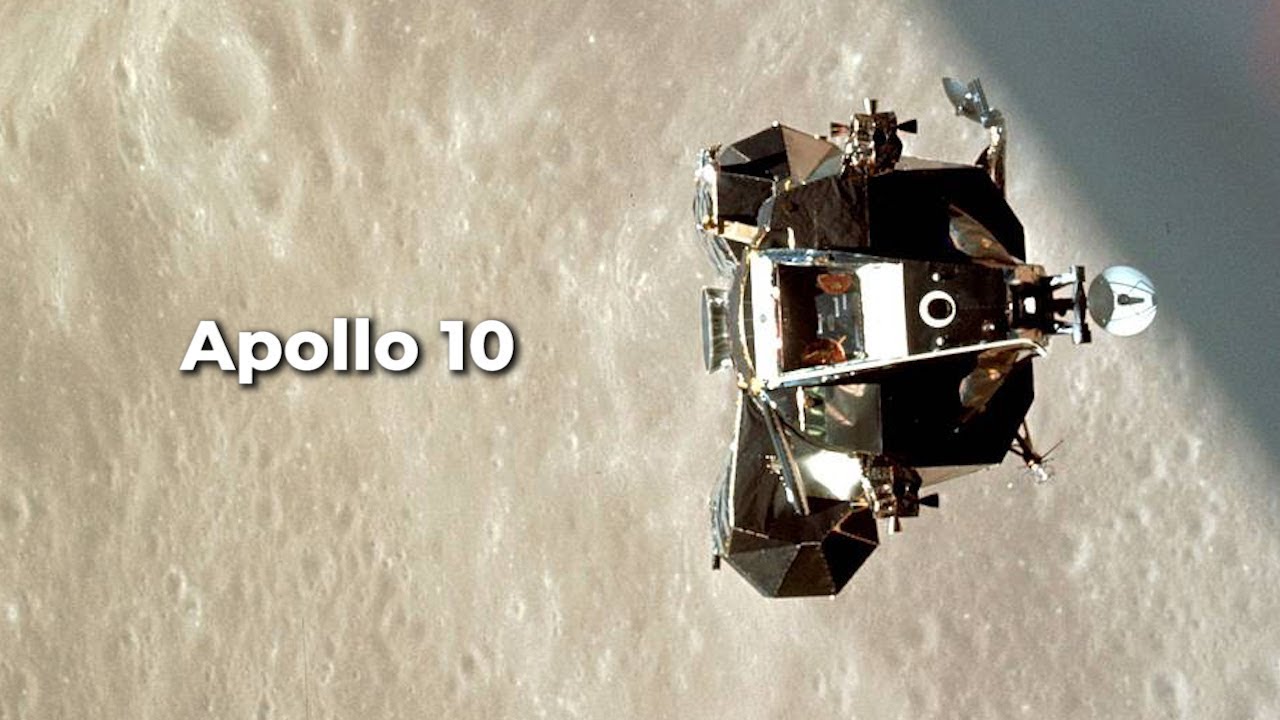

Apollo 10 was a May 1969 human spaceflight, the fourth crewed mission in the United States Apollo program, and the second (after Apollo 8) to orbit the Moon. It was the F mission: a "dress rehearsal" for the first Moon landing, testing all the components and procedures just short of …
Apollo 10 was Command by Thomas P. Stafford, Command Module Pilot John W. Young, and Lunar Module Pilot Eugene A. Cernan. This mission was a F Mission which means a dress rehearsal for the upcoming Apollo 11 Mission that would be the first crewed mission to land on the moon.
The Saturn V was a human-rated expendable rocket used by NASA between 1967 and 1973. Most notably, the Saturn V took the Apollo program to the Moon. It still remains the world's tallest, heaviest, and most powerful rocket ever brought to operational status and is the only launch vehicle to take humans beyond LEO.
CSM-106 "Charlie Brown" was an Apollo Command & Service Module used in the Apollo 10 mission.
Apollo Command/Service Module Details
Date of
Birth: Sept. 17, 1930
Date of Death:
March 18, 2024
Date of
Birth: Sept. 24, 1930
Date of Death:
Jan. 5, 2018
Date of
Birth: March 14, 1934
Date of Death:
Jan. 16, 2017
Flown on Apollo 10. Descent stage may have hit the Moon, ascent stage in heliocentric orbit. Snoopy is the only flown LM ascent stage known to have survived intact (possibly asteroid 2018 AV2).
Apollo Lunar Module DetailsThe National Aeronautics and Space Administration is an independent agency of the executive branch of the United States federal government responsible for the civilian space program, as well as aeronautics and aerospace research. NASA have many launch facilities but most are inactive. The most commonly used pad will be LC-39B at Kennedy Space Center in Florida.
INFO WIKI4 X-band synthetic-aperture radar Earth observation satellites for the Chinese Earth observation satellite company PIESAT.
Synthetic aperture radar satellite for Japanese Earth imaging company Synspective.
Note: Satellite serial number and Cosmos designation not confirmed. Glonass-K are the third generation of satellite design for GLONASS satellite n…
2 Earth observation radar satellites built by the Chinese satellite manufacturer SpaceTY.
USSF-259 is a classified mission for the United States Space Force. It is possibly a batch of classified LEO satellites based on SpaceX’s Starshield …
A batch of 9 Low Earth Orbit communication satellites for the Chinese state owned SatNet constellation operated by the China Satellite Network Group.…
Progress resupply mission to the International Space Station.
9 Low Earth Orbit communication satellites with Ku, Q and V band payloads for the G60 constellation operated by Shanghai Spacesail Technologies with …
10 Low Earth Orbit communication satellites with Ku, Q and V band payloads for the G60 constellation operated by Shanghai Spacesail Technologies with…
Sentinel-3C is the third satellite in the Sentinel-3 constellation, which provides high-accuracy optical, radar and altimetry data for marine and lan…

