PSLV-XL | EOS-09 (RISAT-1B)
Launch Failure
3rd stage failure during burn.L - -- : -- : -- : --
Launch Window
-


-
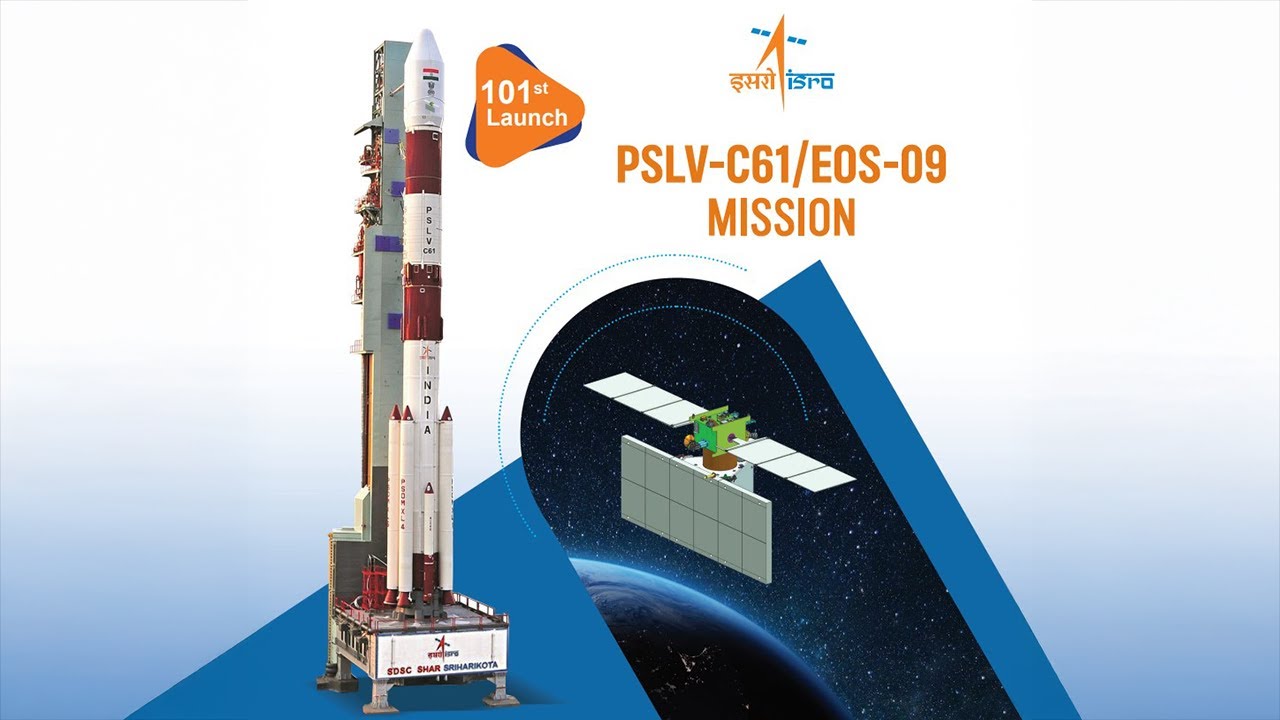

India is set to achieve a significant milestone with the 101st mission of its space programme. On 18 May 2025 at 05:59 AM IST, ISRO will launch EOS-09 aboard the PSLV-C61 from the First Launch Pad (FLP) at Satish Dhawan Space Centre, SHAR . The mission will place the Earth …
RISAT-1B is the third in the series of radar imaging RISAT-1 satellites of ISRO using an active C-band SAR (Synthetic Aperture Radar), providing all-weather as well as the day-and-night SAR observation capability in applications such as agriculture, forestry, soil moisture, geology, sea ice, coastal monitoring, object identification, and flood monitoring, in addition to military surveillance. The RISAT-1 series is developed, manufactured and integrated by ISRO. The 3-axis stabilized spacecraft bus consists of a hexagonal prism shape build around a central cylinder. Most of the spacecraft subsystems and the payload are integrated in the prism structure and the central cylinder. The solar panels and some subsystems are mounted on the cube-shaped section of the spacecraft.

Launch failure.
Liftoff.

Official Webcast by ISRO Official has started
Adjusted T-0.
Added launch time.
PSLV-XL is the upgraded version of Polar Satellite Launch Vehicle in its standard configuration boosted by more powerful, stretched strap-on boosters with 12 tonne propellant load. Weighing 320t at lift-off, the vehicle uses larger strap-on motors (PSOM-XL or S12) to achieve higher payload capability. On 29 December 2005, ISRO successfully tested the improved version of strap-on booster for the PSLV. The first use of PSLV-XL was the launch of Chandrayaan-1 by PSLV C11. The payload capability for this variant is 1,800 kg to SSO.
The Indian Space Research Organisation (ISRO) is the space agency of the Government of India headquartered in the city of Bangalore. Its vision is to "harness space technology for national development while pursuing space science research and planetary exploration."
INFO WIKI
An Indian launch of a radar imaging satellite failed May 17 when a problem with the third stage prevented the payload from reaching orbit. The post PSLV launch of Indian radar imaging satellite fails appeared first on SpaceNews.

On the heels of a busy April, activity is ramping up for May with launches… The post Launch Roundup: Orbital launches from five countries planned appeared first on NASASpaceFlight.com.
4 X-band synthetic-aperture radar Earth observation satellites for the Chinese Earth observation satellite company PIESAT.
Synthetic aperture radar satellite for Japanese Earth imaging company Synspective.
Note: Satellite serial number and Cosmos designation not confirmed. Glonass-K are the third generation of satellite design for GLONASS satellite n…
2 Earth observation radar satellites built by the Chinese satellite manufacturer SpaceTY.
USSF-259 is a classified mission for the United States Space Force. It is possibly a batch of classified LEO satellites based on SpaceX’s Starshield …
A batch of 9 Low Earth Orbit communication satellites for the Chinese state owned SatNet constellation operated by the China Satellite Network Group.…
Progress resupply mission to the International Space Station.
9 Low Earth Orbit communication satellites with Ku, Q and V band payloads for the G60 constellation operated by Shanghai Spacesail Technologies with …
10 Low Earth Orbit communication satellites with Ku, Q and V band payloads for the G60 constellation operated by Shanghai Spacesail Technologies with…
Sentinel-3C is the third satellite in the Sentinel-3 constellation, which provides high-accuracy optical, radar and altimetry data for marine and lan…