Proton-M | MLM Nauka
Launch Successful
L - -- : -- : -- : --
Instantaneous launch window.
Launch Window
-


Instantaneous launch window.
-
Nauka (which means "Science" in Russian), also known as Multipurpose Laboratory Module (MLM), is a new module of the russian segment of the ISS. It will dock at Zvezda's nadir port, replacing the Pirs module occupying it since September 2001. The Nauka module is designed to be used for experiments, docking and cargo as well as serve as a crew work and rest area. It is equipped with full guidance and navigation control including engines and an attitude control system that can be used as a backup by the ISS. The Nauka module also brings the European Robotic Arm, for which a spare elbow joint was already launched in 2010, to the orbital laboratory.

Module is healthy and in planned orbit.

Corrected the T-0
New date confirmed by Roscosmos
Launch postponed to NET July 21 due to thermal blankets missing from MLM Nauka's star trackers.
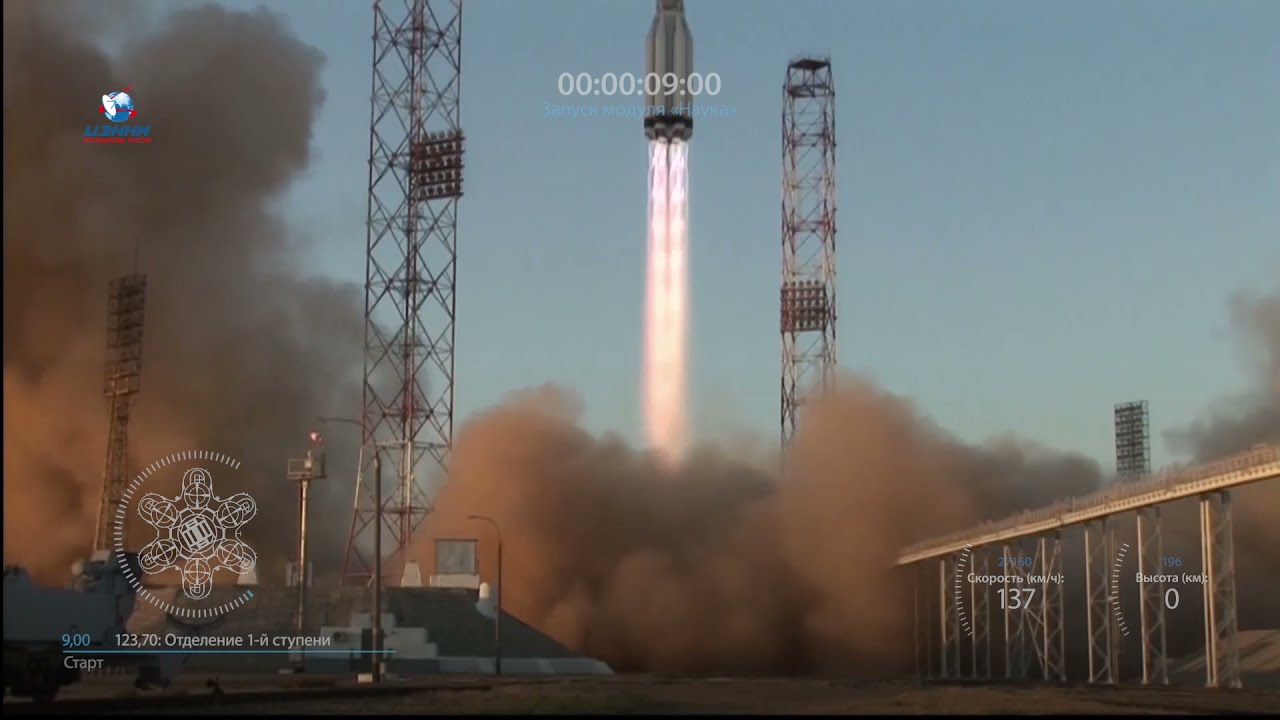
Proton-M is a three stage Russian heavy lift launch vehicle derived from the Soviet Proton launch vehicle. Image Credit: Alex Lane
Khrunichev State Research and Production Space Center is a Moscow-based producer of spacecraft and space-launch systems, including the Proton and Rokot rockets and is currently developing the Angara rocket family. The Proton launch vehicle launches from Baikonur and Rokot launches from Baikonur and Plesetsk. Angara will launch from Plesetsk and Vostochny.
INFO WIKI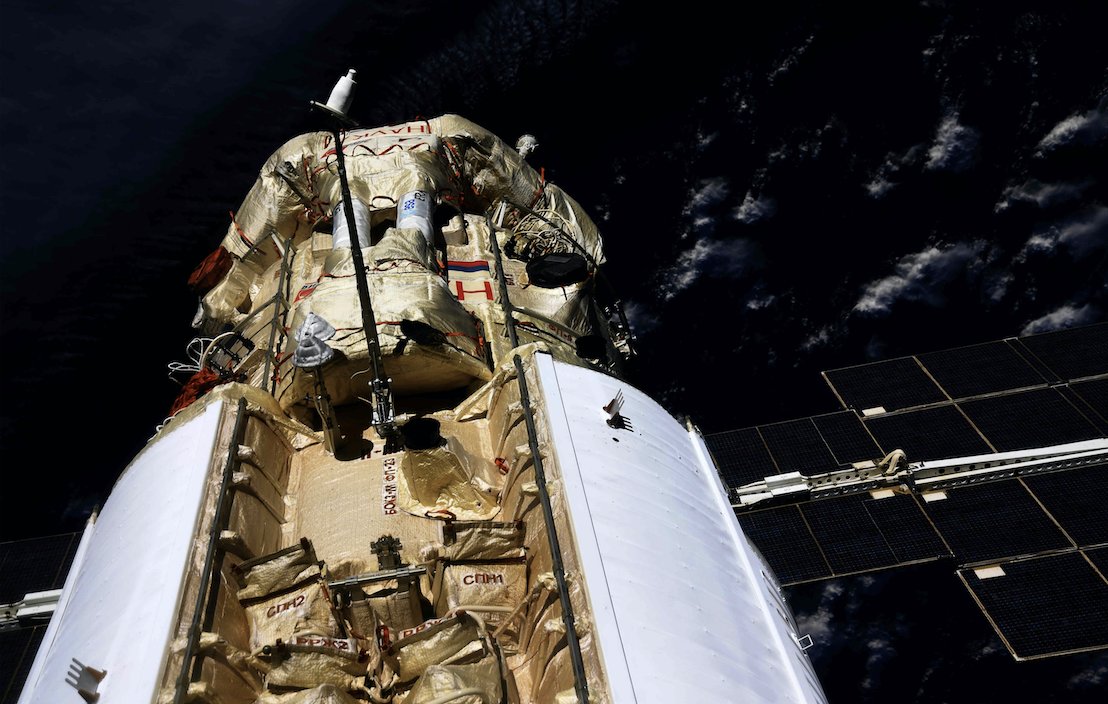
Will this leak be blamed on "external impacts" as well?

Russia’s newest International Space Station module, Nauka, began leaking coolant from a radiator today. This is third Russian radiator to spring a leak in less than a year. The Nauka […]

A radiator on the Russian segment of the International Space Station started leaking coolant Oct. 9, the third such incident involving Russian hardware at the station in less than a year.

The International Space Station is set to receive its biggest expansion in more than a decade after the launch of a Russian research lab and a European robotic arm Wednesday from the Baikonur Cosmodrome in Kazakhstan.

A Russian science module in development for more than 20 years is set for liftoff Wednesday from the Baikonur Cosmodrome in Kazakhstan on top of a Proton rocket, kicking off an eight-day flight to the International Space Station to boost t…
Share-ride of 9 commercial Earth observation and technology demonstration satellites to SSO, details TBD.
A batch of 27 satellites for the Starlink mega-constellation - SpaceX's project for space-based Internet communication system.
4 X-band synthetic-aperture radar Earth observation satellites for the Chinese Earth observation satellite company PIESAT.
Synthetic aperture radar satellite for Japanese Earth imaging company Synspective.
Note: Satellite serial number and Cosmos designation not confirmed. Glonass-K are the third generation of satellite design for GLONASS satellite n…
2 Earth observation radar satellites built by the Chinese satellite manufacturer SpaceTY.
USSF-259 is a classified mission for the United States Space Force. It is possibly a batch of classified LEO satellites based on SpaceX’s Starshield …
A batch of 9 Low Earth Orbit communication satellites for the Chinese state owned SatNet constellation operated by the China Satellite Network Group.…
Progress resupply mission to the International Space Station.
9 Low Earth Orbit communication satellites with Ku, Q and V band payloads for the G60 constellation operated by Shanghai Spacesail Technologies with …

