Long March 4C | Daqi-1 (AEMS)
Launch Successful
L - -- : -- : -- : --
Launch Window
-


-
China’s first satellite dedicated to comprehensive monitoring of the atmospheric environment, named Daqi-1, also known as Atmospheric Environment Monitoring Satellite (AEMS) and developed by the Shanghai Academy of Spaceflight Technology (SAST) in Shanghai, is designed to operate in sun-synchronous orbit. Daqi-1 can monitor fine particle pollution like PM2.5, pollutant gases including nitrogen dioxide, sulfur dioxide and ozone, as well as carbon dioxide concentration. It combines both passive and active sensing, which can realize comprehensive monitoring of the atmospheric environment in a better way, according to a chief designer with SAST. The detection accuracy of fine particles and carbon dioxide column concentration by Daqi-1 has reached the international advanced level, the chief designer said. The atmospheric detection lidar deployed on the satellite is also the world's first that is capable of detecting both atmospheric aerosols and carbon dioxide.

Launch success
Added launch per NOTAMs - payload and launch vehicle identities very uncertain.
The Long March 4C, also known as the Chang Zheng 4C, CZ-4C and LM-4C, previously designated Long March 4B-II, is a Chinese orbital carrier rocket. It is launched from the Jiuquan, Taiyuan Satellite Launch Centre and Xichangs, and consists of 3 stages. Long March 4C vehicles have been used to launch the Yaogan-1, Yaogan-3 SAR satellites and the Fengyun-3A polar orbiting meteorological satellite. On December 15, 2009 a Long March 4C was used to launch Yaogan 8.
The China Aerospace Science and Technology Corporation (CASC) is the main contractor for the Chinese space program. It is state-owned and has a number of subordinate entities which design, develop and manufacture a range of spacecraft, launch vehicles, strategic and tactical missile systems, and ground equipment. It was officially established in July 1999 as part of a Chinese government reform drive, having previously been one part of the former China Aerospace Corporation. Various incarnations of the program date back to 1956.
INFO WIKI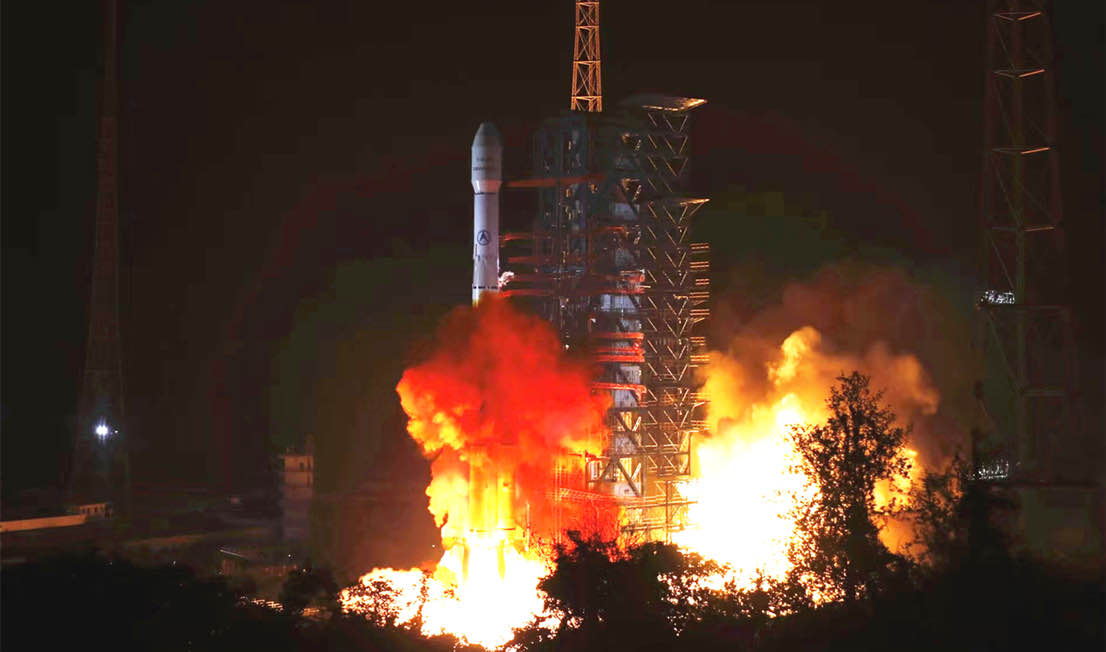
Two Chinese rocket launches hours apart Friday successfully deployed a radio and TV broadcasting spacecraft and an atmospheric environmental monitoring satellite.
Share-ride of 9 commercial Earth observation and technology demonstration satellites to SSO, details TBD.
A batch of 27 satellites for the Starlink mega-constellation - SpaceX's project for space-based Internet communication system.
4 X-band synthetic-aperture radar Earth observation satellites for the Chinese Earth observation satellite company PIESAT.
Synthetic aperture radar satellite for Japanese Earth imaging company Synspective.
Note: Satellite serial number and Cosmos designation not confirmed. Glonass-K are the third generation of satellite design for GLONASS satellite n…
2 Earth observation radar satellites built by the Chinese satellite manufacturer SpaceTY.
USSF-259 is a classified mission for the United States Space Force. It is possibly a batch of classified LEO satellites based on SpaceX’s Starshield …
A batch of 9 Low Earth Orbit communication satellites for the Chinese state owned SatNet constellation operated by the China Satellite Network Group.…
Progress resupply mission to the International Space Station.
9 Low Earth Orbit communication satellites with Ku, Q and V band payloads for the G60 constellation operated by Shanghai Spacesail Technologies with …