Long March 2D | Tianhui-1-04
Launch Successful
L - -- : -- : -- : --
Launch Window
-


-
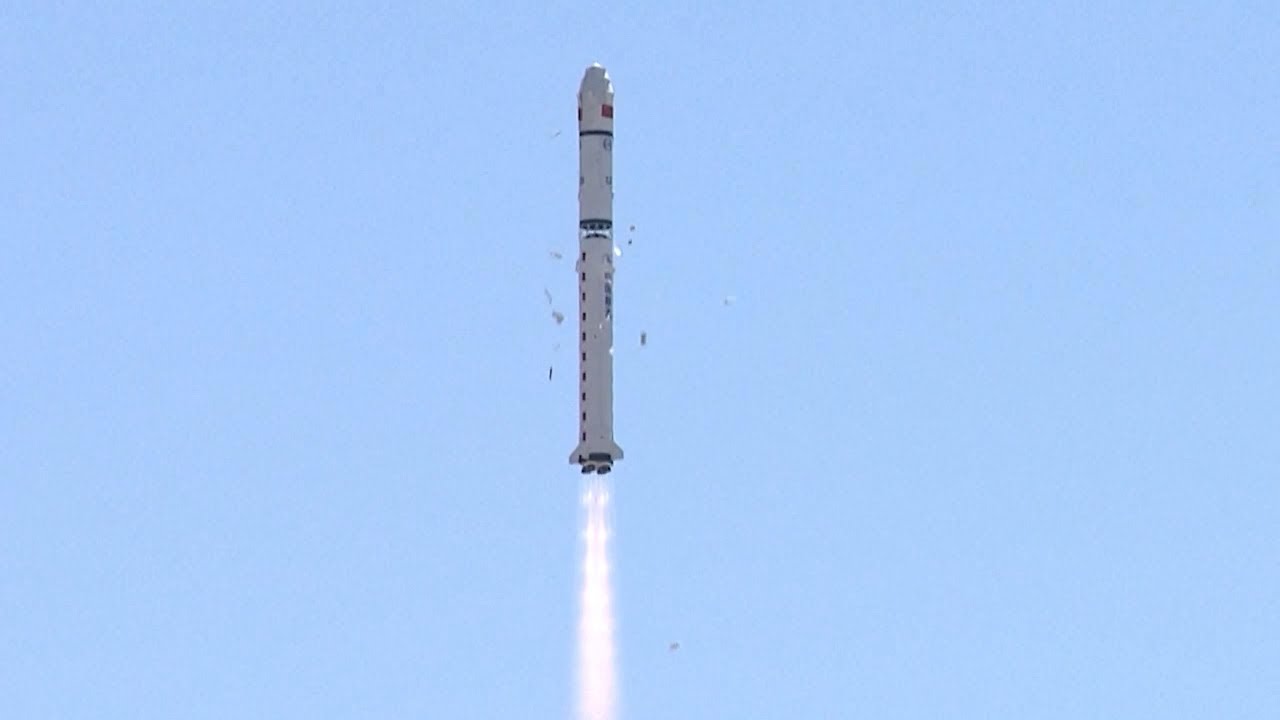
TH 1 (Tianhui-1 = "Sky drawing") is a Chinese stereo-topographic mapping satellite operated by the People’s Liberation Army (PLA). The satellites are built by the Hangtian Dongfanghong Weixing Corporation and the China Aerospace Science and Technology Corporation and the Chinese Academy of Space Technology (CAST). The satellites operate on a 500 km circular sun synchronous orbit. Electrical power is provided by two deployable solar panels that is stored on onboard batteries. They are equipped with a three-dimensional survey camera and a CCD camera with a ground resolution of 5 meters, spectral region of 0.51 µm to 0.69 µm and with a camera angle of 25 degrees. Also on board is a multi-spectral camera with a ground resolution of 10 meters operating in four spectral bands of 0.43 µm to 0.52 µm, 0.52 µm to 0.61 µm, 0.61 µm to 0.69 µm, and 0.76 µm to 0.90 µm. The swath width of the cameras is 60 kilometers wide.

Launch success
Added launch per NOTAMs.
The Long March 2D, also known as the Chang Zheng 2D, CZ-2D and LM-2D, is a Chinese orbital carrier rocket. It is a 2-stage carrier rocket mainly used for launching LEO and SSO satellites.
The China Aerospace Science and Technology Corporation (CASC) is the main contractor for the Chinese space program. It is state-owned and has a number of subordinate entities which design, develop and manufacture a range of spacecraft, launch vehicles, strategic and tactical missile systems, and ground equipment. It was officially established in July 1999 as part of a Chinese government reform drive, having previously been one part of the former China Aerospace Corporation. Various incarnations of the program date back to 1956.
INFO WIKI
China successfully launched a Long March 2D rocket July 29 with a Tianhui military satellite on a mission to collect data for maps and land surveys.

A Chinese Long March 2D rocket lifted off from the Jiuquan Satellite Launch Center in Inner Mongolia at 04:01 UTC today, July 29, carrying Tianhui 1-04, the fourth in China’s series of Tianhui 1 Earth observation satellites, into Low Earth…
3 Chinese reconnaissance satellites of unknown purposes, officially reported as for "Electromagnetic environment probing".
A batch of 9 Low Earth Orbit communication satellites for the Chinese state owned SatNet constellation operated by the China Satellite Network Group.…
Share-ride of 9 commercial Earth observation and technology demonstration satellites to SSO, details TBD.
A batch of 27 satellites for the Starlink mega-constellation - SpaceX's project for space-based Internet communication system.
4 X-band synthetic-aperture radar Earth observation satellites for the Chinese Earth observation satellite company PIESAT.
Synthetic aperture radar satellite for Japanese Earth imaging company Synspective.
Note: Satellite serial number and Cosmos designation not confirmed. Glonass-K are the third generation of satellite design for GLONASS satellite n…
2 Earth observation radar satellites built by the Chinese satellite manufacturer SpaceTY.
USSF-259 is a classified mission for the United States Space Force. It is possibly a batch of classified LEO satellites based on SpaceX’s Starshield …
A batch of 9 Low Earth Orbit communication satellites for the Chinese state owned SatNet constellation operated by the China Satellite Network Group.…