Watch the Launch

Watch the Launch

Michibiki 5 (QZS-5)

Circle Image

Overview

Destination: Geosynchronous Transfer Orbit
Mission: Navigation

Geosynchronous Transfer Orbit Yoshinobu Launch Complex LP-2 Tanegashima Space Center, Japan

QZSS (Quasi Zenith Satellite System) is a Japanese satellite navigation system operating from inclined, elliptical geosynchronous orbits to achieve optimal high-elevation visibility in urban canyons and mountainous areas. The navigation system objective is to broadcast GPS-interoperable and augmentation signals as well as original Japanese (QZSS) signals from a three-spacecraft constellation. The navigation system objective is to broadcast GPS-interoperable and augmentation signals as well as original Japanese (QZSS) signals from a three-spacecraft constellation in inclined, elliptical geosynchronous orbits.

Updates

Cosmic_Penguin • Dec. 22, 2025, 6:54 a.m.

Launch failure.


LL2 • Dec. 22, 2025, 2:07 a.m.

Official Webcast by JAXA | 宇宙航空研究開発機構 has started


Cosmic_Penguin • Dec. 22, 2025, 1:51 a.m.

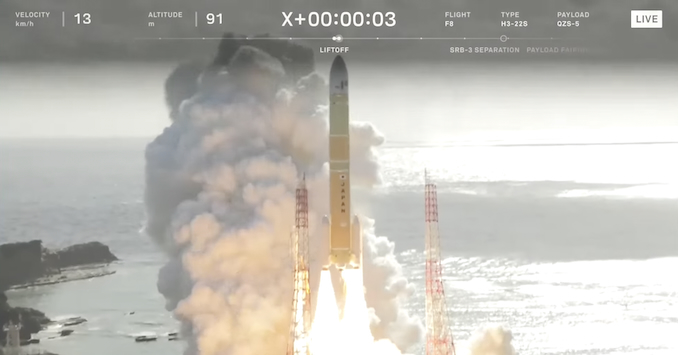
Liftoff.


LL2 • Dec. 22, 2025, 12:53 a.m.

Official Webcast by JAXA | 宇宙航空研究開発機構 has started


Cosmic_Penguin • Dec. 20, 2025, 7:09 a.m.

Refined launch window.


H3-22

Family:
Configuration: 22

The H3 Launch Vehicle is a Japanese expendable launch system. Each H3 booster configuration has a two-digit and a letter designation that indicates the features of that configuration. The first digit represents the number of LE-9 engines on the main stage, either "2" or "3". The second digit indicates the number of SRB-3 solid rocket boosters attached to the base of the rocket, and can be "0", "2" or "4". All layouts of solid boosters are symmetrical. The letter in the end shows the length of the payload fairing, either short "S" or long "L". For example, an H3-24L has two engines, four solid rocket boosters, and a long fairing, whereas an H3-30S has three engines, no solid rocket boosters, and a short fairing.

See Details
Specifications
  • Stages
    2
  • Length
    63.0 m
  • Diameter
    5.27 m
  • Fairing Diameter
    5.27 m
  • Launch Mass
  • Thrust
    7542.0 kN
Family
  • Name
    H3-22
  • Family
  • Variant
    22
  • Alias
  • Full Name
    H3-22
Payload Capacity
  • Launch Cost
    $50000000
  • Low Earth Orbit
  • Geostationary Transfer Orbit
    5400.0 kg
  • Direct Geostationary
  • Sun-Synchronous Capacity

Mitsubishi Heavy Industries

Mitsubishi Heavy Industries

(MHI)

President: Seiji Izumisawa Founded: 1884 Successes: 56 Failures: 2 Pending: 13

Agency Type:

Mitsubishi Heavy Industries, Ltd. is a Japanese multinational engineering, electrical equipment and electronics company headquartered in Tokyo, Japan. MHI is one of the core companies of the Mitsubishi Group. MHI's products include aerospace components, air conditioners, aircraft, automotive components, forklift trucks, hydraulic equipment, machine tools, missiles, power generation equipment, printing machines, ships and space launch vehicles. Through its defense-related activities, it is the world's 23rd-largest defense contractor measured by 2011 defense revenues and the largest based in Japan.

INFO WIKI

Arstechnica

Rocket Report: How a 5-ton satellite fell off a booster; will SpaceX and xAI merge?

"We’re seeing remarkable growth year after year."

SpaceNews

H3 failure linked to payload fairing separation anomaly

An H3 launch failure in December may have been caused by an unusual event that led to the satellite separating from the rocket prematurely. The post H3 failure linked to payload fairing separation anomaly appeared first on SpaceNews.

SpaceNews

Japan’s H3 suffers second-stage anomaly, QZS-5 satellite lost

Japan’s flagship H3 rocket suffered an issue with its second stage late Sunday resulting in the loss of the Michibiki 5 (QZS-5) navigation satellite. The post Japan’s H3 suffers second-stage anomaly, QZS-5 satellite lost appeared first on…

Spaceflight Now

H3 rocket suffers upper stage anomaly, fails to correctly deploy navigation satellite

The Dec. 22 launch was the fourth and final flight of an H3 rocket in 2025.

NASASpaceflight

Launch Roundup: Ariane 6, Falcon 9, Atlas V, and Electron launches highlight busy week

Global launch activity is set to surge over the next week, with 13 missions scheduled… The post Launch Roundup: Ariane 6, Falcon 9, Atlas V, and Electron launches highlight busy week appeared first on NASASpaceFlight.com.

Tanegashima Space Center, Japan

Yoshinobu Launch Complex LP-2


Kinetica 1
Success
3 days, 7 hours ago
9 satellites
Launch Area 130 - Jiuquan Satellite Launch Center, People's Republic of China

Share-ride of 9 commercial Earth observation and technology demonstration satellites to SSO, details TBD.


Falcon 9
Success
3 days, 9 hours ago
Starlink Group 15-27
Space Launch Complex 4E - Vandenberg SFB, CA, USA

A batch of 27 satellites for the Starlink mega-constellation - SpaceX's project for space-based Internet communication system.


Long March 2D
Success
4 days ago
PIESAT-2 13-16
Launch Complex 9 - Taiyuan Satellite Launch Center, People's Republic of China

4 X-band synthetic-aperture radar Earth observation satellites for the Chinese Earth observation satellite company PIESAT.


Electron
Success
4 days, 8 hours ago
Owl By The Dozen (StriX Launch 12)
Rocket Lab Launch Complex 1B - Rocket Lab Launch Complex 1, Mahia Peninsula, New Zealand

Synthetic aperture radar satellite for Japanese Earth imaging company Synspective.


Soyuz 2.1b/Fregat-M
Success
5 days, 18 hours ago
Glonass-K1 No. 20 (?)
43/3 (43L) - Plesetsk Cosmodrome, Russian Federation

Note: Satellite serial number and Cosmos designation not confirmed. Glonass-K are the third generation of satellite design for GLONASS satellite n…


Kuaizhou 11
Success
6 days, 8 hours ago
SpaceTY-51 & 52
Launch Area 95A - Jiuquan Satellite Launch Center, People's Republic of China

2 Earth observation radar satellites built by the Chinese satellite manufacturer SpaceTY.


Falcon 9
Success
6 days, 10 hours ago
USSF-259
Space Launch Complex 4E - Vandenberg SFB, CA, USA

USSF-259 is a classified mission for the United States Space Force. It is possibly a batch of classified LEO satellites based on SpaceX’s Starshield …


Long March 12
Success
6 days, 11 hours ago
SatNet LEO Group 25
Commercial LC-2 - Wenchang Space Launch Site, People's Republic of China

A batch of 9 Low Earth Orbit communication satellites for the Chinese state owned SatNet constellation operated by the China Satellite Network Group.…


Soyuz 2.1b
Success
6 days, 21 hours ago
Progress MS-35 (96P)
31/6 - Baikonur Cosmodrome, Republic of Kazakhstan

Progress resupply mission to the International Space Station.


Gravity-1
Success
1 week ago
SpaceSail Polar Group #16
Yellow Sea (launch location 5) - Haiyang Oriental Spaceport

9 Low Earth Orbit communication satellites with Ku, Q and V band payloads for the G60 constellation operated by Shanghai Spacesail Technologies with …