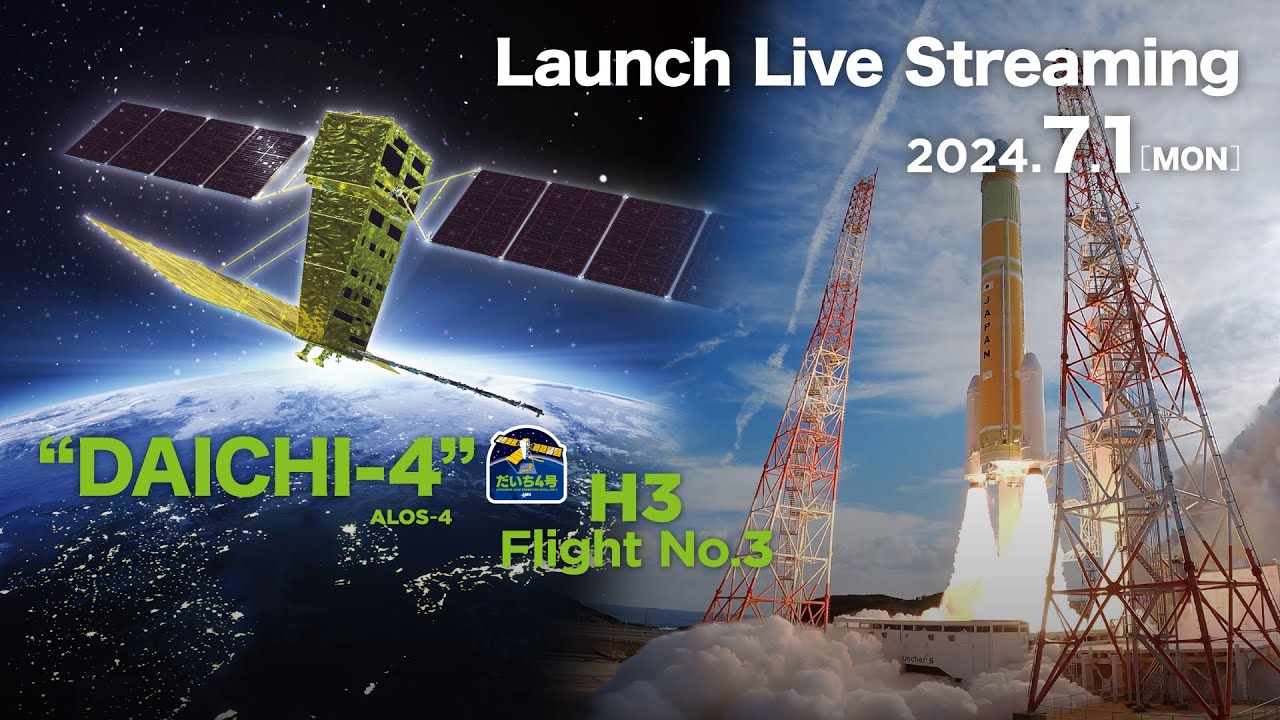
H3-22 | Advanced Land Observing Satellite-4 (ALOS-4)
Launch Successful
L - -- : -- : -- : --
Launch Window
-


-
The Advanced Land Observing Satellite-4 (ALOS-4) is a Japanese satellite designed to observe the Earth's surface using a phased array type L-band synthetic aperture radar (PALSAR-3).

Launch success with satellite solar panels deployed and in proper attitude control.
Spacecraft separation.
Liftoff.

Official Webcast by JAXA | 宇宙航空研究開発機構 has started
Delayed to July 1st due to launch site weather.
The H3 Launch Vehicle is a Japanese expendable launch system. Each H3 booster configuration has a two-digit and a letter designation that indicates the features of that configuration. The first digit represents the number of LE-9 engines on the main stage, either "2" or "3". The second digit indicates the number of SRB-3 solid rocket boosters attached to the base of the rocket, and can be "0", "2" or "4". All layouts of solid boosters are symmetrical. The letter in the end shows the length of the payload fairing, either short "S" or long "L". For example, an H3-24L has two engines, four solid rocket boosters, and a long fairing, whereas an H3-30S has three engines, no solid rocket boosters, and a short fairing.
See DetailsMitsubishi Heavy Industries, Ltd. is a Japanese multinational engineering, electrical equipment and electronics company headquartered in Tokyo, Japan. MHI is one of the core companies of the Mitsubishi Group. MHI's products include aerospace components, air conditioners, aircraft, automotive components, forklift trucks, hydraulic equipment, machine tools, missiles, power generation equipment, printing machines, ships and space launch vehicles. Through its defense-related activities, it is the world's 23rd-largest defense contractor measured by 2011 defense revenues and the largest based in Japan.
INFO WIKI
Japan's H3 Rocket Successfully Launches ALOS-4

On July 1st, 2024 at 11:06:46 PM Eastern Time Japan successfully launched its third H3 rocket, deploying the ALOS-4 satellite.

Japan’s H3 rocket successfully launched an Earth observation satellite Sunday on its third flight.

Following a week in which Tropical Storm Alberto brought high seas, wind, and rain-related delays to the launch schedule in Florida, SpaceX hopes to get back on track this week with launches planned for all three of the active Falcon launc…
Share-ride of 9 commercial Earth observation and technology demonstration satellites to SSO, details TBD.
A batch of 27 satellites for the Starlink mega-constellation - SpaceX's project for space-based Internet communication system.
4 X-band synthetic-aperture radar Earth observation satellites for the Chinese Earth observation satellite company PIESAT.
Synthetic aperture radar satellite for Japanese Earth imaging company Synspective.
Note: Satellite serial number and Cosmos designation not confirmed. Glonass-K are the third generation of satellite design for GLONASS satellite n…
2 Earth observation radar satellites built by the Chinese satellite manufacturer SpaceTY.
USSF-259 is a classified mission for the United States Space Force. It is possibly a batch of classified LEO satellites based on SpaceX’s Starshield …
A batch of 9 Low Earth Orbit communication satellites for the Chinese state owned SatNet constellation operated by the China Satellite Network Group.…
Progress resupply mission to the International Space Station.
9 Low Earth Orbit communication satellites with Ku, Q and V band payloads for the G60 constellation operated by Shanghai Spacesail Technologies with …