Epsilon | RAISE-2 & others
Launch Successful
L - -- : -- : -- : --
Launch Window
-


-
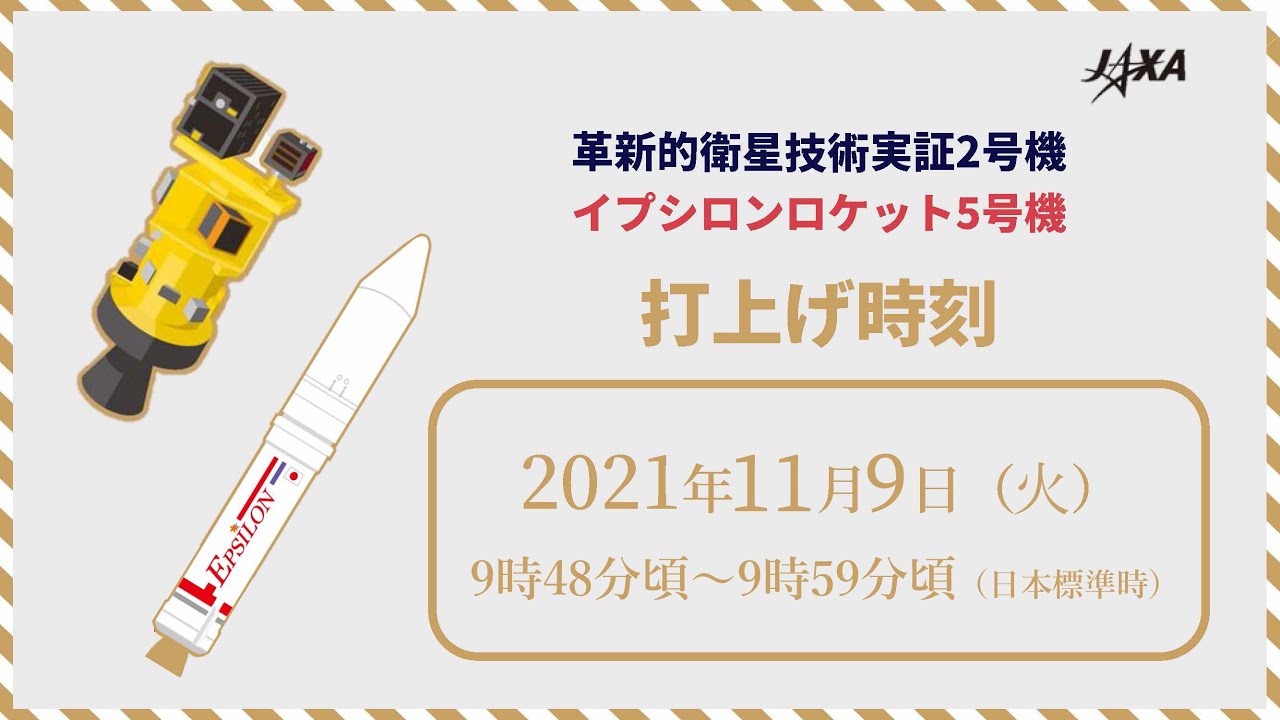
8 payloads will fly on this mission : "RApid Innovative payload demonstration SatellitE-2" (RAISE-2), DRUMS (Debris Removal Unprecedented Micro-Satellite), Hibari, Z-Sat, and four CubeSat (ASTERISC, ARICA, NANODRAGON, KOSEN-1).

Launch success confirmed per webcast
Liftoff

New launch date and time.
Launch delayed due to weather, no new date announced yet.
Confirmation of new launch window
The Epsilon rocket is a Japanese solid-fuel rocket designed to launch scientific satellites. It is a follow-on project to the larger and more expensive M-V rocket which was retired in 2006. The Japan Aerospace Exploration Agency (JAXA) began developing the Epsilon in 2007. It is capable of placing a 590 kg payload into Sun-synchronous orbit.
The Japan Aerospace Exploration Agency (JAXA) is Japan's national aero-space agency. Through the merger of three previously independent organizations, JAXA was formed on 1 October 2003. JAXA is responsible for research, technology development and the launch of satellites into orbit, and is involved in many more advanced missions, such as asteroid exploration and possible manned exploration of the Moon. JAXA launch their Epsilon vehicle from the Uchinoura Space Center and their H-II vehicles from the Tanegashima Space Center.
INFO WIKI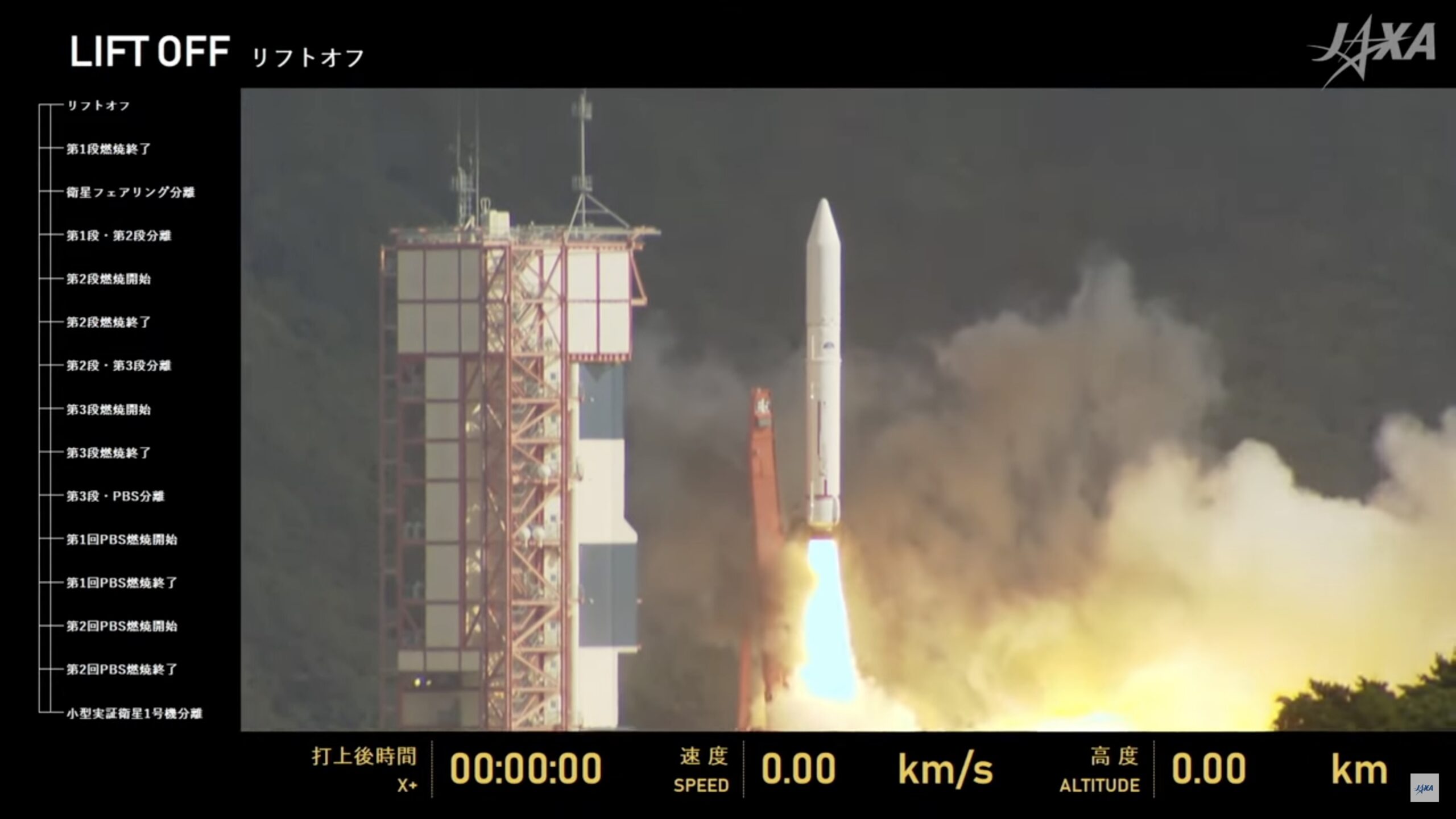
Japan’s solid-fuel Epsilon 5 rocket successfully put nine small satellites into orbit Nov. 9, including an orbital debris removal technology demonstrator.

Japan is working to finally launch its small satellite launcher Epsilon to deliver nine satellites to orbit. Notably, this includes the RAISE-2 technology demonstrator.
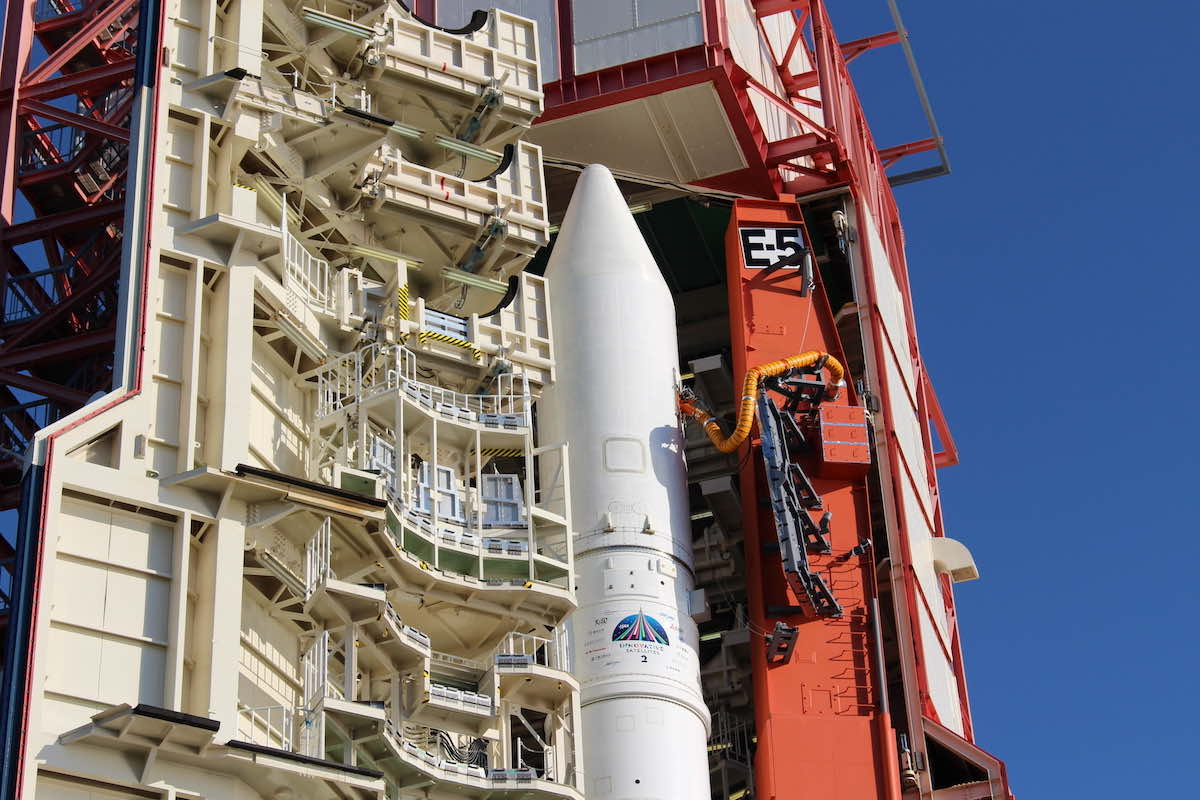
The launch of a solid-fueled Japanese Epsilon rocket with nine small satellites, originally scheduled to blastoff last week, has been grounded until after the flight of a larger H-2A launcher later this month, Japan’s space agency said Fri…

Japan will make its first orbital launch in ten months Friday, using its small satellite launcher Epsilon to deliver nine satellites to orbit. Notably, this includes the RAISE-2 technology demonstrator. Liftoff, from the Uchinoura Space Ce…
4 X-band synthetic-aperture radar Earth observation satellites for the Chinese Earth observation satellite company PIESAT.
Synthetic aperture radar satellite for Japanese Earth imaging company Synspective.
Note: Satellite serial number and Cosmos designation not confirmed. Glonass-K are the third generation of satellite design for GLONASS satellite n…
2 Earth observation radar satellites built by the Chinese satellite manufacturer SpaceTY.
USSF-259 is a classified mission for the United States Space Force. It is possibly a batch of classified LEO satellites based on SpaceX’s Starshield …
A batch of 9 Low Earth Orbit communication satellites for the Chinese state owned SatNet constellation operated by the China Satellite Network Group.…
Progress resupply mission to the International Space Station.
9 Low Earth Orbit communication satellites with Ku, Q and V band payloads for the G60 constellation operated by Shanghai Spacesail Technologies with …
10 Low Earth Orbit communication satellites with Ku, Q and V band payloads for the G60 constellation operated by Shanghai Spacesail Technologies with…
Sentinel-3C is the third satellite in the Sentinel-3 constellation, which provides high-accuracy optical, radar and altimetry data for marine and lan…