Electron | They Go Up So Fast (Rideshare)
Launch Successful
L - -- : -- : -- : --
Launch Window
-


-
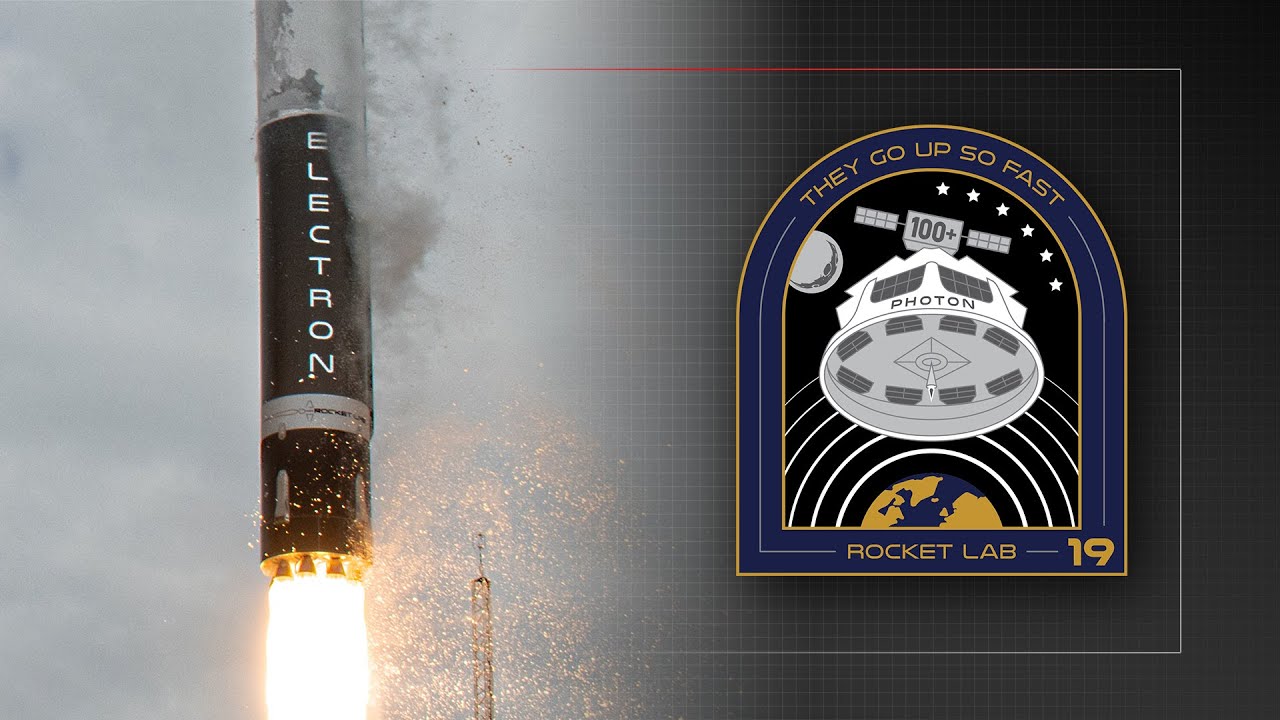

Rocket Lab's 19th Electron mission will deploy a range of satellites for commercial and government satellite operators, as well as place a next-generation Rocket Lab Photon spacecraft in orbit to build spacecraft heritage ahead of Rocket Lab’s mission to the Moon for NASA later this year.
The Electron rocket will carry seven satellites to low Earth orbit: one Earth-observation satellite for BlackSky, two Internet-Of-Things (IoT) nanosatellites for companies Fleet Space and Myriota, a technology demonstration satellite for the University of New South Wales (UNSW) Canberra Space, a weather satellite pathfinder technology demonstration from Care Weather technologies, a technology demonstrator for the U.S. Army’s Space and Missile Defense Command as well as Rocket Lab’s in-house designed and built Photon Pathstone spacecraft which will operate on orbit as a risk reduction demonstration to build spacecraft heritage ahead of Rocket Lab’s mission to the Moon for NASA later this year.

Success confirmed

First five payloads successfully deployed per live webcast. One more burn before the final payload - about forty minutes from now.

Adjusting T-0
Launch is GO. Window opens on March 22 at 22:20 UTC.
Launch expected on March 22. Precise T-0 not available yet.
Electron is a two-stage orbital expendable launch vehicle (with an optional third stage) developed by the American aerospace company Rocket Lab. Electron is a small-lift launch vehicle designed to launch small satellites and cubesats to sun-synchronous orbit and low earth orbit. The Electron is the first orbital class rocket to use electric-pump-fed engines, powered by the 9 Rutherford engines on the first stage. It is also used as a suborbital testbed (called HASTE) for hypersonics research.
See DetailsRocket Lab is an American aerospace manufacturer with a wholly owned New Zealand subsidiary. The company develops lightweight, cost-effective commercial rocket launch services. The Electron Program was founded on the premise that small payloads such as CubeSats require dedicated small launch vehicles and flexibility not currently offered by traditional rocket systems. Its rocket, the Electron, is a light-weight rocket and is now operating commercially. The company is also producing a variety of spacecrafts and spacecrafts components.
INFO WIKI
Rocket Lab launched seven satellites Monday from New Zealand on a rideshare mission serving the U.S. and Australian militaries and space services startups. A spacecraft developed in-house by Rocket Lab was also aboard to prove out technolo…

The 19th flight of Rocket Lab’s Electron rocket, named They Go Up So Fast, lifted off on Monday, March 22 at 22:30 UTC. On board the mission were six customer satellites and an internal Photon pathfinder satellite named Pathstone, which wi…
A batch of 9 Low Earth Orbit communication satellites for the Chinese state owned SatNet constellation operated by the China Satellite Network Group.…
NeonSat-2 to 6 are part of the South Korean government's Earth observation micro-satellite constellation NeonSat (New-space Earth Observation Satelli…
Classified payload for the US National Reconnaissance Office.
Dedicated rideshare flight to a sun-synchronous orbit with dozens of small microsatellites and nanosatellites for commercial and government customers.
SpaceX Crew-13 is the thirteenth crewed operational flight of a Crew Dragon spacecraft to the International Space Station as part of NASA's Commercia…
14th test flight of the two-stage Starship launch vehicle. 3rd flight of Starship V3 and the first Starship flight to deploy satellites (a group of S…
A classified mission for the United States Space Force. It is possibly a batch of classified LEO satellites based on SpaceX’s Starshield satellite bu…
Synthetic aperture radar satellite for Japanese Earth imaging company Synspective.
3 Chinese reconnaissance satellites of unknown purposes, officially reported as for "Electromagnetic environment probing".
A batch of 9 Low Earth Orbit communication satellites for the Chinese state owned SatNet constellation operated by the China Satellite Network Group.…