Press Event
ESA Hera First Images Reveal of Dimorphos
Museum für Naturkunde Berlin Falcon 9 Block 5 | Hera
ESA invites accredited journalists to an exclusive European Media Conference at the Museum für Naturkunde Berlin on Wednesday, 25 November 2026, with participation in person and online. Leading experts will present the first detailed images of Dimorphos after NASA’s DART impact, acquired by ESA’s newly arrived Hera mission, and their initial scientific interpretation.
What happened when DART struck Dimorphos in 2022? Did the impact leave a crater, substantially reshape the asteroid, or both? Hera’s historic new images will provide the first detailed post-impact view of Dimorphos and may begin to answer questions that have remained open for four years.
The morning briefing gives journalists advance access to the imagery, the science team and interviews under embargo. Media may publish from 18:30 CET, ahead of ESA’s official public presentation of the images at ~20:00 CET during the evening ESA’s “Double Impact!” event.
From DART’s successful deflection to Hera’s historic post-impact view
In September 2022, NASA’s DART spacecraft deliberately struck Dimorphos, shortening its orbital period around Didymos by approximately 33 minutes. Yet the physical consequences of the impact remain uncertain. Hera’s investigation will help reveal how the asteroid responded and improve our ability to predict the effectiveness of kinetic-impact deflection for other asteroids.
The November images are only the beginning. Subsequent close-range investigations by Hera and its two CubeSats, Milani and Juventas, will measure the asteroids’ properties in far greater detail, including Dimorphos’ mass, surface and internal structure. Together, these data will help scientists validate models for future planetary-defence missions.
European Media Conference – 11:00 CET
Date: Wednesday, 25 November 2026
Time: 11:00 – 14:00 CET
Venue: Museum für Naturkunde Berlin, Invalidenstraße 43, 10115 Berlin
Participation: In person and online
Updates

Cosmic_Penguin • Nov. 23, 2026, 4:32 p.m.
Added event.
Related Information
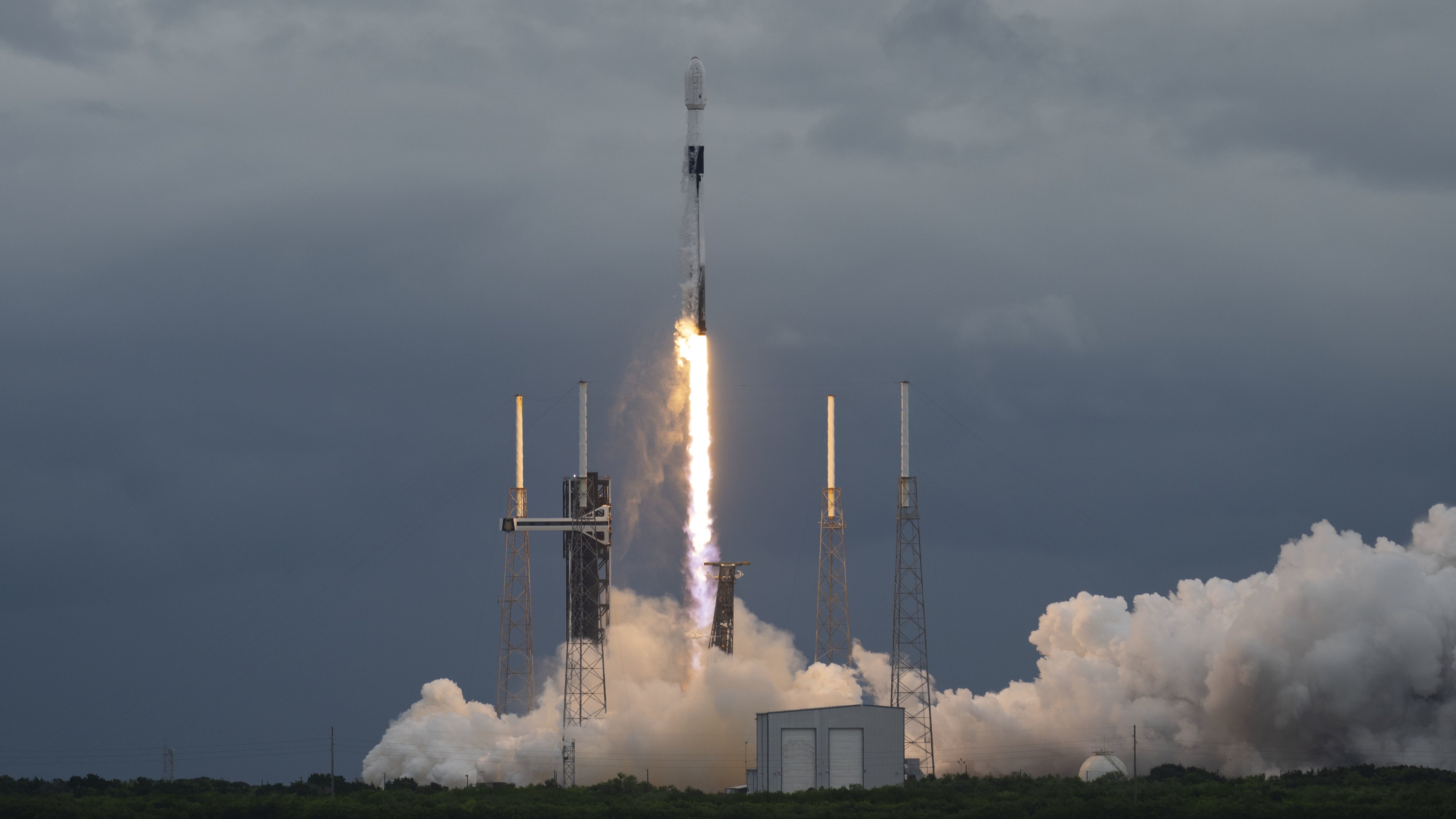
Falcon 9 Block 5 | Hera
SpaceX | United States of AmericaCape Canaveral SFS, FL, USA
Status: Launch Successful
Mission:
Hera is a space mission in development at the European Space Agency in its Space Safety program. Its primary objective is to study the Didymos binary asteroid system that was impacted by DART and contribute to validation of the kinetic impact method to deviate a near-Earth asteroid in a colliding trajectory with Earth. It will measure the size and the morphology of the crater created by and momentum transferred by an artificial projectile impacting an asteroid, which will allow measuring the efficiency of the deflection produced by the impact. It will also analyze the expanding debris cloud caused by the impact.
Asteroid B1061 - Flight Proven ( ) Atlantic OceanFalcon 9
NROL-136
Space Launch Complex 4E - Vandenberg SFB, CA, USAFifteenth batch of satellites for a reconnaissance satellite constellation built by SpaceX and Northrop Grumman for the National Reconnaissance Offic…
Falcon 9
USSF-317
Space Launch Complex 4E - Vandenberg SFB, CA, USAA classified mission for the United States Space Force. It is possibly a batch of classified LEO satellites based on SpaceX’s Starshield satellite bu…
Long March 8A
SatNet LEO Group 30
Commercial LC-1 - Wenchang Space Launch Site, People's Republic of ChinaA batch of 9 Low Earth Orbit communication satellites for the Chinese state owned SatNet constellation operated by the China Satellite Network Group.…
Long March 2D
Shijian 24
Launch Complex 9 - Taiyuan Satellite Launch Center, People's Republic of ChinaExperimental Chinese satellite of unknown purposes.
Vulcan VC6L
Amazon Leo (LV-01)
Space Launch Complex 41 - Cape Canaveral SFS, FL, USAAmazon Leo, formerly known as Project Kuiper, is a mega constellation of satellites in Low Earth Orbit that will offer broadband internet access, thi…
Electron
The Mountain God Rises (iQPS Launch 10)
Rocket Lab Launch Complex 1A - Rocket Lab Launch Complex 1, Mahia Peninsula, New ZealandSynthetic aperture radar Earth observation satellite for Japanese Earth imaging company iQPS.
Soyuz 2.1b/Fregat-M
MKA Kinosputnik, KOEN and others
Cosmodrome Site 1S - Vostochny Cosmodrome, Siberia, Russian FederationShare-ride of multiple satellites, including dual-use optical Earth observation satellites and drone-guiding satellites: * MKA Kinosputnik * KOEN…
Starship
Starlink Group 31-2 (Starship Flight 15)
Orbital Launch Pad 2 - SpaceX Starbase, TX, USA15th test flight of the two-stage Starship launch vehicle and 4th flight of Starship V3. Second Starship flight to deploy satellites (a group of Star…
Falcon 9
USSF-627
Space Launch Complex 4E - Vandenberg SFB, CA, USAA classified mission for the United States Space Force. It is possibly a batch of classified LEO satellites based on SpaceX’s Starshield satellite bu…
Long March 2D
CAS Pathfinder-1
Launch Area 94 (SLS-2 / 603) - Jiuquan Satellite Launch Center, People's Republic of ChinaThe Chinese Academy of Science (CAS)' Pathfinder-1 satellites is built for in-orbit validation of critical technologies for the upcoming main mission…