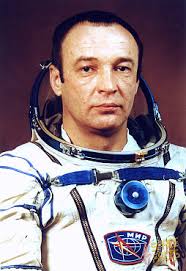
Gennadi Manakov
Russian - (RFSA)
Deceased
Date of Birth: June 1, 1950
Date of Death: Sept. 26, 2019
Gennadi Mikhailovich Manakov is a former cosmonaut who commanded two Soyuz flights. He was selected on 2 September 1985 and flew as Commander on Soyuz TM-10 and Soyuz TM-16, retiring on 20 December 1996.
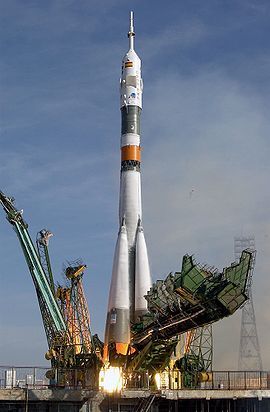
Soyuz-U2 | Soyuz TM-10
Soviet Space Program | RussiaBaikonur Cosmodrome, Republic of Kazakhstan
Status: Success
Mission:
Soyuz TM-10 was the tenth mission and the seventh long-duration expedition to Mir space station. The mission began on August 1, 1990, 09:32:21 UTC, launching Commander Gennadi Manakov and Flight Engineer Gennadi Strekalov into orbit. They docked with Mir two days later. During their stay there, cosmonauts performed an EVA, various station repair and maintenance tasks, and carried out scientific experiments in biology, geophysics, space technology, astronomy etc. They were visited by a Progress M-5 resupply spacecraft and Soyuz TM-11 expedition. The mission concluded with a safe landing back on Earth on December 10, 1990, 06:08:12 UTC.
Low Earth OrbitSoyuz-U2 | Soyuz TM-16
Soviet Space Program | RussiaBaikonur Cosmodrome, Republic of Kazakhstan
Status: Success
Mission:
Soyuz TM-16 was the 16th mission and the 13th long-duration expedition to Mir space station. The mission began on January 24, 1993, 05:58:05 UTC, launching Commander Gennadi Manakov and Flight Engineer Alexander Poleshchuk into orbit. They docked with Mir two days later. During their stay there, cosmonauts performed EVAs, various station repair and maintenance tasks, and carried out scientific experiments in materials research, space technology, astrophysics and earth observation. One of the experiments was the deployment of a 20-m foil reflector, which was a test of a future solar reflector designed to illuminate regions on the Earth's surface. Station crew was visited by several Progress resupply spacecrafts, and welcomed aboard the Soyuz TM-17 crew. The mission concluded with a safe landing back on Earth on July 22, 1993, 06:41:50 UTC.
Low Earth OrbitThe Roscosmos State Corporation for Space Activities, commonly known as Roscosmos, is the governmental body responsible for the space science program of the Russian Federation and general aerospace research. Soyuz has many launch locations the Russian sites are Baikonur, Plesetsk and Vostochny however Ariane also purchases the vehicle and launches it from French Guiana.
Falcon 9
Starlink Group 15-27
Space Launch Complex 4E - Vandenberg SFB, CA, USAA batch of 27 satellites for the Starlink mega-constellation - SpaceX's project for space-based Internet communication system.
Long March 2D
PIESAT-2 13-16
Launch Complex 9 - Taiyuan Satellite Launch Center, People's Republic of China4 X-band synthetic-aperture radar Earth observation satellites for the Chinese Earth observation satellite company PIESAT.
Electron
Owl By The Dozen (StriX Launch 12)
Rocket Lab Launch Complex 1B - Rocket Lab Launch Complex 1, Mahia Peninsula, New ZealandSynthetic aperture radar satellite for Japanese Earth imaging company Synspective.
Soyuz 2.1b/Fregat-M
Glonass-K1 No. 20 (?)
43/3 (43L) - Plesetsk Cosmodrome, Russian FederationNote: Satellite serial number and Cosmos designation not confirmed. Glonass-K are the third generation of satellite design for GLONASS satellite n…
Kuaizhou 11
SpaceTY-51 & 52
Launch Area 95A - Jiuquan Satellite Launch Center, People's Republic of China2 Earth observation radar satellites built by the Chinese satellite manufacturer SpaceTY.

